Nanostructured silicide composites for thermoelectric applications
a technology of silicide composites and nanostructured silicides, applied in the direction of thermoelectric device junction materials, non-metal conductors, conductive materials, etc., can solve the problems of high cost, material problems to overcome, and low abundance of such devices
- Summary
- Abstract
- Description
- Claims
- Application Information
AI Technical Summary
Benefits of technology
Problems solved by technology
Method used
Image

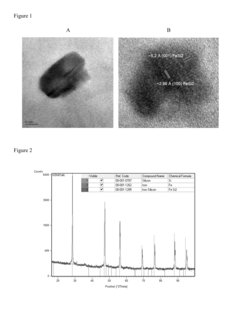
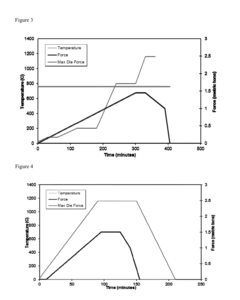
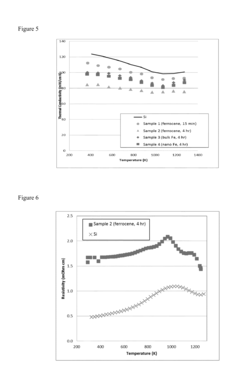
Examples
example 1
Producing a Si / FeSi2 Nanocomposite Thermoelectric Material
[0052]This example provides a method according to the present invention of producing a nanocomposite thermoelectric material comprising Si with FeSi2 inclusions.
[0053]A homogenous mixture of n-type Si powder and ferrocene was prepared by high-energy ball milling. The Si powder was prepared using a procedure previously reported by Bux and co-workers (S. Bux et al., Advanced Functional Materials, 2009, 19, 2445-2452). Approximately 50 mg of ferrocene (from Sigma Aldrich) was added to approximately 3 grams of Si powder to yield approximately 1% (v / v) of ferrocene in an argon glove box. Additional Si was added to the mixture to account for a portion of the Si reacting with the ferrocene. The mixture was then removed from the argon glove box and loaded into a tungsten carbide vial and sealed. The mixture was then ball milled for 15 minutes using an SPEX mixer mill with 7 / 16″ tungsten carbide ball bearings. Upon milling, the vial w...
example 2
Producing a Si / WSi2 Nanocomposite Thermoelectric Material
[0061]This example provides a method according to the present invention of producing a nanocomposite thermoelectric material comprising Si with WSi2 inclusions.
[0062]A homogenous mixture of n-type Si powder and tungstencene was prepared by high-energy ball milling. The Si powder was prepared using a procedure previously reported by Bux and co-workers (S. Bux et al., Advanced Functional Materials, 2009, 19, 2445-2452). Approximately 50 mg of tungstencene (from Sigma Aldrich) was added to approximately 3 grams of Si powder to yield approximately 1% (v / v) of tungstencene in an argon glove box. Additional Si was added to the mixture to account for a portion of the Si reacting with the tungstencene. The mixture was then removed from the argon glove box and loaded into a tungsten carbide vial and sealed. The mixture was then ball milled for 2 hours using an SPEX mixer mill with 7 / 16″ tungsten carbide ball bearings. Upon milling, the...
PUM
| Property | Measurement | Unit |
|---|---|---|
| size | aaaaa | aaaaa |
| pressure | aaaaa | aaaaa |
| temperature | aaaaa | aaaaa |
Abstract
Description
Claims
Application Information
 Login to View More