This helps you quickly interpret patents by identifying the three key elements:
Problems solved by technology
Method used
Benefits of technology
Benefits of technology
The present invention provides an amyloid fibril suppressant with excellent amyloid fibril lysis and formation inhibition activities. The suppressant also inhibits production of the amyloid causal protein. The pharmaceutical composition of this invention is useful for prevention and treatment of amyloidosis, especially refractory amyloidosis such as familial amyloid polyneuropathy (FAP). The effect of the suppressant was confirmed using various techniques such as inhibition of amyloid fibril formation, lysis of existing fibril, and inhibition of amyloid fibril formation in animal models.
Problems solved by technology
Thereafter, deposition of amyloid to heart, kidney and digestive tract becomes remarkable, causing malfunction of these organs.
However, development of a therapeutic agent for refractory amyloidosis singly exhibiting a clinically sufficiently curative effect has not been succeeded yet.
For this reason, drugcombination therapy expecting an effect by combination use is envisaged, however, in this case, there is a possibility of generation of various problems such as generation of side effects due to drug interaction, and the like.
Method used
the structure of the environmentally friendly knitted fabric provided by the present invention; figure 2 Flow chart of the yarn wrapping machine for environmentally friendly knitted fabrics and storage devices; image 3 Is the parameter map of the yarn covering machine
View more
Image
Smart Image Click on the blue labels to locate them in the text.
Viewing Examples
Smart Image
Click on the blue label to locate the original text in one second.
Reading with bidirectional positioning of images and text.
[0076]Transthyretin (TTR) used in the present example was purified from serum obtained from a patient having Val30Met type mutation, according to guidelines approved by the Ethics Committee of Kumamoto University Graduate School of Life Science, which committee is defined by rules on bioethics. Purity determination was conducted using unheated (non-reduced) SDS-PAGE.
[0077]6-O-α-(4-O-α-D-glucuronyl)-D-glycosyl-β-cyclodextrin (GUG-β-CyD) was purchased from Ensuiko Sugar Refining Co., Ltd., and polyamidoamine dendrimer (G2) was purchased from Sigma. GUG-β-CDE was prepared as described below. GUG-β-CyD (67.8 mg) was dissolved in dimethyl sulfoxide (DMSO), the condensing agent 4-(4,6-dimethoxy-1,3,5-triazin-2-yl)-4-methyl-morpholinium chloride (DMT-MM) (15.5 mg) was added, then, they were reacted at room temperature for 12 hours together with polyamidoamine dendrimer (G2) (0.5 mL), to obtain a conjugate (GUG-β-CDE). The resulta...
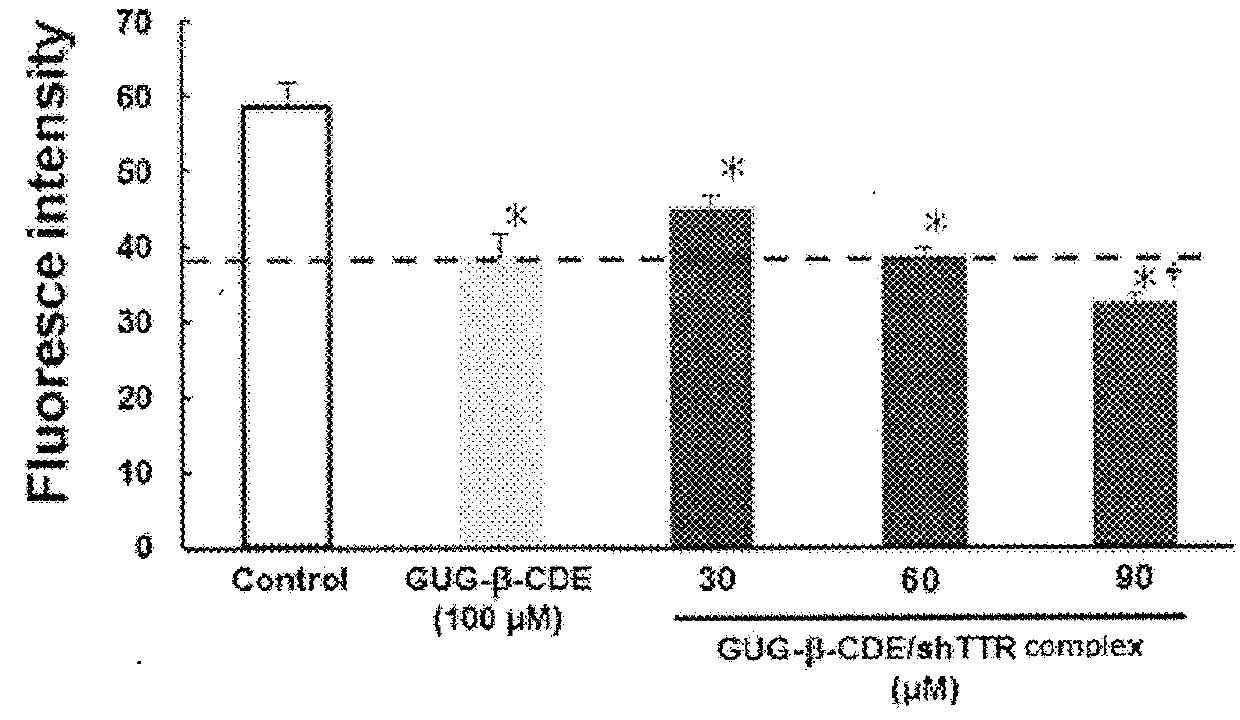
[0082]According to the same manner as in Example 1, amyloid was formed in presence or absence of various concentrations (30 μM, 60 μM, 90 μM) of GUG-β-CDE / shRNA, and amyloid fibril formation of TTR was quantitatively analyzed. As a control, GUG-β-CDE (100 μM) was used. The result is shown in FIG. 2. The fibril formation inhibiting effect obtained by 100 μM GUG-β-CDE was confirmed at about half concentration (60 μM) by forming a complex with shRNA. That is, the concentration of GUG-β-CDE showing the amyloid fibril formation inhibiting action could be approximately halved by forming a complex with shRNA.
[0083]The amyloid fibril lysis action of the GUG-β-CDE / shRNA complex was confirmed. Specifically, the following process was conducted.
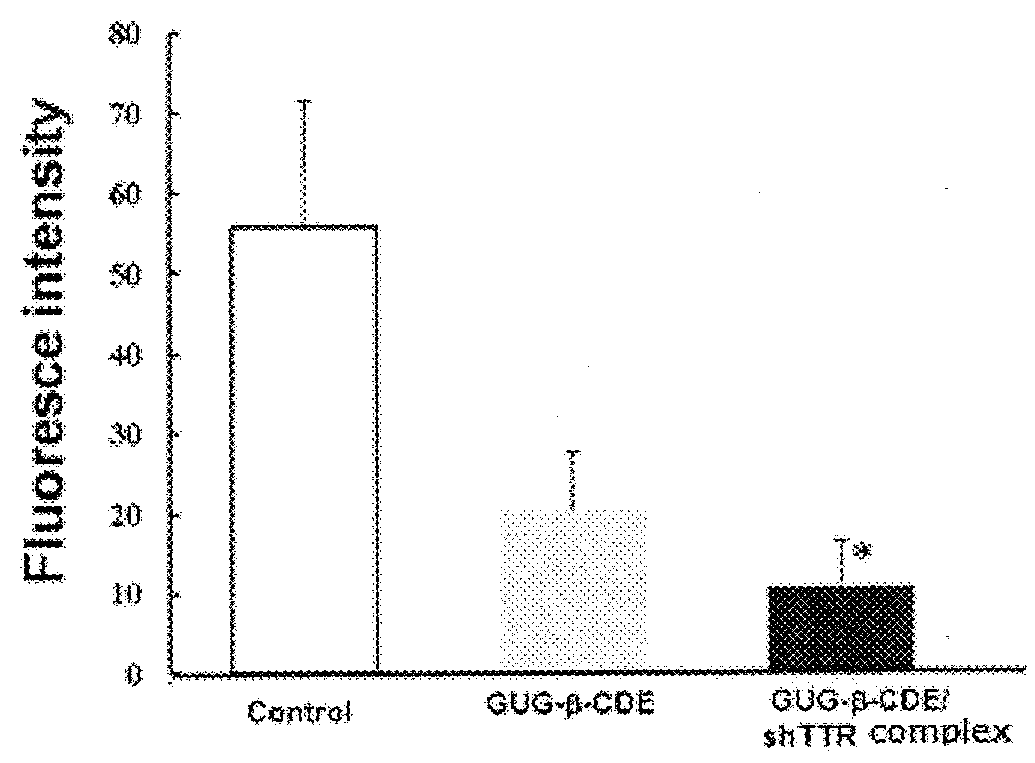
[0084]Amyloid fibril of human serum-derived Val30MetTTR was formed, then, the amyloid fibril was incubated for 6 hours in presence or absence of 100 μM GUG-β-CDE / shRNA. Thereafter, the amyloid fibril was quantitatively analyzed. As a control, GUG-β-CDE (100 μM) was used. The result is shown in FIG. 3. GUG-β-CDE (100 μM) shows the amyloid fibril lysis effect for TTR amyloid fibril once formed, and this effect was significantly enhanced by forming a complex with shRNA.
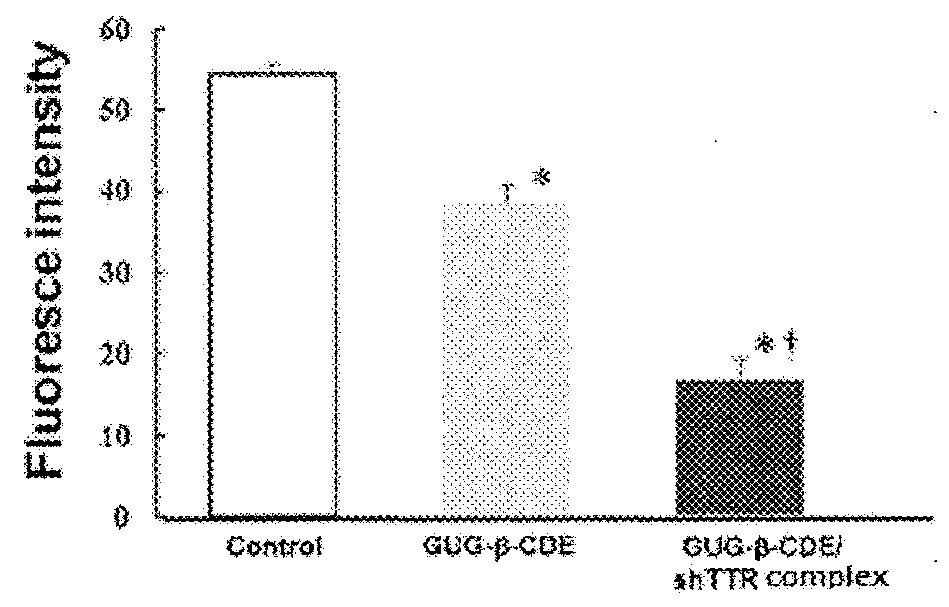
[0085]By forming a complex with shRNA, the remarkable amyloid fibril formation inhibiting effect could be obtained even at low Concentration (100 μM) which is 1 / 500 of the concentration (50 mM) at which GUG-β-CyD exhibits the effect on amyloid fibril formation inhibition, and the effect on the lysis action was exhibited at low concentration (100 μM) which is ⅕ of the concentrati...
the structure of the environmentally friendly knitted fabric provided by the present invention; figure 2 Flow chart of the yarn wrapping machine for environmentally friendly knitted fabrics and storage devices; image 3 Is the parameter map of the yarn covering machine
Login to View More
PUM
Property
Measurement
Unit
Ratio
aaaaa
aaaaa
Login to View More
Abstract
The purpose of the present invention is to provide a therapeutic agent that is more effective in refractoryamyloidosis. More specifically, it is to provide a novel substance that is highly safe and is more excellent in a TTR proteinamyloidfibril formation-inhibiting effect as compared with conventional therapeutic agents. Provided by the invention is an amyloidfibril suppressant comprising as an active ingredient a complex of a conjugate (GUG-β-CDE) of glucuronylglucosyl-β-cyclodextrin (GUG-β-CyD) and polyamide amine dendrimer having an alkylene diamine as the core with RNA that causes RNA interference in the mRNA of transthyretin (TTR). Also provided by the present invention is a pharmaceutical composition comprising the amyloidfibril suppressant for the prevention and / or treatment of amyloidosis.
Description
TECHNICAL FIELD[0001]The present invention relates to a novel amyloid fibril suppressant. Further, the present invention relates to a pharmaceutical composition comprising the suppressant for prevention and / or treatment of amyloidosis.BACKGROUND ART[0002]Amyloidosis denotes a syndrome in which proteins having a β-sheet structure are polymerized to form insoluble microfibril called amyloid or amyloid fibril, and the microfibril deposits in vivo to cause tissue injury. Virchow, the German pathologist, found that the tissue specimen of amyloidosis stains purple with iodine. Based on this result, Virchow supposed that the substance deposited to tissue is polysaccharide, named it “starch-like substance”, namely “amyloid” and proposed that the pathological condition caused by deposition of amyloid is called amyloidosis.[0003]In the subsequent studies, it was found that the main components of amyloid are proteins that polymerize in the form of nylon to form fibril, and the serum amyloid P ...
Claims
the structure of the environmentally friendly knitted fabric provided by the present invention; figure 2 Flow chart of the yarn wrapping machine for environmentally friendly knitted fabrics and storage devices; image 3 Is the parameter map of the yarn covering machine
Login to View More
Application Information
Patent Timeline
Application Date:The date an application was filed.
Publication Date:The date a patent or application was officially published.
First Publication Date:The earliest publication date of a patent with the same application number.
Issue Date:Publication date of the patent grant document.
PCT Entry Date:The Entry date of PCT National Phase.
Estimated Expiry Date:The statutory expiry date of a patent right according to the Patent Law, and it is the longest term of protection that the patent right can achieve without the termination of the patent right due to other reasons(Term extension factor has been taken into account ).
Invalid Date:Actual expiry date is based on effective date or publication date of legal transaction data of invalid patent.


 Login to View More