

Antimicrobial composition comprising citral, hexanal and linalool as active ingredients and application in packaging minimally processed fruits or vegetables
a technology of hexanal and linalool, which is applied in the field of antimicrobial compositions comprising citral, hexanal and linalool, can solve the problems of short shelf life and quality loss of minimally processed fruits or vegetables, difficult marketing and export, and difficult to preserve foodstuffs, so as to improve the effect of active packaging and improve the preservation effect of foodstuffs
- Summary
- Abstract
- Description
- Claims
- Application Information
AI Technical Summary
Benefits of technology
Problems solved by technology
Method used
Image

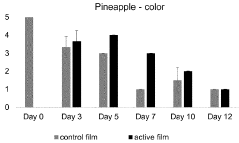
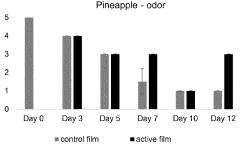
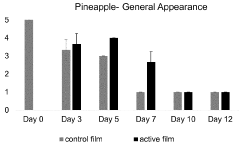
Examples
example 1
on of Synergistic Effect of Citral, Hexanal and Linalool
[0109]Saccharomyces cerevisiae CECT 13084, Aspergillus niger CECT 2807 and Penicillium aurantiogriseum CECT 2264 were obtained from Colección Española de Cultivos tipo (CECT, Valencia, Spain). These microorganisms were selected as common spoilage microorganisms of fruit according to bibliographic data.
[0110]50 μl of yeast and moulds inoculum (7 log CFU / ml yeast and 106 spores / ml molds) were cultured on MEA agar Petri dishes. Sterilized square piece of paper (2×2 cm2) were placed on the lid of the Petri dish and impregnated individually with citral, hexanal and linalool mixture (equal volume 1:1:1, (from 1 to 30 μL). Petri dishes were sealed with Parafilm® to reduce volatiles losses. Inoculated agar plates without active agents were included as reference control. Plates were incubated at 25° C. for 3 days. After the incubation period, qualitative analysis was carried out by visual inspection. The minimum amount in μL that comple...
example 2-10
[0114]Examples 2-10, corresponding to combinations comprising different ratios of citral, hexanal and linalool were carried out in order to prove synergistic effect at other ratios of the three active components besides the one in Example 1. Comparative Examples with a 100% of each one of the active components were also carried out to calculate FIC index (see above). Finally, a control was performed without any active compound. The combinations are shown in Table 2.
TABLE 1Different combinations of citral, hexanal and linalool to prove synergisticeffect at other ratios of the three active components besides the one inExample 1ExampleCitralHexanalLinaloolEx. 217.265.717.2Ex. 349.5149.5Ex. 49055Ex. 5149.549.5Ex. 617.217.265.7Ex. 749.549.51Ex. 865.717.217.2Ex. 95905Ex. 105590Comp. Ex. 110000Comp. Ex. 201000Comp. Ex. 300100Control000
[0115]Specifically, all Examples, Comparative Examples and the Control were tested to calculate FIC index for moulds and yeast (similarly as Example 1) and a...
example.11
e of an Active Lid
[0120]The active lid is a bi-layer structure made of:[0121]An external layer (structural layer): polypropylene (PP)[0122]An inner layer (active layer): PP+volatile active agents
[0123]The inner layer is the one that will be disposed in the interior side of the package and will allow the active agents to be released in the head space where the foodstuff is confined. The active agents are a volumetric mixture of citral, hexanal, linalool (CHL, 1:1:1).
[0124]The active lid manufacturing process has been carried out in 2 steps:
[0125]Step 1).—Compounding
[0126]PP composite containing 8.5% (w / w) of citral:hexanal:linalool (CHL, 1:1:1) (nominal concentration) was produced using a ZSK 26 Mc (Coperion) twin screw extruder. The final concentration of citral:hexanal:linalool in the PP compound was 8.05% (w / w) assuming approximately 5% of losses during compounding processing.
[0127]Step 2).—Cast-Coextrusion
[0128]An active PP bi-layer lid was obtained with a Dr Collin coextrusion l...
PUM
| Property | Measurement | Unit |
|---|---|---|
| Volume | aaaaa | aaaaa |
| Volume | aaaaa | aaaaa |
| Volume | aaaaa | aaaaa |
Abstract
Description
Claims
Application Information
 Login to View More