
Engineered heterodimeric proteins
a technology of heterodimer proteins and heterodimer proteins, which is applied in the field of heterodimer antibodies, can solve the problems of difficult production of pure and developable heterodimer antibodies, and achieve the effects of promoting heterodimer formation, hindering the assembly of corresponding heavy-chain homodimers, and promoting heterodimer formation
- Summary
- Abstract
- Description
- Claims
- Application Information
AI Technical Summary
Benefits of technology
Problems solved by technology
Method used
Image

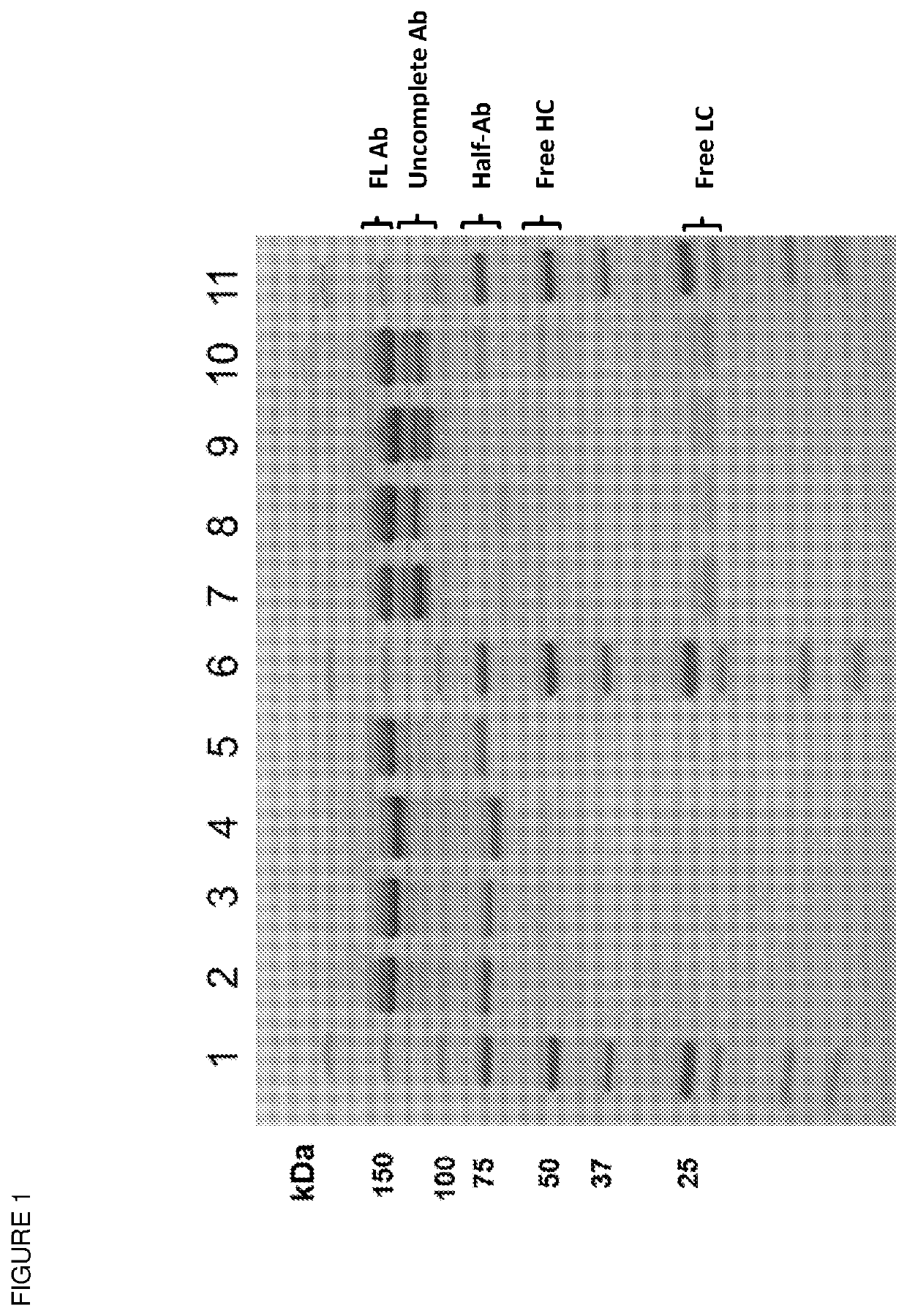
Examples
example 1
[0076]Rational design strategies were used to produce a set of proteins to identify mutations that exhibit desired properties such as correct heavy chain-light chain pairing. The design strategy for engineering of heavy chain-light chain pairing included identifying a representative Fab. A criterion for a representative Fab was that it was a member of commonly used VH and VL subgroup such as VH3 and Vκ1, or lambda light chain. After the selection of a Fab (anti c-Kit heavy chain, SEQ ID NO: 7 and light chain, SEQ ID NO: 21), an in silico analysis of the Fab interface was carried out to identify residues important for possible interactions between heavy and light chains.
[0077]After introducing a set of mutations in the variable domains VH and VK and constant domains CH1 and CK a model was generated with the modeling software MOE (Chemical Computing Group Inc.) using AMBER99 force-field. Blastp 2.2.30+ program was used to run the mutated domains against the PDB database...
example 2
Expression and Purification of Engineered Fabs
[0079]Heavy chain and light chain DNA was synthesized at GeneArt (Regensburg, Germany) and cloned into a mammalian expression vector using restriction enzyme-ligation based cloning techniques. The resulting plasmids were co-transfected into HEK293T cells. For transient expression of Fabs, equal quantities of vector for each engineered chain were co-transfected into suspension-adapted HEK293T cells using Polyethylenimine (PEI; Cat#24765 Polysciences, Inc.). Typically, 100 ml of cells in suspension at a density of 1-2 Mio cells per ml was transfected with DNA containing 50 μg of expression vector encoding the engineered heavy chain and 50 μg expression vectors encoding the engineered light chain. The recombinant expression vectors were then introduced into the host cells and the construct produced by further culturing of the cells for a period of 7 days to allow for secretion into the culture medium (HEK, serum-fee medium) supplemented wit...
example 3
Mass Spectrometry Analysis of Engineered Fabs
[0081]Evaluation of correct heavy chain-light chain pairing of Fab variants was done by liquid chromatography-mass spectrometry (LC-UV-ESI-MS). In brief, purified proteins were concentrated to 100 μL using spin concentrators (3000 MWCO, Millipore) and analysed by reversed phase chromatography (column BEH C4 1.7 μm 2.1*50 mm, Waters) on an UPLC (Acquity UPLC I-Class, Waters) with 100% water, 0.05% Trifluoro acetic acid (TFA) and 100% acetonitrile, 0.04% TFA. Fab variants were separated at 80° C. by applying a first gradient of 5%-10% of acetonitrile, 0.04% in 0.2 minutes, and a second gradient of 10% to 45% of acetonitrile, 0.04% in 4 minutes. Eluted Fab variants were detected by UV (210-450 nm) and ionized by electrospray ionization (ESI) before analysis of their mass by QTOF (Xevo G2-S QTof, Waters). Finally, the relative composition of the injected Fab mixture was determined by double integration of UV signal and mass intensity.
[0082]Re...
PUM
| Property | Measurement | Unit |
|---|---|---|
| Fraction | aaaaa | aaaaa |
| Fraction | aaaaa | aaaaa |
| Mass | aaaaa | aaaaa |
Abstract
Description
Claims
Application Information
 Login to View More