
Compound having affinity substance to antibody and bioorthogonal functional group, or salt thereof
- Summary
- Abstract
- Description
- Claims
- Application Information
AI Technical Summary
Benefits of technology
Problems solved by technology
Method used
Image

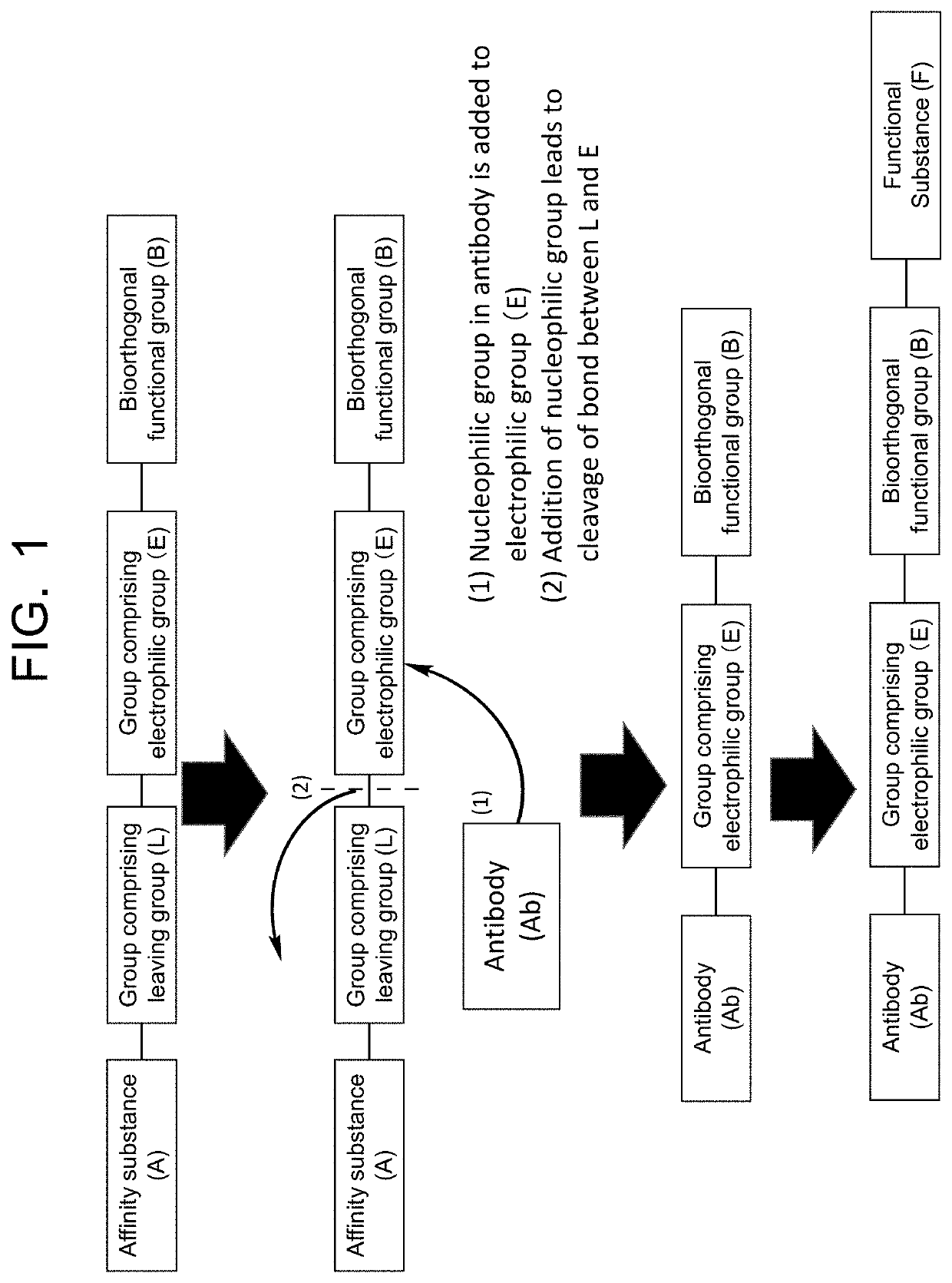
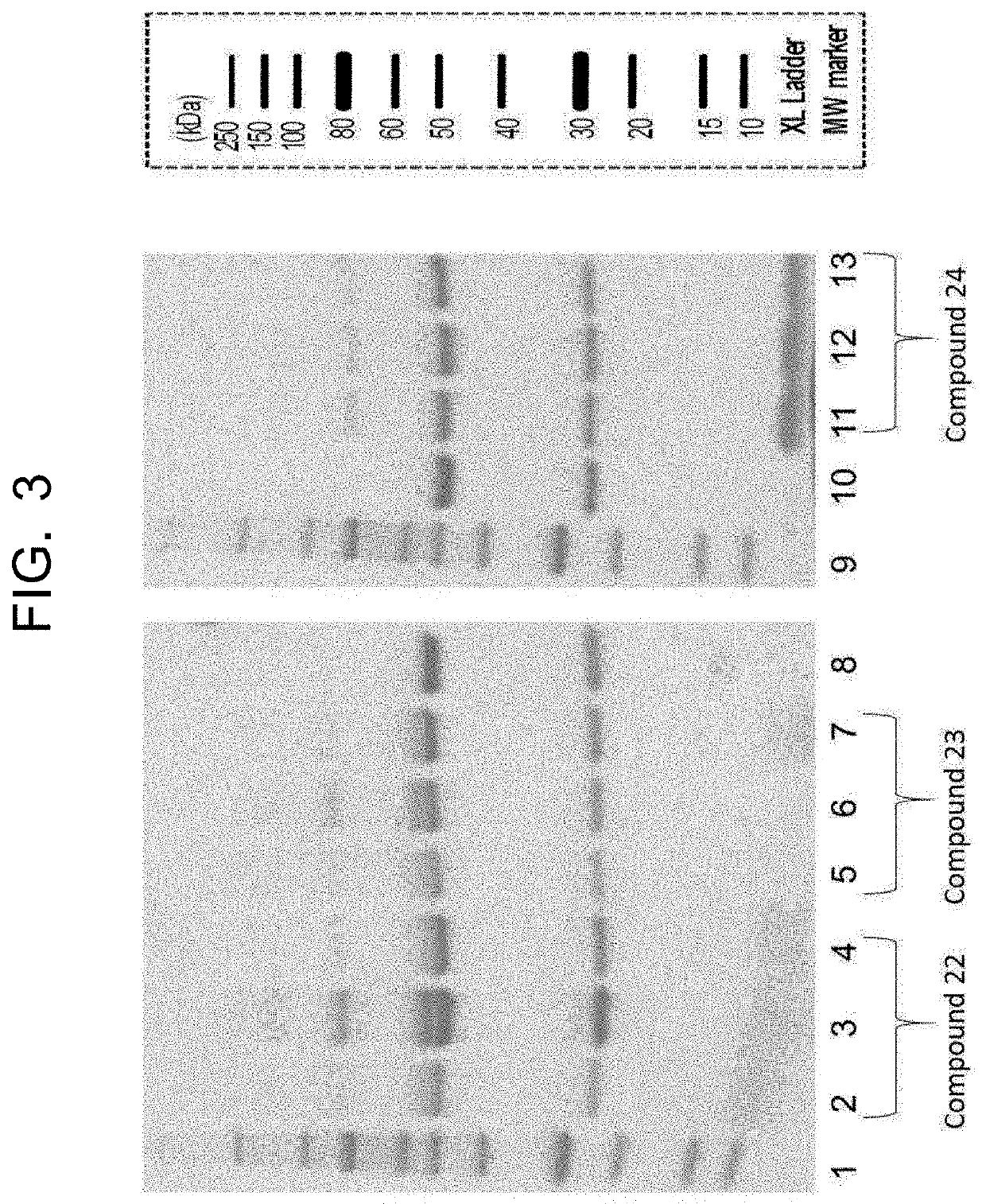
Examples
example 1
of IgG1 Fc Affinity Substance
[0894](1-1) Synthesis of affinity peptide to antibody
[0895]All the peptides illustrated below, which are affinity substances to an antibody, were prepared by similar methods. A compound having an N-terminal capped with an acetyl group (compounds 1, 2, and 32 to 53) and a compound having an N-terminal capped with 3-(triphenylmethylthio) propionic acid (compounds 3, 31, and 54) were prepared by solid phase peptide synthesis using a Rink amide resin by Fmoc method, and stirred for three hours in a solution of trifluoroacetic acid:water:triisopropylsilane:ethanedithiol=94:2.5:1.0:2.5, thereby performing cutting out from the resin and deprotection. The resin was removed by filtration, diethyl ether was added for precipitation, and the diethyl ether was removed by decantation to obtain a peptide as crude crystals. This peptide was purified by preparative HPLC to obtain an affinity peptide as a product.
[0896]Each of compounds 35 to 53, which are peptides each h...
example 2
of Antibody-Modifying Linker and Coupling Thereof with IgG1 Fc-Affinity Peptide Azide Adduct
[0929](2-1) Synthesis of Imidazolylcarbonyl Compound
[0930](2-1-1) Synthesis of Imidazolylcarbonyl Compound (compound 6)
[0931]3-Butyn-1-ol (0.100 g, 1.32 mmol) and carbonyldiimidazole (263 mg, 1.62 mmol) were dissolved in a THF solvent and stirred at room temperature for one hour. The reaction solution was diluted with ethyl acetate and was washed with water and brine. Thereafter, sodium sulfate was added thereto, and the resulting mixture was allowed to stand for five minutes. Sodium sulfate was removed by filtration, and the resulting solution was concentrated under reduced pressure to obtain a crude product, which was then purified by silica gel column chromatography. The fraction containing the product was collected and concentrated under reduced pressure to obtain 1H-imidazole-1-carboxylic acid-3-butynyl ester (0.180 g, 1.10 mmol) corresponding to compound 6.
[0932]1H NMR (400 MHz, Chlorof...
reference example 1
ference in Reactivity Due to Difference in Number of Atoms from Affinity Peptide to Antibody-Modifying Group (Electrophilic Group) by Model Experiment
[0949](1-1) Synthesis of IgG Antibody Trastuzumab-Peptide Conjugate
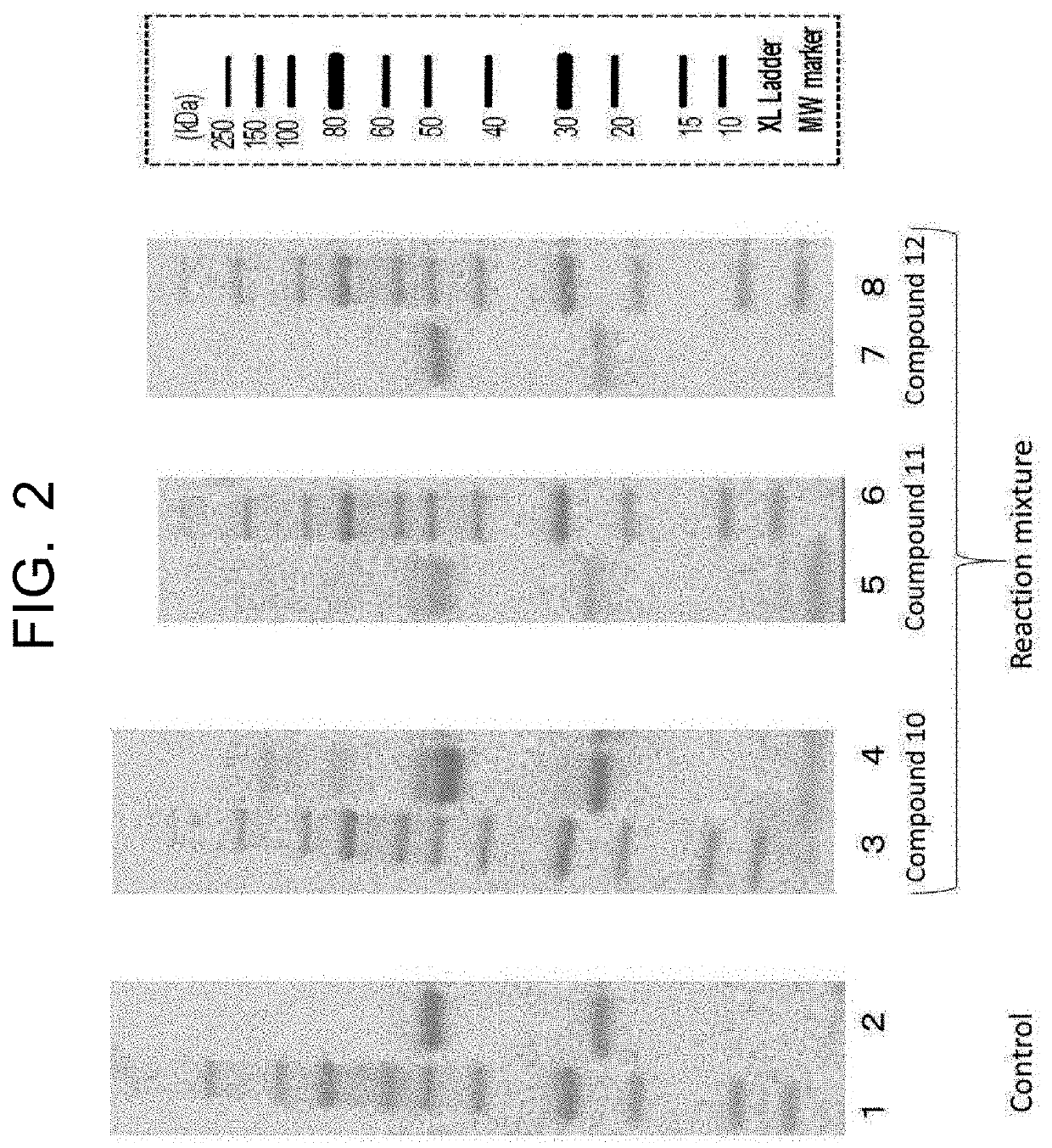
[0950]20 μg of anti-HER2 IgG antibody trastuzumab (Chugai Pharmaceutical Co. Ltd.) was dissolved in 2.0 μL of 100 mM HEPES buffer (pH 7.2), 20 molar equivalents of the peptide-imidazolylcarbonyl compound (compounds 10, 11, and 12) synthesized in Example 2 (2-2) was added to the antibody, and the resulting mixture was stirred at 37° C. for four hours. The reaction solution was subjected to water substitution by ultrafiltration (Amicon Ultra, 3K MWCO) to remove the peptide reagent, and the reaction was thereby stopped, thus obtaining an IgG antibody trastuzumab-peptide conjugate.
[0951](1-2) Analysis of IgG Antibody Trastuzumab-Peptide Conjugate by SDS-PAGE
[0952]The three types of IgG antibody trastuzumab-peptide conjugates obtained in (1-1) using three types of peptide-im...
PUM
| Property | Measurement | Unit |
|---|---|---|
| Fraction | aaaaa | aaaaa |
| Fraction | aaaaa | aaaaa |
| Mass | aaaaa | aaaaa |
Abstract
Description
Claims
Application Information
 Login to View More