Polymerization Catalyst System and Process to Produce Highly Reactive Polyisobutylene
a polyisobutylene and catalyst technology, applied in the field of polymerization catalyst systems, can solve the problems of bf/sub>3/sub>not easy to handle, detrimental to the reactor, and inability to meet the requirements of the process,
- Summary
- Abstract
- Description
- Claims
- Application Information
AI Technical Summary
Benefits of technology
Problems solved by technology
Method used
Image

Examples
example 1
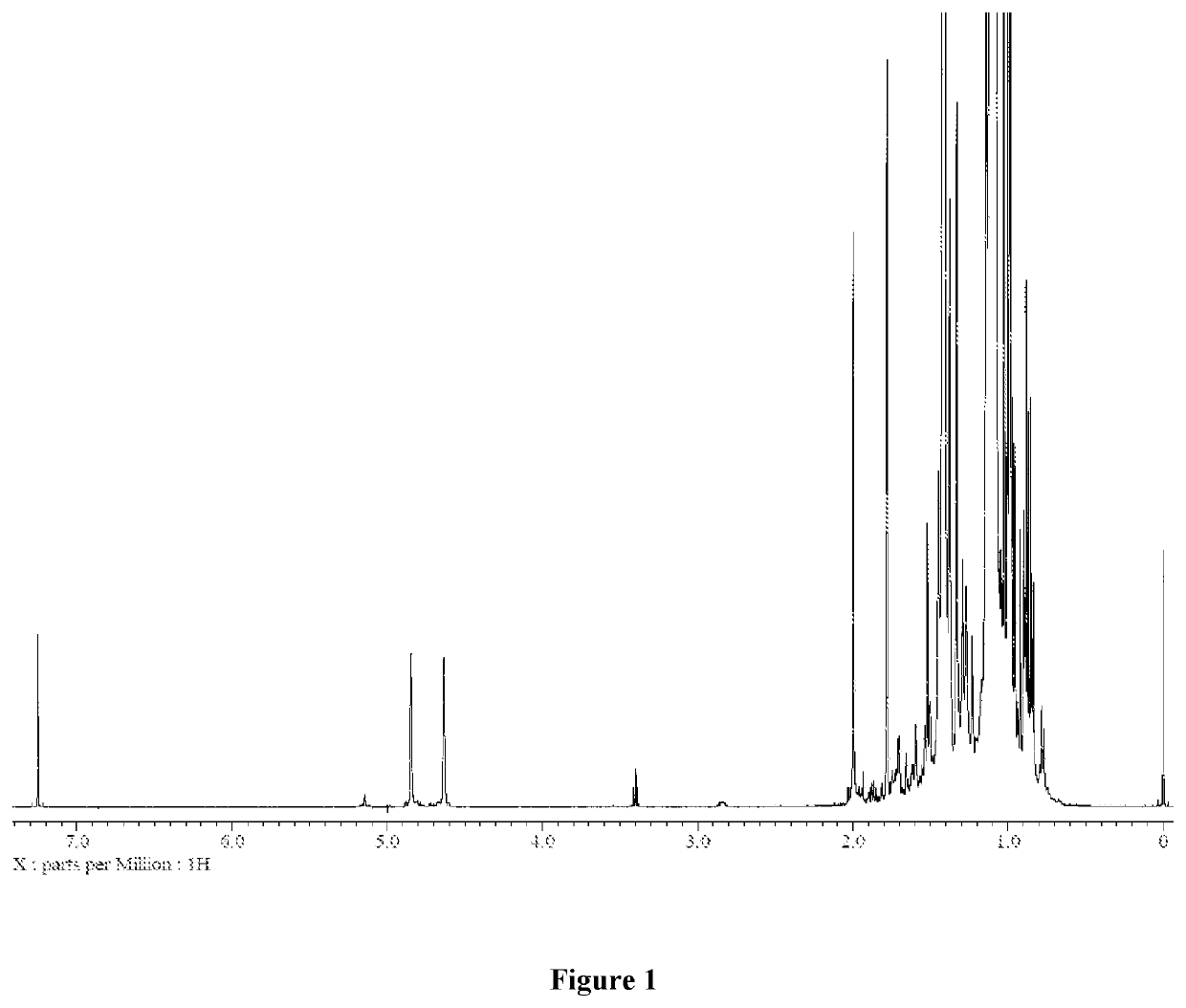
[0089]Polymerizations were performed in a jacketed reactor equipped with condenser operating at −10° C. under nitrogen atmosphere. In a typical example of experiment, 800 mL of hexanes was placed in the reactor at 0° C. 200 mL of IB (4 M) was condensed and added to the polymerization reactor containing hexanes. Then, polymerization was started under stirring by the addition of the prepared AlCl3⋅ethers complex, 0.01 M (wherein, [AlCl3]=0.01 M, [i-Pr2O]=0.005 M, and [Bu2O]=0.005 M) to the reactors at 0° C. After 1 hour of the polymerization time, polymerization was terminated by addition of methanol. 98% polymerization yield observed. The product had Mn, NMR=1500 Dalton, and exo olefin content 78%.
[0090]The polymerization yields were determined gravimetrically. The distribution of different olefin end-groups and molecular weight (Mn, NMR) were determined by 1H NMR.
example 2
[0091]Polymerizations were performed in a jacketed reactor equipped with condenser operating at −10° C. under nitrogen atmosphere. In a typical example of experiment, 800 mL of hexanes was placed in the reactor at 0° C. 200 mL of IB (4 M) was condensed and added to the polymerization reactor containing hexanes. Then, polymerization was started under stirring by the addition of the prepared Lewis acids⋅i-Pr2O complex, 0.01 M (wherein, [AlCl3]=0.005 M, [EADC]=0.005 M, and [i-Pr2O]=0.01 M) to the reactors at 0° C. After 1 hour of the polymerization time, polymerization was terminated by addition of NaOH solution. 98% polymerization yield observed. The product had Mn, NMR=1500 Dalton, and exo olefin content 80%.
TABLE 1Polymerization of IB using [Lewis acid · Lewis base] = 0.005 to 0.01 M in dry hexanes at0° C. with [Lewis acid] / [Lewis base] =0.5 to 1.0Mn,[AlCl3][i-Pr2O][Bu2O]Conv.aNMRbexobEntry(M)(M)(M)(%)(Dalton)(%)1.0.010.01—981300562.0.01—0.01282800773.0.010.0050.005981500784.0.010.0...
PUM
| Property | Measurement | Unit |
|---|---|---|
| temperature | aaaaa | aaaaa |
| temperature | aaaaa | aaaaa |
| temperature | aaaaa | aaaaa |
Abstract
Description
Claims
Application Information
 Login to View More
 - R&D
- Intellectual Property
- Life Sciences
- Materials
- Tech Scout
- Unparalleled Data Quality
- Higher Quality Content
- 60% Fewer Hallucinations
Browse by: Latest US Patents, China's latest patents, Technical Efficacy Thesaurus, Application Domain, Technology Topic, Popular Technical Reports.
© 2025 PatSnap. All rights reserved.Legal|Privacy policy|Modern Slavery Act Transparency Statement|Sitemap|About US| Contact US: help@patsnap.com