Unlock instant, AI-driven research and patent intelligence for your innovation.

Biocompatible hydrogel comprising hyaluronic acid and polyethylene glycol

a biocompatible, hydrogel technology, applied in the direction of prosthesis, bandages, surgery, etc., can solve the problems of unsuitable medical and pharmaceutical materials, complicated preparing process, increased preparing cost, etc., to achieve excellent biocompatibility, no risk of toxicity, and useful use

Pending Publication Date: 2022-09-08
KYUNGPOOK NAT UNIV IND ACADEMIC COOP FOUND
View PDF0 Cites 0 Cited by
  • Summary
  • Abstract
  • Description
  • Claims
  • Application Information

AI Technical Summary

Benefits of technology

The present invention is a hydrogel that is made through the use of a special electron beam. This hydrogel is made without using any harmful chemicals or solvents, and can be easily mass-produced by using the electron beam. The hydrogel is also very safe and compatible with the human body, making it useful for various applications such as cell carriers, drug carriers, anti-adhesion agents, cell supports, dental fillers, orthopedic fillers, wound dressings, skin fillers, and so on. In summary, the invention provides a safe, efficient, and flexible way to make a hydrogel that can be used for various applications.

Problems solved by technology

However, since the cross-linking agent and / or the curing agent used in the cross-linking reaction is harmful to the living body, when hydrogels prepared using such a cross-linking agent and / or curing agent are used in the living body, there is a problem that the hydrogels may cause a harmful action.
In particular, such hydrogels are unsuitable to be used as medical and pharmaceutical materials, such as wound dressings, drug delivery carriers, contact lenses, cartilages, intestinal anti-adhesion agents, and the like.
In addition, when the cross-linking agent and / or the curing agent is used, the remaining cross-linking agent and / or curing agent in the hydrogel needs to be removed after preparing the hydrogel, so that the preparing process is complicated and the preparing cost is increased.
However, since the synthetic polymer-derived hydrogel is not suitable to be used for medical purposes in terms of biocompatibility and biodegradability, it is required to develop a hydrogel formed solely by intra-molecular or inter-molecular cross-linking of biocompatible molecules without using a cross-linking agent, a curing agent, an organic solvent, etc.
However, since hyaluronic acid itself is easily decomposed in vivo or under conditions such as acid and alkali and its use is very limited, in the preparation of a hyaluronic acid-based hydrogel, it is general to add a chemical cross-linking agent (WO2013 / 055832).

Method used

the structure of the environmentally friendly knitted fabric provided by the present invention; figure 2 Flow chart of the yarn wrapping machine for environmentally friendly knitted fabrics and storage devices; image 3 Is the parameter map of the yarn covering machine
View more

Image

Smart Image Click on the blue labels to locate them in the text.
Viewing Examples
Smart Image
  • Biocompatible hydrogel comprising hyaluronic acid and polyethylene glycol
  • Biocompatible hydrogel comprising hyaluronic acid and polyethylene glycol
  • Biocompatible hydrogel comprising hyaluronic acid and polyethylene glycol

Examples

Experimental program
Comparison scheme
Effect test

example 1

on of Hyaluronic Acid (HA)-Polyethylene Glycol (PEG) Hydrogel Through Electron Beam Irradiation

[0088]The present inventors conducted experiments under various conditions below to prepare a HA-PEG composite hydrogel only by electron beam irradiation without the addition of a cross-linking agent. Hereinafter, in the example results, a case in which the hydrogel was formed was represented by Y, and a case in which the hydrogel was not formed was represented by N. In addition, the hydrogel was also expressed as a bulk gel.

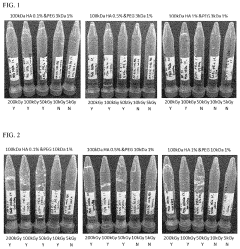
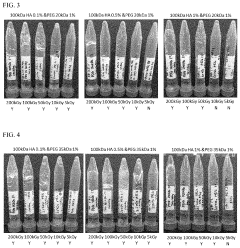
[0089]First, the results according to each concentration and electron beam dose under a condition that 100 kDa of hyaluronic acid and 0.6 kDa to 35 kDa of PEG are mixed may be summarized in Tables and photos below.

[0090]In PEG of 0.6 kDa and 1 kDa, it was confirmed that Gel was not formed under all the conditions of performing the experiment.

0.6 kDa PEG 1%100 kDa HA200 kGy100 kGy50 kGy10 kGy5 kGyNote0.1%NNNNNNo gel formation0.5%NNNNN 1%NNNNN

1 kDa PEG 1%100 kDa HA200 kG...

example 2

on of Pores and Confirmation of Water Retention of HA-PEG Hydrogel Formed Through Electron Beam Irradiation

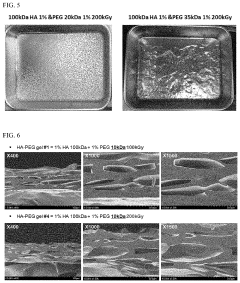
[0119]In order to confirm the pore size of a hyaluronic acid-PEG hydrogel formed through electron beam irradiation, a hydrogel sample was freeze-dried, cut in half using a blade, and then coated with Osmium, and thereafter, the size and thickness of the hole were confirmed through a scanning electron microscope (SEM). In an analysis experiment through the SEM, a hyaluronic acid-PEG hydrogel prepared by irradiating 100 kGy and 200 kGy to 1% 10 kDa PEG, 20 kDa PEG, and 35 kDa PEG along with 1% 100 kDa hyaluronic acid was used.

[0120]First, when describing the hyaluronic acid-PEG hydrogel prepared by irradiating 100 kGy and 200 kGy to 1% 10 kDa PEG mixed with 1% 100 kDa hyaluronic acid through the SEM, it was confirmed that the thickness of the sample prepared through freeze-drying was slightly thinner as the electron beam dose was increased, and it was confirmed that there was no ...

example 3

ion of In Vivo Decomposition of HA-PEG Hydrogel

[0125]Next, an experiment was conducted to confirm the degree of decomposing the hyaluronic acid-PEG hydrogel in the body, and two hydrogels formed by irradiating an electron beam of 100 kGy to 1% 100 kDa hyaluronic acid and 1% 20 kDa PEG and 1% 100 kDa hyaluronic acid and 1% 35 kDa PEG were cut to a width and a length of 1 cm, respectively, and then inserted into the abdominal cavity of C57BL / 6J mice and the abdomen was cut and open after 1 week, and the decomposed degree was confirmed (FIG. 11).

[0126]As a result, it was confirmed that the decomposed degree was somewhat different depending on the molecular weight of the PEG mixed with hyaluronic acid. After 1 week, when the inserted hyaluronic acid-PEG hydrogel was taken out and checked, it was confirmed that the hyaluronic acid-PEG hydrogel mixed with PEG of 20 kDa, which had a slightly smaller molecular weight than the hyaluronic acid-PEG hydrogel mixed with PEG of 35 kDa, was decomp...

the structure of the environmentally friendly knitted fabric provided by the present invention; figure 2 Flow chart of the yarn wrapping machine for environmentally friendly knitted fabrics and storage devices; image 3 Is the parameter map of the yarn covering machine
Login to View More

PUM

PropertyMeasurementUnit
molecular weightaaaaaaaaaa
energy intensityaaaaaaaaaa
Login to View More

Abstract

The present invention relates to a biocompatible hydrogel comprising hyaluronic acid and polyethylene glycol, and more particularly, to a biocompatible hydrogel prepared by inducing inter-molecular and / or intra-molecular cross-linking of hyaluronic acid and polyethylene glycol only by irradiating radiation without adding a reactor, a chemical cross-linking agent, or the like, a method for preparing the same, and the use thereof.

Description

TECHNICAL FIELD[0001]This application claims the priority of Korean Patent Application No. 10-2019-0089858, filed on Jul. 24, 2019, the entirety of which is a reference of the present application.[0002]The present invention relates to a biocompatible hydrogel comprising hyaluronic acid and polyethylene glycol, and more particularly, to a biocompatible hydrogel prepared by inducing inter-molecular and / or intra-molecular cross-linking of hyaluronic acid and polyethylene glycol merely by irradiating radiation without adding a reactor, a chemical cross-linking agent, or the like, a method for preparing the same, and use thereof.BACKGROUND ART[0003]Recently, injectable hydrogels have received much attention in a medical field, and are expected to be widely used, such as a release system of a physiologically active material from a medical filler, and organ / tissue regeneration using a three-dimensional structure. These injectable hydrogels have an advantage of being simply injected into th...

Claims

the structure of the environmentally friendly knitted fabric provided by the present invention; figure 2 Flow chart of the yarn wrapping machine for environmentally friendly knitted fabrics and storage devices; image 3 Is the parameter map of the yarn covering machine
Login to View More

Application Information

Patent Timeline
no application Login to View More
Patent Type & Authority Applications(United States)
IPC IPC(8): A61L26/00A61L27/26A61L27/52C08L71/02C08L5/08C08J3/075C08J3/24C08J3/28
CPCA61L26/008A61L26/0052A61L26/0076A61L27/26A61L27/52C08L71/02C08L5/08C08J3/075C08J3/246C08J3/28A61L2400/06A61L2430/34C08L2203/02C08L2312/00C08J2305/08C08J2371/02C08J2405/08C08J2471/02C08J3/24A61L26/00C08G65/3328C08B37/0072A61L26/0019A61L31/06A61L31/145
Inventor YOO, JEONG SOOLEE, WOONG HEEKIM, WANWOOK
Owner KYUNGPOOK NAT UNIV IND ACADEMIC COOP FOUND