Unlock instant, AI-driven research and patent intelligence for your innovation.

Method for typing of HLA class I alleles

a typing method and allele technology, applied in the field of typing of hla class i alleles, can solve the problems of reducing the credibility of testing results, affecting the collection, quality control and supply of specific antibodies, and the use of methods that require complicated manipulation

Inactive Publication Date: 2004-09-14
SHIONOGI & CO LTD
View PDF1 Cites 5 Cited by
  • Summary
  • Abstract
  • Description
  • Claims
  • Application Information

AI Technical Summary

Benefits of technology

The purpose of this invention is to solve problems of the manipulation of HLA class I locus antigen typing by the classical serological method, and to prodive a method, a kit and a reagent for classifing the subtype of the HLA class I antigens at the allele level (allele typing), which has not been distinguished by the classical method. Furthermore, the aim of this invention is to provide a method for typing of the HLA class I alleles which can automate and machanize easily.
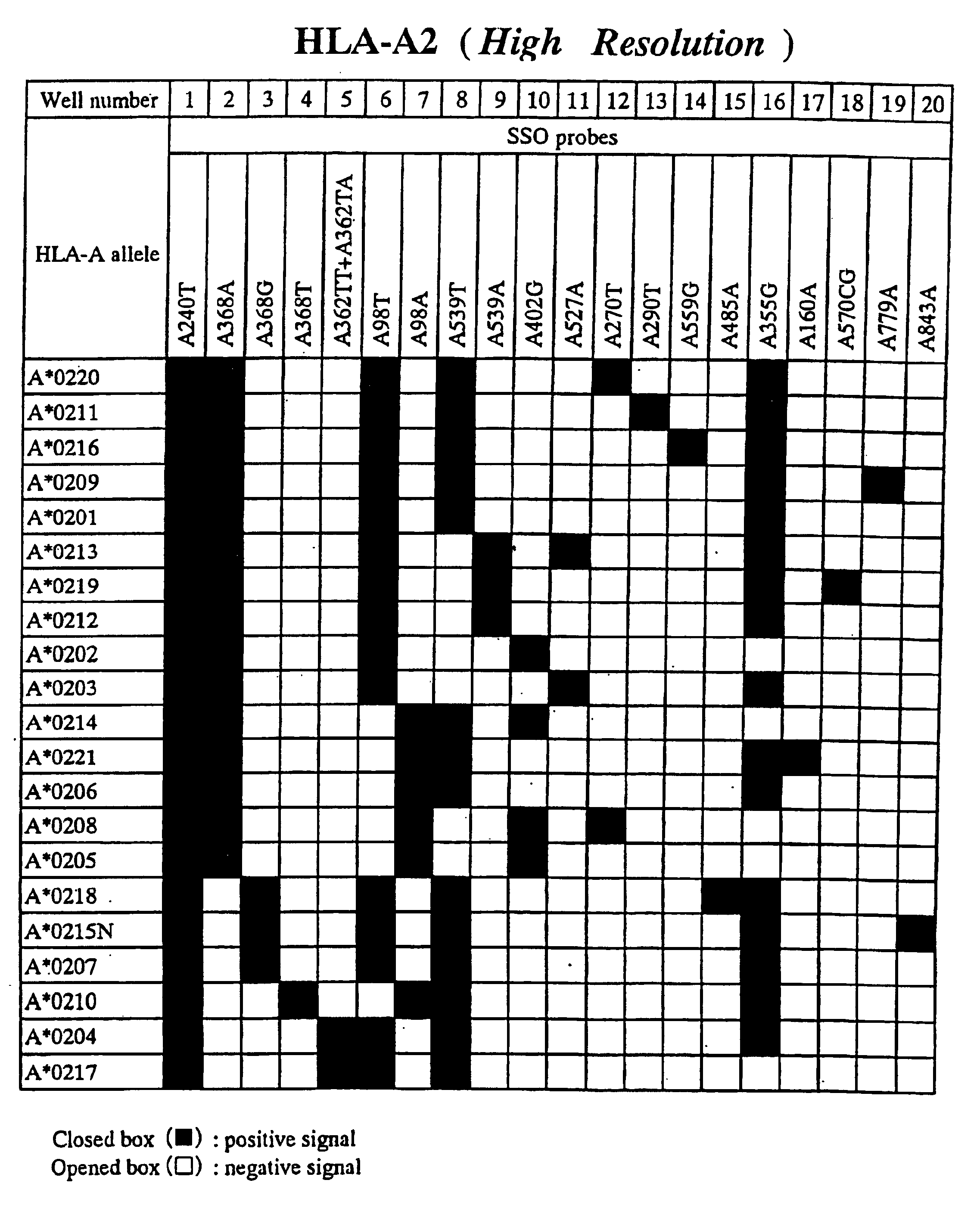
The Typing Table at the step (d) is made using signal patterns obtained by hybridizing the PCR amplified products from samples whose HLA class I antigen types or allele types are known, with DNA probes which can specifically hybridize with the sequence of at least one specific HLA class I allele. Persons skilled in the art can make easily the Typing Table. As the Typing Table, FIGS. 1 to 6 can be referred. If someone wants to use DNA probes, which are not described in this description, another Typing Table can be used. The Typing Table is made from signal patterns obtained by hybridizing the PCR amplified products from samples whose HLA class I antigen types or allele types are known, with another DNA probe. As described above, persons skilled in the art can also make easily these Typing Tables. It should be considered that each sample has the HLA class I allele type in a homozygous or heterozygous state, when the HLA class I allele type is distinguished according to the Typing Tables.
In a preferable embodiment, the hybridization at the step (b) is performed in a solution containing formamide at the temperature of the 37.degree. C. The preferable temperature is from 32.degree. C. to 42.degree. C. The temperature can be changed according to the sequence, the length and the type of the used DNA probe as mentioned above for the formamide concentration. The most desirable temperature is about 37.degree. C. Hybridization is usually performed at comparatively high temperature, at about 65.degree. C., to improve the specificity. By using the solution containing formamide, the reaction can be performed at low temperature, at about 37.degree. C.
Novel HLA-A alleles, HLA-B alleles and HLA-C alleles have been discovered. In the report of the WHO (World Health Organization) Nomenclature Committee for the HLA system, 82, 186, and 42 of alleles have been assigned for the HLA-A, -B and -C loci, respectively, at March 1997. This invention can discriminate all these alleles. Furthermore, the method shown in this invention, together with an optional, easy-performed improvement, such as adding extra DNA probes or primers, can cope with discrimination of alleles which may be discovered and enrolled in the future.

Problems solved by technology

However, this method has problems in terms of collection, quality control and supply of the specific antibodies.
Therefore, poor conditions of subjects, for example, a low survival rate of cells caused by disease or influence by passage of time after blood collection, lead to decrease of credibility for results of testing.
However, all these methods require complicated manipulation, strict reaction condition and skill.
Those are not suitable for handling a large number of samples and offer only low resolution HLA typing.
Furthermore, the typing methods for each gene are not standardized.

Method used

the structure of the environmentally friendly knitted fabric provided by the present invention; figure 2 Flow chart of the yarn wrapping machine for environmentally friendly knitted fabrics and storage devices; image 3 Is the parameter map of the yarn covering machine
View more

Image

Smart Image Click on the blue labels to locate them in the text.
Viewing Examples
Smart Image
  • Method for typing of HLA class I alleles
  • Method for typing of HLA class I alleles
  • Method for typing of HLA class I alleles

Examples

Experimental program
Comparison scheme
Effect test

example 1

HLA-A2 Allele Typing

Leukocytes (Samples 1-4) which were isolated from peripheral blood (about 10 ml) of normal subjects according to usual methods, were lysed in 500 .mu.l of guanidine thiocyanate buffer (4M guanidine thiocyanate, 25 mM sodium citrate(pH7.0), 0.5% sodium N-lauroylsarcosinate, 1% mercaptoethanol). The solution was extracted twice with phenol to eliminate proteins. After mixing with 3M sodium acetate buffer (pH 5.2), genome DNAs were obtained by adding twice volume of chilled ethanol. By using this DNAs, typing of the HLA-A2 alleles was performed as follows.

By using A2-5T and 5'-biotinylated A3-273T for a primer pair, amplification of the region containing the exon 2, the intron 2 and the exon 3 of the HLA-A2 alleles from DNAs described above was performed by the PCR method. Likewise, by using A4-8C and 5'-biotinylated A4-254G for a primer pair, amplification of the region containing the exon 4 of the HLA-A alleles was also performed by the PCR method. The reaction so...

example 2

HLA-B40 Allele Typing

Leukocytes (Samples 5-8) which were isolated from peripheral blood (about 10 ml) of normal subjects according to usual methods, were lysed in 500 .mu.l of guanidine thiocyanate buffer (4M guanidine thiocyanate, 25 mM sodium citrate(pH7.0), 0.5% sodium N-lauroylsarcosinate, 1% mercaptoethanol). The solution was extracted twice with phenol to eliminate proteins. After mixing with 3M sodium acetate buffer (pH 5.2, genome DNAs were obtained by adding twice volume of chilled ethanol. By using this DNAs, typing of the HLA-B40 alleles was performed as follows.

By using BASF-1 and 5'-biotinylated BASR-1 for a primer pair, amplification of the region containing the exon 2, the intron 2 and the exon 3 of the HLA-B40 alleles from DNAs described above was performed by the PCR method. The reaction solution was composed of genomic DNAs (100 ng), 1.4 units of thermostable DNA which was pretreated with Taq Start.TM.Antibody for 5 min at room temperature, 33.5 mM Tris-HCl (pH 8.8...

example 3

HLA-A Antigen and Allele Typing

Leukocytes (Samples 9-12) which were isolated from peripheral blood (about 10 ml) of normal subjects according to usual methods, were lysed in 500 .mu.l of guanidine thiocyanate buffer(4M guanidine thiocyanate, 25 mM sodium citrate(pH7.0), 0.5% sodium N-lauroylsarcosinate, 1% mercaptoethanol). The solution was extracted twice with phenol to eliminate proteins. After mixing with 3 M sodium acetate buffer (pH5.2), genome DNAs were obtained by adding twice volume of chilled ethanol. By using this DNAs, typing of the HLA-A antigens and alleles was performed as follows.

By using CGA011, CGA012 and 5'-biotinylated AIn3-66C for a primer pair, amplification of the region containing the exon 2, the intron 2 and the exon 3 of the HLA-A alleles from DNAs described above was performed by the PCR method. The reaction solution was composed of genomic DNAs (100 ng), 1.4 units of thermostable DNA polymerase which was pretreated with Taq Start.TM.Antibody for 5 min at r...

the structure of the environmentally friendly knitted fabric provided by the present invention; figure 2 Flow chart of the yarn wrapping machine for environmentally friendly knitted fabrics and storage devices; image 3 Is the parameter map of the yarn covering machine
Login to View More

PUM

PropertyMeasurementUnit
Angleaaaaaaaaaa
Angleaaaaaaaaaa
Fractionaaaaaaaaaa
Login to View More

Abstract

This invention provides a method, a kit and a reagent for typing of the HLA class I alleles. Explaining concretely, a single HLA class I antigen or allele is determined by combining PCR amplification using a primer pair which can amplify all HLA-A alleles, all HLA-B alleles or all HLA-C alleles, or which is specific to the common sequence to alleles of the specific group consisting of the specific HLA-A alleles or the specific HLA-B alleles, with reverse hybridization analysis using DNA probes capable of specifically hybridizing with the sequence of al least a specific HLA-A allele, at least a specific HLA-B allele or at least a specific HLA-C allele, which are covalently immobilized on wells of microtiter plates.

Description

HLA (Human Leukocyte Antigen) that is Human major histocompatibility antigen, is expressed on membranes of imuunocompetent cells, presents processed peptides derived from exogenous and endogenous antigens to T lymphocytes, and functions as a marker to recognize self and non-self. The present invention relates to a method, a reagent and a kit for typing of the HLA class I alleles. This invention is especially useful for judgement of compatibility between a donor and a recipient in organ transplantation, and for association analysis between the HLA class I genes and various types of diseases in the clinical and medical field. This invention enables us to easily automate and mechanize detection and determination of the HLA class I alleles.BACKGROUND OF ARTTyping of the HLA antigens has been mainly performed by the serological method using human alloantibodies. By using the specific antibodies to each HLA antigen which are contained in cord blood or serum from subjects who have frequent...

Claims

the structure of the environmentally friendly knitted fabric provided by the present invention; figure 2 Flow chart of the yarn wrapping machine for environmentally friendly knitted fabrics and storage devices; image 3 Is the parameter map of the yarn covering machine
Login to View More

Application Information

Patent Timeline
no application Login to View More
IPC IPC(8): C12Q1/68C12Q1/6834C12Q1/6881
CPCC12Q1/6881C12Q1/6834C12Q2531/113C12Q2600/156
Inventor MORIBE, TOYOKIKANESHIGE, TOSHIHIKO
Owner SHIONOGI & CO LTD
Features
  • R&D
  • Intellectual Property
  • Life Sciences
  • Materials
  • Tech Scout
Why Patsnap Eureka
  • Unparalleled Data Quality
  • Higher Quality Content
  • 60% Fewer Hallucinations
Social media
Patsnap Eureka Blog
Learn More