
Semiconductor device and method of manufacturing the same
a semiconductor and semiconductor technology, applied in the field of semiconductor devices, can solve the problems of inability to accurately display images, inability to uniformly irradiate regions of semiconductors with laser light, and inability so as to reduce the influence of crystal state fluctuation, the effect of reducing the fluctuation of laser light irradiation number
- Summary
- Abstract
- Description
- Claims
- Application Information
AI Technical Summary
Benefits of technology
Problems solved by technology
Method used
Image

Examples
embodiment mode 1
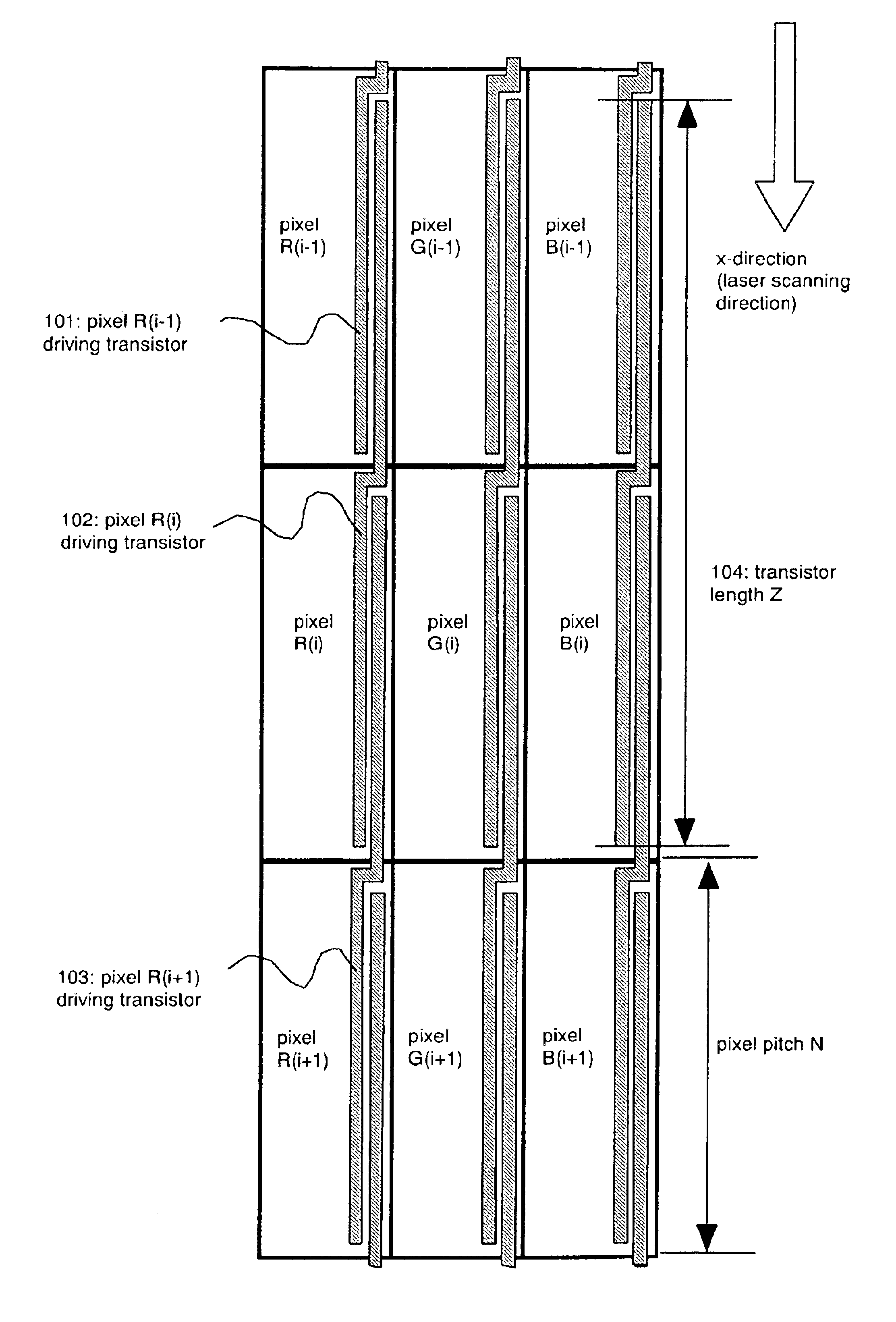
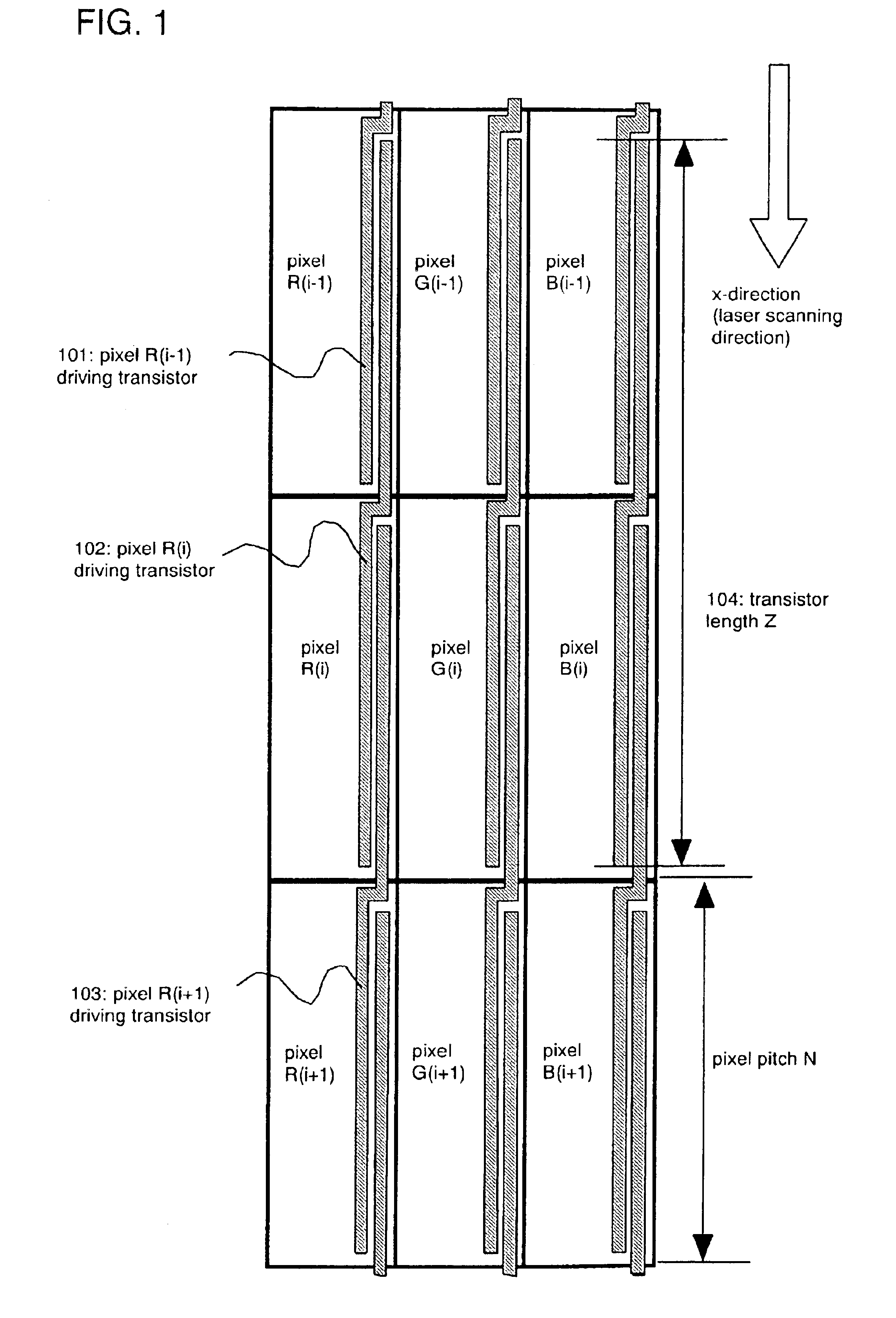
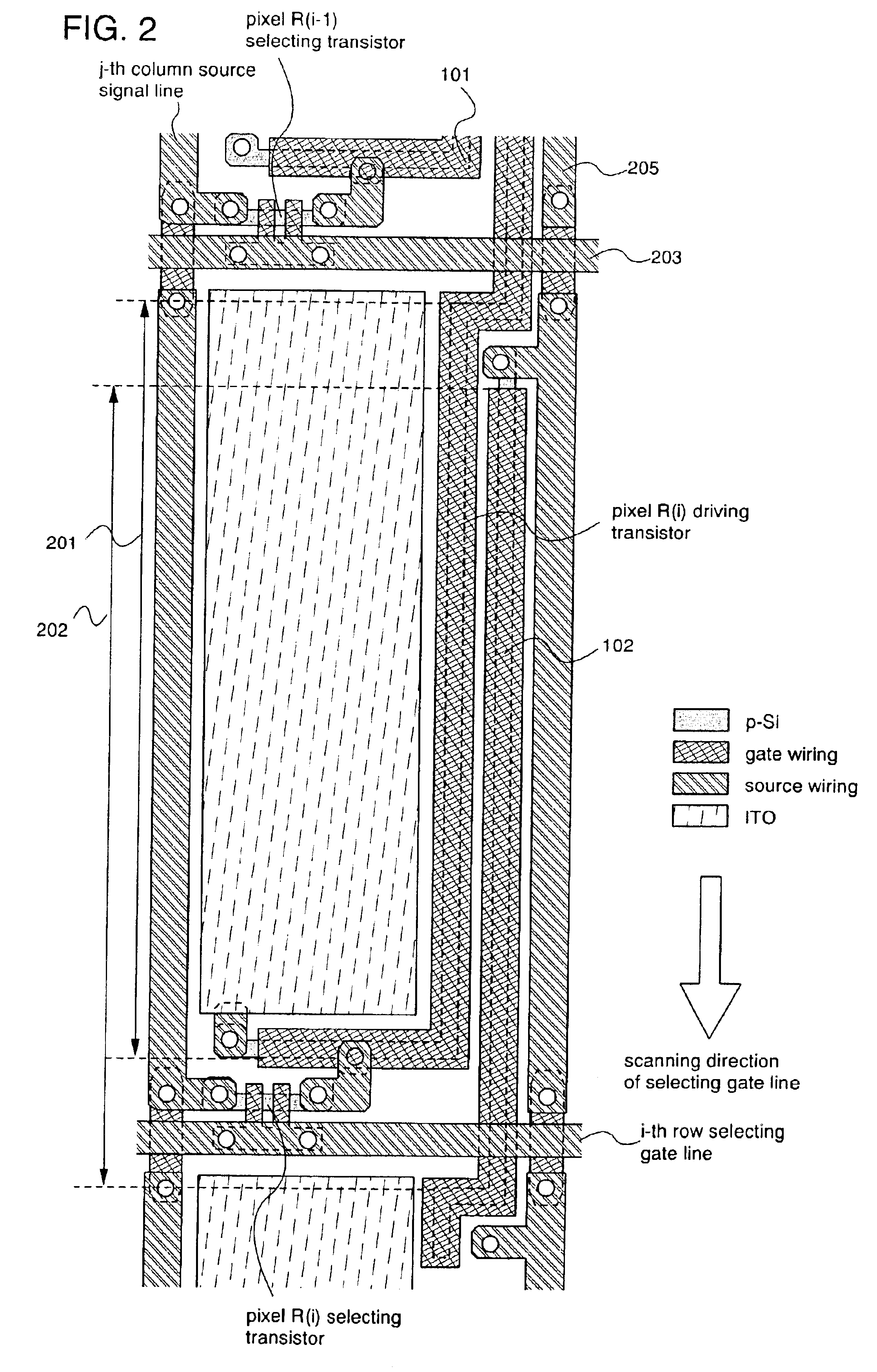
[0094]An embodiment mode of a semiconductor device according to the present invention will be described with reference to FIGS. 1 to 6. FIG. 1 is a schematic diagram of arrangement of transistors in pixels. FIG. 1 shows three pixels for red, green, and blue arranged in accordance with the stripe arrangement. However, the number of pixels in FIG. 1 will be nine if one pixel is to have one color. For discrimination, the R color portion of the first pixel from the top of FIG. 1 is referred to as pixel R(i−1), the G color portion thereof is pixel G(i−1), and the B color portion thereof is pixel B(i−1). Similarly, the R color portion of the second pixel from the top is referred to as pixel R(i), the G color portion thereof is G(i), and the B color portion thereof is pixel B(i). The R color portion of the third pixel from the top is referred to as pixel R(i+1), the G color portion thereof is G(i+1), and the B color portion thereof is pixel B(i+1).
[0095]Each pixel has transistors. For inst...
embodiment mode 2
[0120]This embodiment gives a description with reference to FIGS. 7 to 11 on arrangement of driving transistors which is different from that of Embodiment Mode 1. FIG. 7 is a schematic diagram of arrangement of transistors in pixels.
[0121]In FIG. 7, a driving transistor of each pixel is placed so as to reach a region of a surrounding pixel and two transistors are connected in series or parallel to work as one transistor. Therefore a pixel R(i+1) driving transistor 2704 and a pixel R(i) driving transistor 1701 are placed in a pixel R(i). A pixel R(i) driving transistor 2702 is placed in a pixel R(i−1). The pixel R(i) driving transistor 1701 and the pixel R(i) driving transistor 2702 are electrically connected to each other. In this manner, a driving transistor of one pixel is placed in the one pixel and a pixel above in FIG. 7 and the driving transistor in the one pixel and the driving transistor in the above pixel are electrically connected to each other.
[0122]The length of a drivin...
embodiment mode 3
[0141]The above embodiment modes describe novel arrangement for transistors. In this embodiment mode, novel arrangement for selecting gate lines will be described with reference to FIGS. 12 to 15B. FIG. 12 is a schematic diagram of arrangement of transistors in pixels. FIG. 12 shows two pixels arranged in accordance with the stripe arrangement. However, the number of pixels in FIG. 12 will be six if one pixel is to have one color. For discrimination, the R color portion of the first pixel from the top of FIG. 12 is referred to as pixel R1, the G color portion thereof is pixel G1, and the B color portion thereof is pixel B1. Similarly, the R color portion of the second pixel from the top is referred to as pixel R2, the G color portion thereof is G2, and the B color portion thereof is pixel B2.
[0142]Each pixel has transistors. For instance, the pixel G1 has a transistor for driving a light emitting element of the pixel. This transistor is called a pixel G1 driving transistor 1201. Sim...
PUM
 Login to View More
 Abstract
Description
Claims
Application Information
 Login to View More