Radio frequency motion tracking system and method

US7009561B2Inactive Publication Date: 2006-03-07MENACHE

Image

Smart Image Click on the blue labels to locate them in the text.
Viewing Examples
Smart Image
  • Radio frequency motion tracking system and method
  • Radio frequency motion tracking system and method
  • Radio frequency motion tracking system and method

Examples

Experimental program
Comparison scheme
Effect test

embodiment

First Exemplary System Embodiment

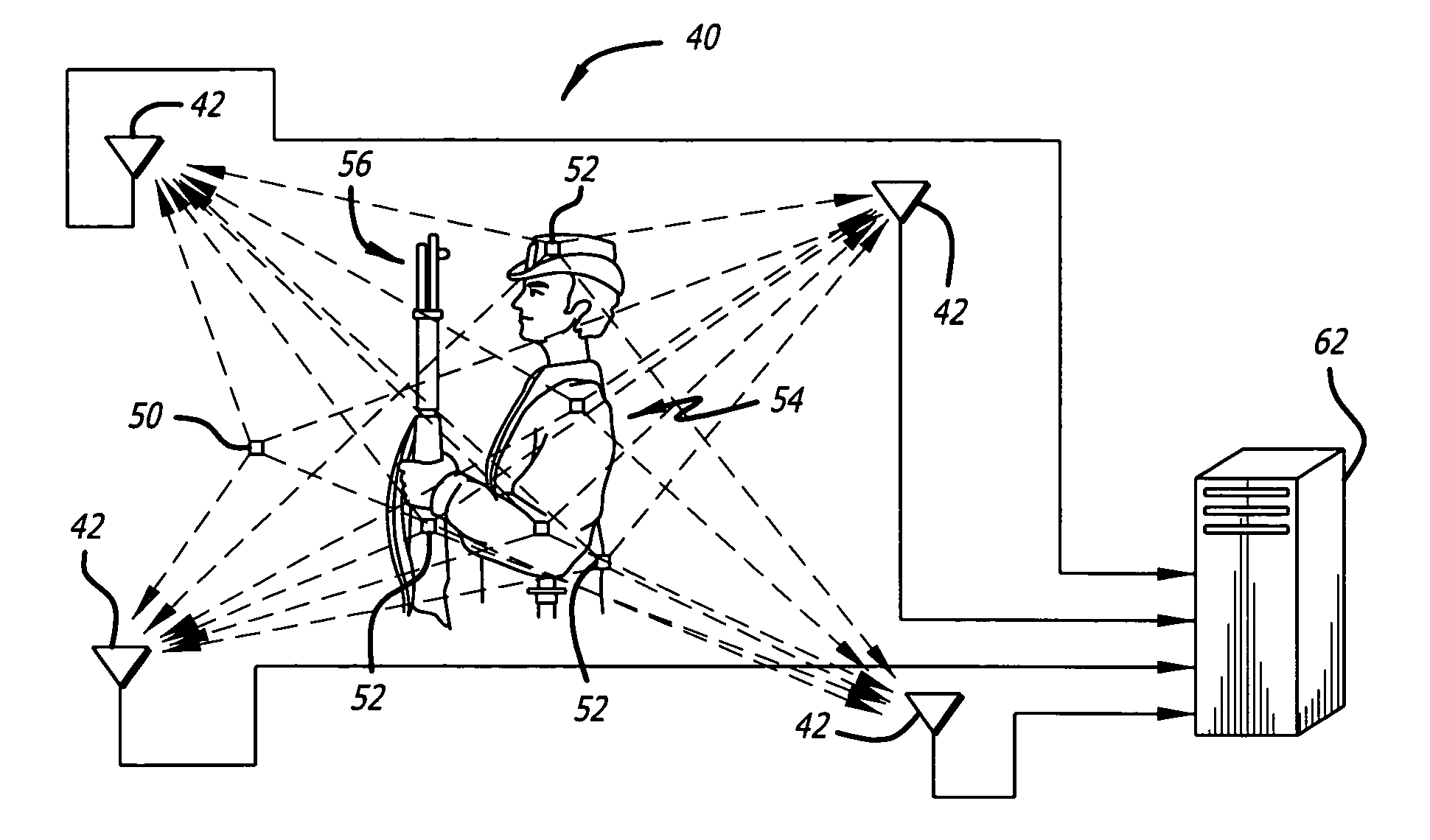
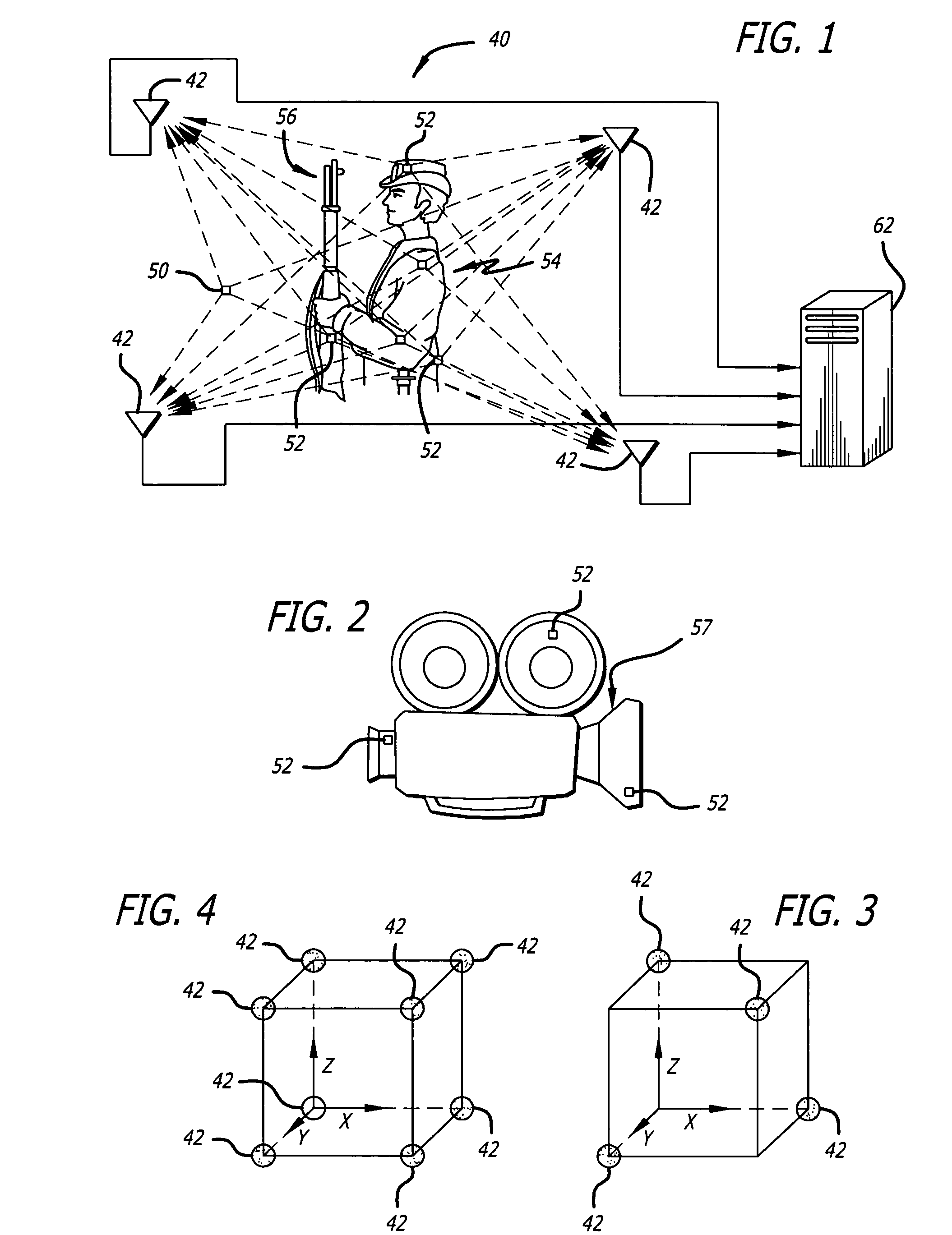
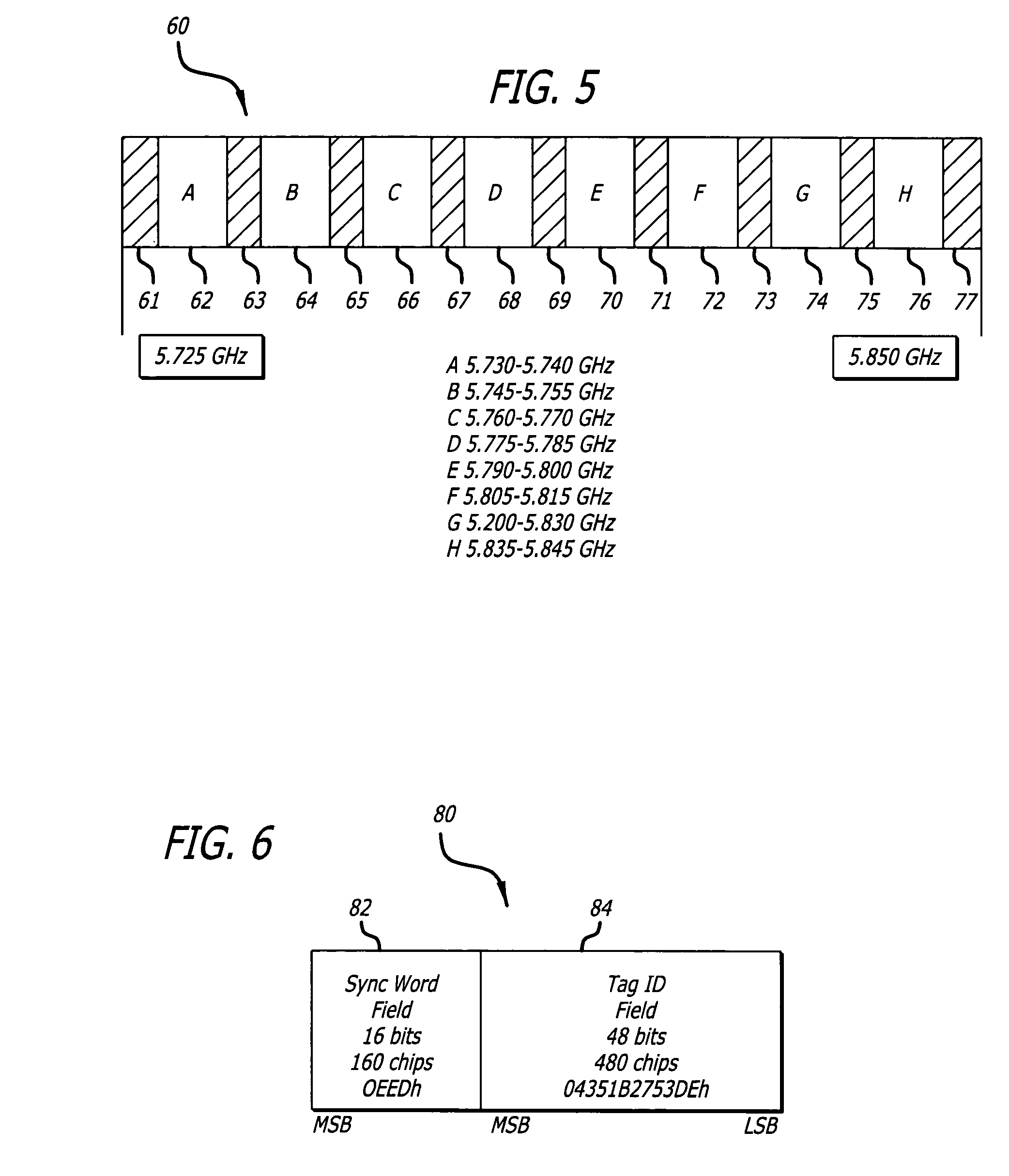
[0099]In a first exemplary system embodiment, tags 50 and 52 transmit direct-sequence spread-spectrum microwave signal bursts. Sensors 42 down-convert and analog-to-digital (A / D) sample the received signal band. Digital samples from sensors 42 are processed to extract code pseudorange and carrier pseudorange measurements for each of the tags 50 and 52. These pseudorange measurements are processed to determine the tag positions at each sampling instant.

[0100]According to simulation results, the system is expected to operate with a capture zone of 130 m×55 m×10 m and can capture the positions of tags 52 anywhere within the zone. The minimum preferred sensor configuration is 8 sensors, one each near each of the vertices of the capture zone. Up to an additional 24 sensors placed around the periphery of the capture zone provide enhanced performance. Sensors 42 are setback such that there is approximately 5 to 15 meters between the front of a sensor and th...

second system embodiment

[0212]A second system embodiment is similar to the first system embodiment, but uses some different techniques. The second system embodiment has generally been determined to be slightly preferred over the first system embodiment and is therefore considered to be a second generation design.

[0213]The capture zone is a rectangular parallelepiped with maximum diagonal up to 150 meters. The system captures tag positions anywhere within this capture zone. The system operates with any number of sensors 42 from 4 to 32. The sensors are placed such that the distance between the front of a sensor and the capture zone is between 5 percent and 15 percent of the maximum diagonal of the capture zone.

[0214]The buffer zone for each sensor is the volume defined by a plane tangent to the capture zone at its closest point to that sensor and a parallel plane twice the setback distance of that sensor away from the capture zone. Tags are excluded from the buffer zone. The system is capable of capturing 1...

the structure of the environmentally friendly knitted fabric provided by the present invention; figure 2 Flow chart of the yarn wrapping machine for environmentally friendly knitted fabrics and storage devices; image 3 Is the parameter map of the yarn covering machine
Login to View More

PUM

No PUM Login to View More

Abstract

A radio frequency (RF) motion capture system includes stationary sensor receivers, one or more transmitter marker tags on one or more objects to be tracked within a capture zone, at least one stationary reference tag transmitter, and a processing system for processing the received signals. The individual tags transmit burst of spread-spectrum RF signals. The transmitted signals include a common sync code, and a tag identification code that is unique to each tag. By computing double differences of pseudoranges, clock terms are cancelled out allowing the processing system to precisely determine the location of each tag as it moves through the capture zone without the need to synchronize clocks between sensors and tags. The system can be used for RF match moving.

Description

CROSS-REFERENCE TO RELATED APPLICATIONS[0001]This application is a continuation-in-part of U.S. application Ser. No. 10 / 386,586, filed Mar. 11, 2003, now U.S. Pat. No. 6,831,603. This application also claims priority from U.S. Provisional Application Ser. No. 60 / 523,658 filed Nov. 7, 2003.BACKGROUND OF THE INVENTION[0002]1. Field of the Invention[0003]Optical motion capture systems generally employ reflective patches adhered or sewn to an actor's clothing, and a light shining on the actor. Optical cameras record the reflections from the patches, and a processing system processes the images recorded by the cameras to determine the positions of the patches as the actor moves through a scene. Examples of optical motion capture systems include U.S. Pat. Nos. 6,580,811 entitled Wavelet-Based Facial Motion Capture for Avatar Animation, and U.S. Pat. No. 6,567,116 entitled Multiple Object Tracking System. The former patent incorporates wavelet transforms for feature detection and tracking....

Claims

the structure of the environmentally friendly knitted fabric provided by the present invention; figure 2 Flow chart of the yarn wrapping machine for environmentally friendly knitted fabrics and storage devices; image 3 Is the parameter map of the yarn covering machine
Login to View More

Application Information

Patent Timeline
07 Mar 2006
Publication
US7009561B2
IPC
G01S3/02; G03B19/18; G01S19/11; G01S5/02; G01S5/14; G01S19/09; H03M13/00; H04L7/04
CPC
A63F13/06; G01S5/14; G01S5/0247; A63F2300/1012; A63F2300/6045; Y10T156/10; G01S5/06; A63F13/216
Inventors
MENACHE, ALBERTO; STURZA, MARK ALAN