Hydrogel of (semi) interpenetrating network structure and process for producing the same

a network structure and hydrogel technology, applied in the direction of prosthesis, bandages, tampons, etc., can solve the problems of brittleness and lack of mechanical strength of most of them at the momen

Inactive Publication Date: 2011-10-04
HOKKAIDO UNIVERSITY
View PDF26 Cites 3 Cited by
  • Summary
  • Abstract
  • Description
  • Claims
  • Application Information

AI Technical Summary

Benefits of technology

The hydrogel exhibits excellent mechanical strength, high water content, and stress-dispersing properties, enabling applications in biomaterials, artificial cartilages, and other demanding uses with improved flexibility and permeability.

Problems solved by technology

When an attempt is made to utilize such gels for daily life or in the medical and industrial fields, exploiting such properties, however, most of them currently lack mechanical strength and are brittle, apart from some of them such as polyvinyl alcohol (PVA) and poly-2-hydroxyethyl methacrylate (PHEMA) gels.

Method used

the structure of the environmentally friendly knitted fabric provided by the present invention; figure 2 Flow chart of the yarn wrapping machine for environmentally friendly knitted fabrics and storage devices; image 3 Is the parameter map of the yarn covering machine
View more

Image

Smart Image Click on the blue labels to locate them in the text.
Viewing Examples
Smart Image
  • Hydrogel of (semi) interpenetrating network structure and process for producing the same
  • Hydrogel of (semi) interpenetrating network structure and process for producing the same
  • Hydrogel of (semi) interpenetrating network structure and process for producing the same

Examples

Experimental program
Comparison scheme
Effect test

example 1

Preparation of Single-Network Type Gel

[0087]From a silicone plate having an area of 100 mm×100 mm and a thickness of 2 mm, a frame having outer sides of 80 mm×80 mm and a width of 5 mm was cut out and a groove of 3 mm was bored on a location on the frame. The silicone frame was interposed between two glass plates each having an area of 100 mm×100 mm and a thickness of 3 mm to assemble a polymerization reactor.

[0088]25 ml of 2 mol / l aqueous solution of 2-acrylamido-2-methylpropane sulfonic acid (AMPS) as a monomer, 1 ml of 2 mol / l aqueous solution of N,N′-methylenebisacrylamide (MBAA) as a crosslinker and 1 ml of 0.1 mol / l aqueous solution of 2-oxoglutaric acid as an initiator were combined and conditioned with water to obtain 50 ml of an aqueous solution. The solution was then deoxygenated using a nitrogen gas. Subsequently, the deoxygenated solution was poured into an opening of the silicone plate placed on one of the glass plates of the polymerization reactor and the other glass p...

example 2

Preparation of Single-Network Type Gel

[0096]40 ml of 2 mol / l aqueous solution of acrylic acid (AA) as a monomer, 4 ml of 0.2 mol / l aqueous solution of N,N′-methylenebisacrylamide (MBAA) as a crosslinker and 1 ml of 0.1 mol / l aqueous solution of 2-oxoglutaric acid as an initiator were combined and conditioned with water to obtain 50 ml of an aqueous solution. The solution was then deoxygenated using a nitrogen gas. Subsequently, the deoxygenated solution was poured into an opening of a silicone plate placed on one of glass plates of a polymerization reactor similar to one in Example 1 and the other glass plate was superposed on the silicone plate to seal around the opening. Afterward, polymerization was carried out using a UV lamp having a wavelength of 365 nm (22 W, 0.34 A) to irradiate ultraviolet radiation at a normal temperature for six hours to prepare an AA gel having a degree of crosslinking of 1 mol %.

Preparation of Double-Network Type Gel

[0097]20 ml of 5 mol / l aqueous soluti...

example 3

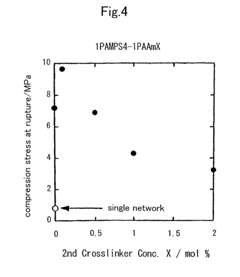
[0104]In a similar manner as Example 1, but altering the ratio between the monomers composing the first and second network structures and also altering the degrees of crosslinking of the first and second network structures, mechanical strength was determined. Hereinbelow, an abbreviated designation is used for each double-network type gel, consisting of first monomer concentration (M), monomer name and degree of crosslinking (mol %)-second monomer concentration (M), monomer name and degree of crosslinking (mol %) in the mentioned order. By way of illustration, a double-network type gel in which a first network structure is PAMS having a monomer concentration of 1 M and a degree of crosslinking of 4 mol %, and a second network structure is PAAm having a monomer concentration of 1 M and a degree of crosslinking of 0.1 mol % is designated as 1PAMPS4-1PAAm0.1. It should be noted that the monomer concentrations here are those at the time of production and differ from the monomer amounts ...

the structure of the environmentally friendly knitted fabric provided by the present invention; figure 2 Flow chart of the yarn wrapping machine for environmentally friendly knitted fabrics and storage devices; image 3 Is the parameter map of the yarn covering machine
Login to View More

PUM

PropertyMeasurementUnit
water contentaaaaaaaaaa
tensile stressaaaaaaaaaa
degree of shrinkageaaaaaaaaaa
Login to View More

Abstract

A hydrogel of the semi-interpenetrating network structure or interpenetrating network structure, characterized in that the hydrogel is one formed from a first monomer ingredient at least 10 mol % of which is accounted for by a charge-possessing unsaturated monomer, the molar ratio of the first monomer ingredient to the second monomer ingredient being from 1 / 2 to 1 / 100, and that the second monomer ingredient has been polymerized and crosslinked to a lower degree of crosslinking than the first monomer ingredient. The hydrogel is usable in a diaper, sanitary good, sustained-release agent, construction material, building material, communication material, soil conditioner, contact lens, ocular lens, hollow fiber, artificial cartilage, artificial organ, material for fuel cells, battery diaphragm, impact-resistant material, cushion, etc.

Description

[0001]This application is a U.S. National Phase Application under 35 USC 371 of International Application PCT / JP03 / 04556 filed Apr. 10, 2003, which is incorporated herein in its entirety by this reference.TECHNICAL FIELD[0002]This invention relates to a hydrogel of a semi-interpenetrating structure or an interpenetrating structure, having a high content of water and an excellent mechanical strength, and a process for producing the same.BACKGROUND ART[0003]Polymer gels possess a number of interesting properties which solids or liquids cannot singly have, such as low surface friction property, permeability for materials and organism-like positive motorial property against external stimulations. When an attempt is made to utilize such gels for daily life or in the medical and industrial fields, exploiting such properties, however, most of them currently lack mechanical strength and are brittle, apart from some of them such as polyvinyl alcohol (PVA) and poly-2-hydroxyethyl methacrylate...

Claims

the structure of the environmentally friendly knitted fabric provided by the present invention; figure 2 Flow chart of the yarn wrapping machine for environmentally friendly knitted fabrics and storage devices; image 3 Is the parameter map of the yarn covering machine
Login to View More

Application Information

Patent Timeline
no application Login to View More
Patent Type & AuthorityPatents(United States)
IPC IPC(8): A61K9/14A61F13/15A61L27/52C08F2/00C08F2/44C08F220/58C08F265/00C08F283/00
CPCA61L27/52C08F220/58C08F283/00C08L2205/04C08F220/585C08F265/00C08J3/02
InventorOSADA, YOSHIHITOGONG, JIAN PING
OwnerHOKKAIDO UNIVERSITY