
Modified flavin adenine dinucleotide-dependent glucose dehydrogenase
a technology of glucose dehydrogenase and which is applied in the field of modified flavin adenine dinucleotide-dependent glucose dehydrogenase, can solve the problems of affecting the measured value, difficult to accurately measure glucose, and low specificity of pqqgdh, so as to achieve the effect of improving the accuracy of glucose level measurement, superior temperature dependency and accurate measurement of glucose level
- Summary
- Abstract
- Description
- Claims
- Application Information
AI Technical Summary
Benefits of technology
Problems solved by technology
Method used
Image


Examples
experimental example
Reagents
50 mM PIPES buffer pH 6.5 (containing 0.1% Triton X-100)
24 mM PMS solution
2.0 mM 2,6-dichlorophenolindophenol (DCPIP) solution
1 M D-glucose solution
[0220]A reaction reagent is obtained by mixing 20.5 ml of the PIPES buffer, 1.0 ml of the DCPIP solution, 2.0 ml of the PMS solution, and 5.9 ml of the D-glucose solution, which are described above.
[0221]Measuring Condition
[0222]3 ml of the reaction reagent is preheated at 37° C. for 5 minutes. 0.1 ml of a GDH solution is added thereto, the mixture is gently mixed. Then the mixture is placed in a spectrophotometer controlled at 37° C., and a change in absorbance at 600 nm is recorded for 5 minutes. From a linear portion of the record, a per-minute absorbance change (ΔODTEST) is measured using water as a control. As a blank test, a per-minute absorbance change (ΔODBLANK) is measured in a similar manner but by adding, to the reagent mixture, a solvent used for dissolving the GDH instead of the GDH solution. A GDH activity is obtain...
examples
[0233]The present invention is described more specifically in the following with reference to Examples.
example b1
Evaluation of Temperature Dependency of FADGDH
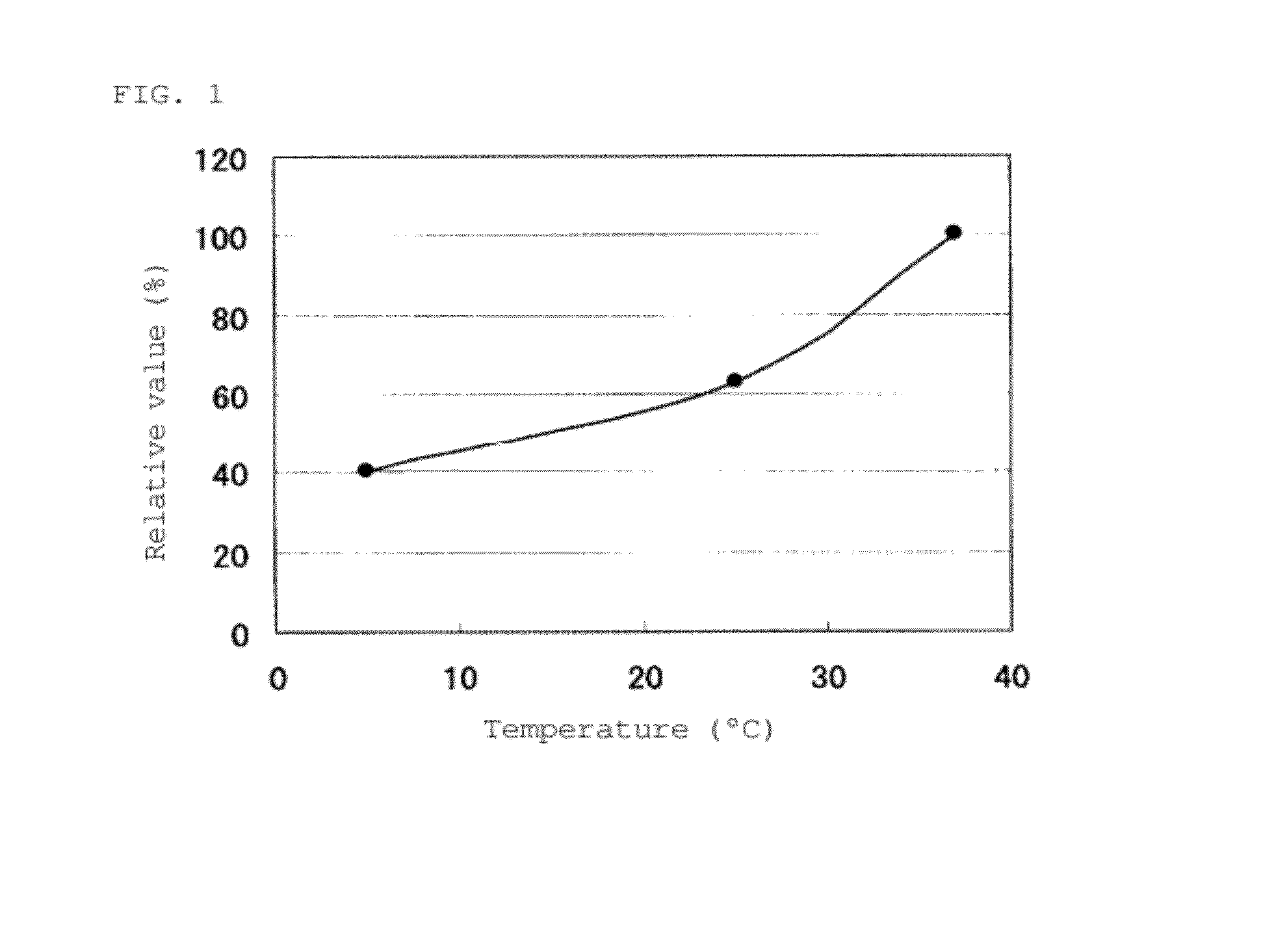
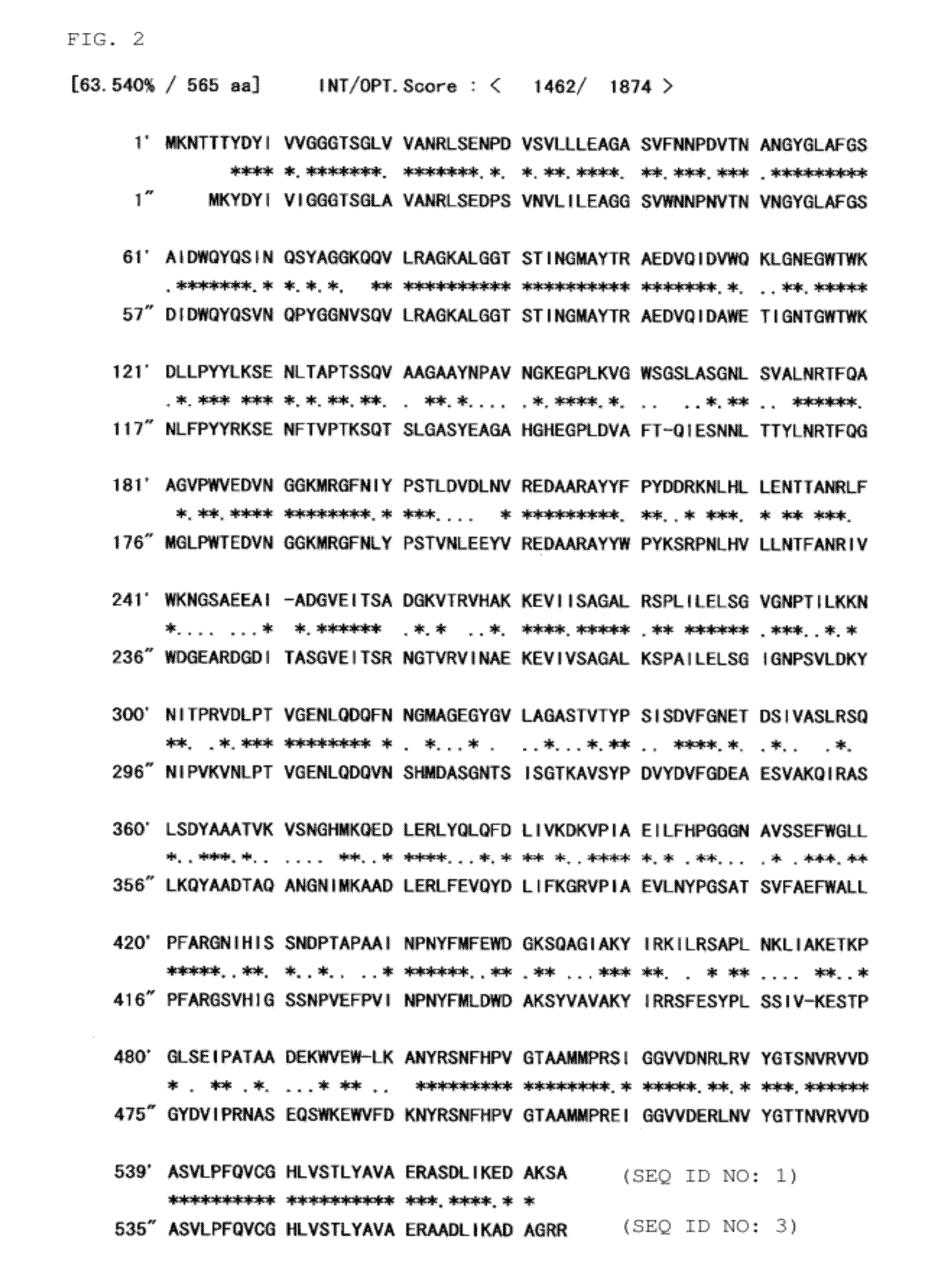
[0234]The FADGDH comprising the amino acid sequence shown in SEQ ID NO: 2 was used. An FADGDH purified preparation was prepared using the above described methods, and an activity thereof was measured in a 38 mM PIPES buffer (pH 6.5) at a predetermined temperature condition. A temperature dependency curve of the enzyme activity is shown in FIG. 1. The vertical axis represents a relative activity value at each temperature, wherein an activity value at 37° C. was defined as 100%. When the activity value at 37° C. was 100%, the activity value at 25° C. was about 63%, and the activity value at 5° C. was about 40%. Furthermore, the temperature dependency of the FADGDH of SEQ ID NO: 1 was similar to that of the FADGDH of SEQ ID NO: 2.
PUM
| Property | Measurement | Unit |
|---|---|---|
| temperature | aaaaa | aaaaa |
| temperature | aaaaa | aaaaa |
| Tm | aaaaa | aaaaa |
Abstract
Description
Claims
Application Information
 Login to View More