These failures typically require the procedure to be repeated.
The
first generation of expandable stents did not offer a controllable radial expansion.
However, prior art stents still do not provide control over the final, expanded configuration of the stent.
Consequently, once the foregoing types of intraluminal stents were expanded at the desired location within a body passageway, the expanded size of the stent could not be increased.
However, these stents have several shortcomings which contribute to procedural failure rates.
The currently used stents are not readily visible under fluoroscopic guidance procedures.
As a result, precise positioning of the stent during the
insertion procedure was difficult to achieve.
Consequently, the stent could be inadvertently positioned in the wrong or non-optimal location in the body passageway.
These stents also shorten longitudinally after radial expansion, which is not desirable for their intended use.
The shortening of the stent resulted in longitudinal movement of the stent during expansion, which sometimes resulted in the stent being fully expanded in the wrong or non-optional position.
The bending, buckling or twisting of the ribs can only be avoided if the struts are made of a very flexible or bendable material; however, the use of such material compromises the strength of the stent.
Not only does the stent not retain its longitudinal length, the complex
stent design is both difficult to manufacture and uniformly expand in a body passageway.
Although the improved stent overcomes the deficiencies of prior art stents with respect to accurate stent positioning, problems can still exist with respect to
tissue damage by the stent during
insertion and / or expansion of the stent.
These surfaces can cause
irritation and / or damage to surrounding tissue as the stent is moved within the body passageways.
Such
irritation or damage to the surrounding tissue can create various types of complications during the surgical procedure.
These surfaces can also cause damage to surrounding tissue during the expansion of the stent.
This movement of the ends can result in the stent ends digging into and / or penetrating the surrounding tissue.
Stent designs that have flared out ends can also cause damage to tissue during
insertion of the stent and expansion of the stent.
Several problems can develop after the stent is inserted into a body passageway.
The renarrowing or closure of the body passageway can be caused by a
structural failure of the stent due to contractive forces by the body passageway on the stent and / or by the body passageway growing into the openings in the stent.
Other problems can include vascular narrowing and
restenosis.
Both of these problems are the result of a body passageway that was not treated with an invasive
angioplasty, narrowing or closing, and from the insertion of a stent in one portion of the body passageway causing vascular narrowing or
restenosis in another part of the body passageway.
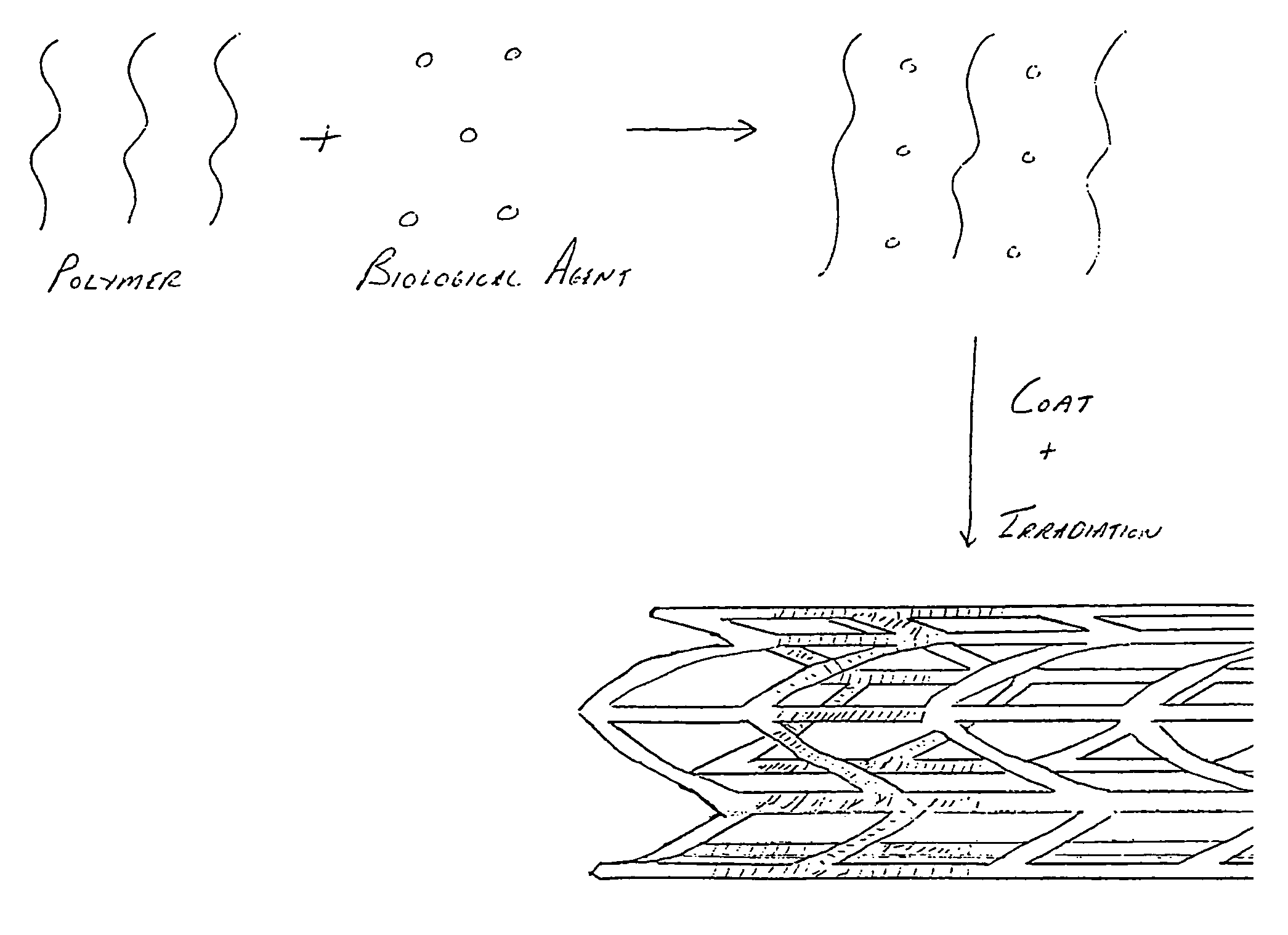
The method of
coating the stent involves a series of steps that significant increases the cost, complexity and time for the manufacture of the stent.


 Login to View More