

Low-alkali degumming process for hemp plants at room temperature
A room temperature, process technology, applied in the field of textile primary processing, can solve the problems of large investment in biological degumming equipment, large amount of chemical agents used, high chroma of degumming wastewater, etc., and achieve the effect of large equipment investment, poor safety and high maintenance costs
- Summary
- Abstract
- Description
- Claims
- Application Information
AI Technical Summary
Problems solved by technology
Method used
Image

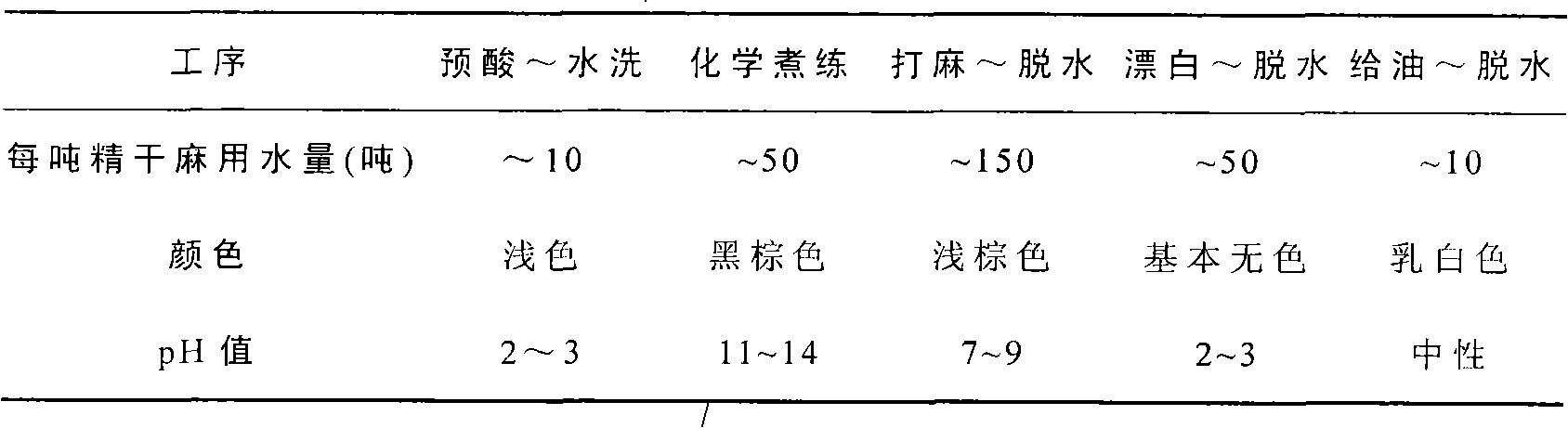
Examples
Embodiment 1
[0053] The production process of low-alkali degumming of ramie in summer at room temperature:
[0054] 1. Raw hemp pretreatment:
[0055] 1) Binding: tie the ramie into a 500-650g handle as needed;
[0056] 2) Cage: place the ramie neatly and flatly on the hemp cage;
[0057] 2. Soda soaking at room temperature
[0058] Soak the raw hemp in the leaching lye solution composed of NaOH 5g / L, common ramie degumming aid 8g / L, hydrogen peroxide 5g / L and water, the leaching alkali bath ratio is 1:30, the leaching alkali temperature is 50 ℃, soaking The time is 24h.
[0059] 3. Knock hemp: Knock hemp 6-7 circles per bunch of hemp on the disc knocking machine;
[0060] 4. Dehydration: time 3min;
[0061] 5. Oiling:
[0062] Continuous oil supply: temperature 60~80℃, oil bath concentration 3~5g / L, time 1~2min
[0063] Tank type oil supply: temperature 60~80℃, oil bath concentration 2g / L, time 4h
[0064] 6. Dehydration: time 3min;
[0065] 7. Shaking hemp: time 1min
[0066] 8. ...
Embodiment 2
[0070] Low-alkali degumming production process of ramie at room temperature in winter:
[0071] 1. Raw hemp pretreatment:
[0072] 1) Binding: tie the ramie into a 500-650g handle as needed;
[0073] 2) Cage loading: place the ramie fluffy on the hemp cage;
[0074] 2. Soda soaking at room temperature
[0075] 1) Preparation of leaching lye solution: in the soaking tank, prepare leaching lye solution with NaOH 10g / L, common ramie degumming aid 12g / L, hydrogen peroxide 5g / L and water;
[0076] 2) Soaking at room temperature: Immerse the ramie in the pre-prepared soaking lye solution according to the bath ratio of 1:30; soaking time: 120h; soaking temperature 5 ℃.
[0077] 3. Knock hemp: Knock hemp 6-7 circles per bunch of hemp on the disc knocking machine;
[0078] 4. Dehydration: time 3min;
[0079] 5. Oiling:
[0080] Continuous oil supply: temperature 60~80℃, oil bath concentration 3~5g / L, time 1~2min
[0081] Tank type oil supply: temperature 60~80℃, oil bath concent...
Embodiment 3
[0087] The production process of cannabis room temperature low alkali degumming:
[0088] 1. Raw hemp pretreatment:
[0089] 1) Binding: tie the hemp into a 500-650g handle as needed;
[0090] 2) Cage: place the cannabis neatly on the hemp cage;
[0091] 2. Soda soaking at room temperature
[0092] 1) Preparation of leaching lye solution: in the soaking tank, prepare leaching lye solution with NaOH 5g / L, common ramie degumming aid 5g / L, hydrogen peroxide 3g / L and water;
[0093] 2) Soda soaking at room temperature: Hang the hemp into the pre-prepared soaking lye solution according to the bath ratio of 1:20; soaking time: 48h;
[0094] 3. Knock hemp: Knock hemp 6-7 circles per bunch of hemp on the disc knocking machine;
[0095] 4. Dehydration: time 3min
[0096] 5. Oiling:
[0097] Continuous oil supply: temperature 60~80℃, oil bath concentration 3~5g / L, time 1~2min
[0098] Tank type oil supply: temperature 60~80℃, oil bath concentration 2g / L, time 4h
[0099] 6. Dehy...
PUM
 Login to View More
 Abstract
Description
Claims
Application Information
 Login to View More