

Method for preparing cross-linked carboxymethyl chitin tissue engineering scaffold
A technology of tissue engineering scaffold and carboxymethyl chitin, which is applied in the field of preparation of cross-linked carboxymethyl chitin tissue engineering scaffold, can solve the problems of complex process and high cost of scaffold, and achieve simple preparation process, abundant sources and fast degradation fast effect
- Summary
- Abstract
- Description
- Claims
- Application Information
AI Technical Summary
Problems solved by technology
Method used
Image

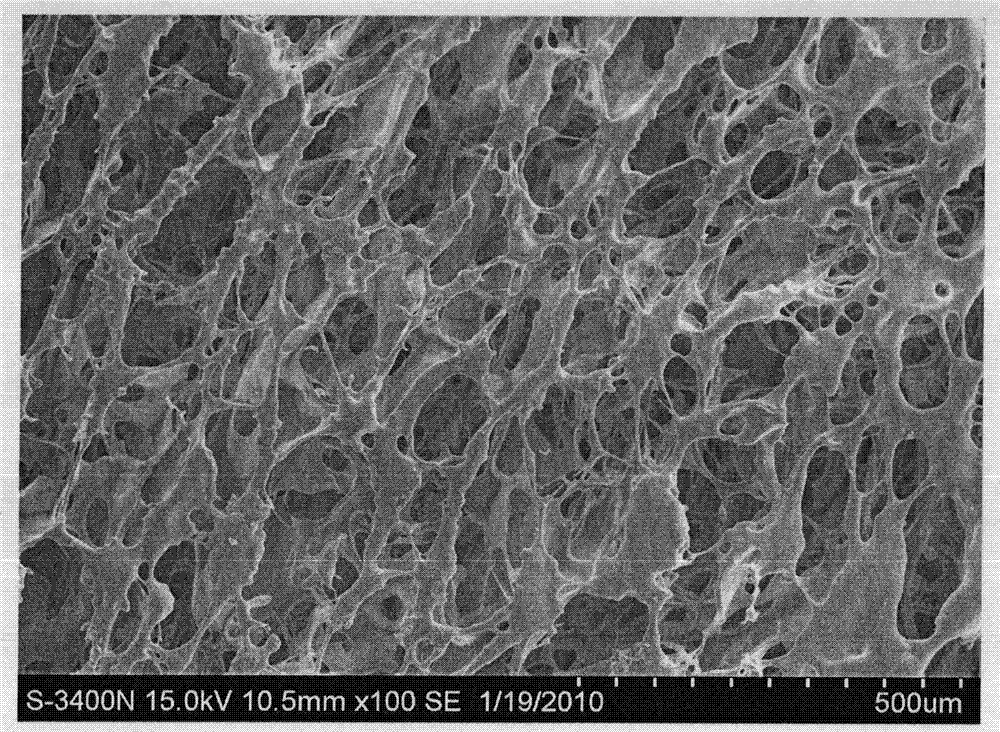


Examples
Embodiment 1
[0022] Implementation Example 1: The degree of substitution of carboxymethyl chitin is 90%, the degree of deacetylation is 60%, and the molecular weight is 200,000. Take 0.4 g of carboxymethyl chitin and put it into a beaker, add 15 g of deionized water to prepare a carboxymethyl chitin solution with a concentration of 2.7% (w / w), add catalyst 0.1151 g of N-hydroxysuccinimide to the solution And buffer agent 0.2133g 4-morpholineethanesulfonic acid was stirred for 5min. Dissolve 0.1917 g of dehydrating agent 1-ethyl-(3,3-dimethylaminopropyl) carbodiimide hydrochloride in 5 g of deionized water, add it to the carboxymethyl chitin solution prepared above, and stir rapidly 30 seconds to get carboxymethyl chitin gel. The gel was washed in 0.1M Na2HPO4 solution for one day, and the washing solution was changed three times. The gel was washed with deionized water for three days, and the washing solution was changed every 8 hours. Freeze the washed gel at -20°C and freeze-dry the po...
Embodiment 2
[0023] Implementation Example 2: The degree of substitution of carboxymethyl chitin is 30%, the degree of deacetylation is 90%, and the molecular weight is 50,000. Take 0.4 g of carboxymethyl chitin and put it into a beaker, add 2.7 g of deionized water to prepare a carboxymethyl chitin solution with a concentration of 15% (w / w), add catalyst 0.1151 g of N-hydroxysuccinyl Amine and Buffer 0.0821 g 4-morpholineethanesulfonic acid was stirred for 1 hour. Dissolve 0.1917 g of dehydrating agent 1-ethyl-(3,3-dimethylaminopropyl) carbodiimide hydrochloride in 5 g of deionized water, add it to the carboxymethyl chitin solution prepared above, and stir rapidly 2 minutes to get carboxymethyl chitin gel. The gel was washed in 0.1M Na2HPO4 solution for one day, and the washing solution was changed three times. The gel was washed with deionized water for three days, and the washing solution was changed every 8 hours. Freeze the washed gel at -20°C and freeze-dry the porous scaffold.
Embodiment 3
[0024] Implementation Example 3: The degree of substitution of carboxymethyl chitin is 150%, the degree of deacetylation is 38%, and the molecular weight is 9,000. Put 1.2 g of carboxymethyl chitin into a beaker, add 3 g of deionized water to prepare a carboxymethyl chitin solution with a concentration of 40% (w / w), and add a catalyst of 0.3453 g of N-hydroxysuccinimide to the solution Stir with buffer 0.0853 g 4-morpholineethanesulfonic acid for 10 hours. Dissolve 0.5751 g of dehydrating agent 1-ethyl-(3,3-dimethylaminopropyl) carbodiimide hydrochloride in 5 g of deionized water, add it to the carboxymethyl chitin solution prepared above, and stir rapidly Carboxymethyl chitin gel was obtained in 10 minutes. The gel was washed in 0.1M Na2HPO4 solution for one day, and the washing solution was changed three times. The gel was washed with deionized water for three days, and the washing solution was changed every 8 hours. Freeze the washed gel at -20°C and freeze-dry the porous...
PUM
| Property | Measurement | Unit |
|---|---|---|
| degree of substitution | aaaaa | aaaaa |
Abstract
Description
Claims
Application Information
 Login to View More