
Alumina-zirconia-titania composite carrier and its preparation method
A composite carrier, zirconia technology, applied in catalyst carriers, chemical instruments and methods, hydrocarbons, etc., can solve the problem of low dispersion of catalyst active component Pd, high catalyst surface acidity, specific surface and pore size distribution unsuitable for catalysts requirements, etc., to achieve the effect of improving the ability to resist heavy metal poisoning, low surface acidity, and avoiding the reduction of activity
- Summary
- Abstract
- Description
- Claims
- Application Information
AI Technical Summary
Problems solved by technology
Method used
Image

Examples
Embodiment 1
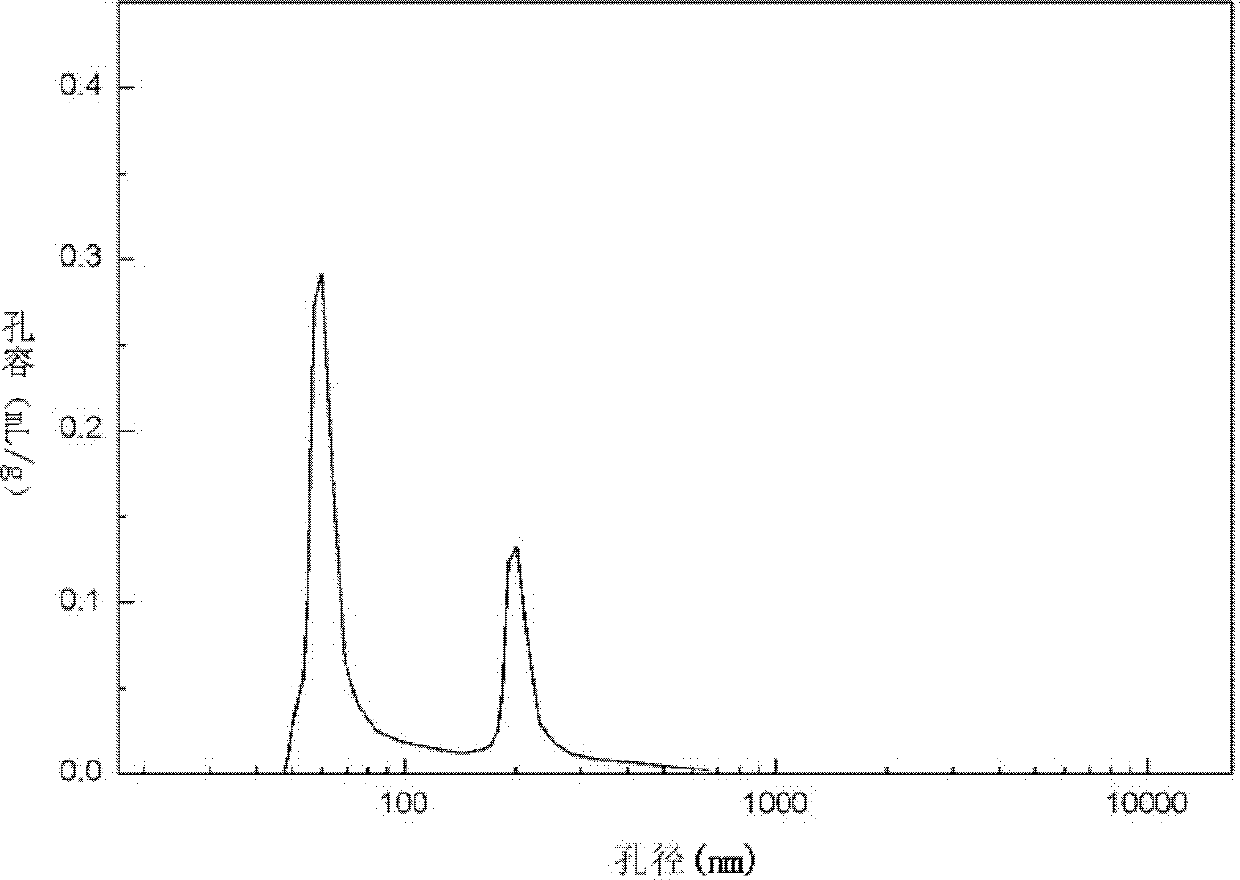
[0036] Under stirring, containing 1286g NaAlO 2 solution and containing 378g of ZrCl 4 , 475g of TiCl 4 The solution was mixed at 50°C, then neutralized with NaOH solution, aluminum zirconium titanium hydroxide co-precipitated, stirred for 10 hours to make the aluminum zirconium titanium hydroxide form uniform fine particles, filtered and washed with distilled water to remove Na + and Cl - ions, adding 7.65% citric acid as a pore-expanding agent, kneading and extruding to make a Φ4mm strip, drying at 120°C for 4 hours and then roasting at 1200°C for 5 hours to obtain an alumina-zirconia-titania composite carrier, where α -Al 2 o 3 and TiO 2 , ZrO 2 The weight ratio is 8:1:1, the bulk density is 0.88g / ml, the pore volume is 0.497ml / g, and the specific surface area is 17.1m 2 / g, the carrier has a bimodal distribution at 60nm and 220nm, and the average pore size is 90nm. The carrier pore size distribution is as follows: less than 10nm is 0%; 10-100nm is 74.30%; greater t...
Embodiment 2
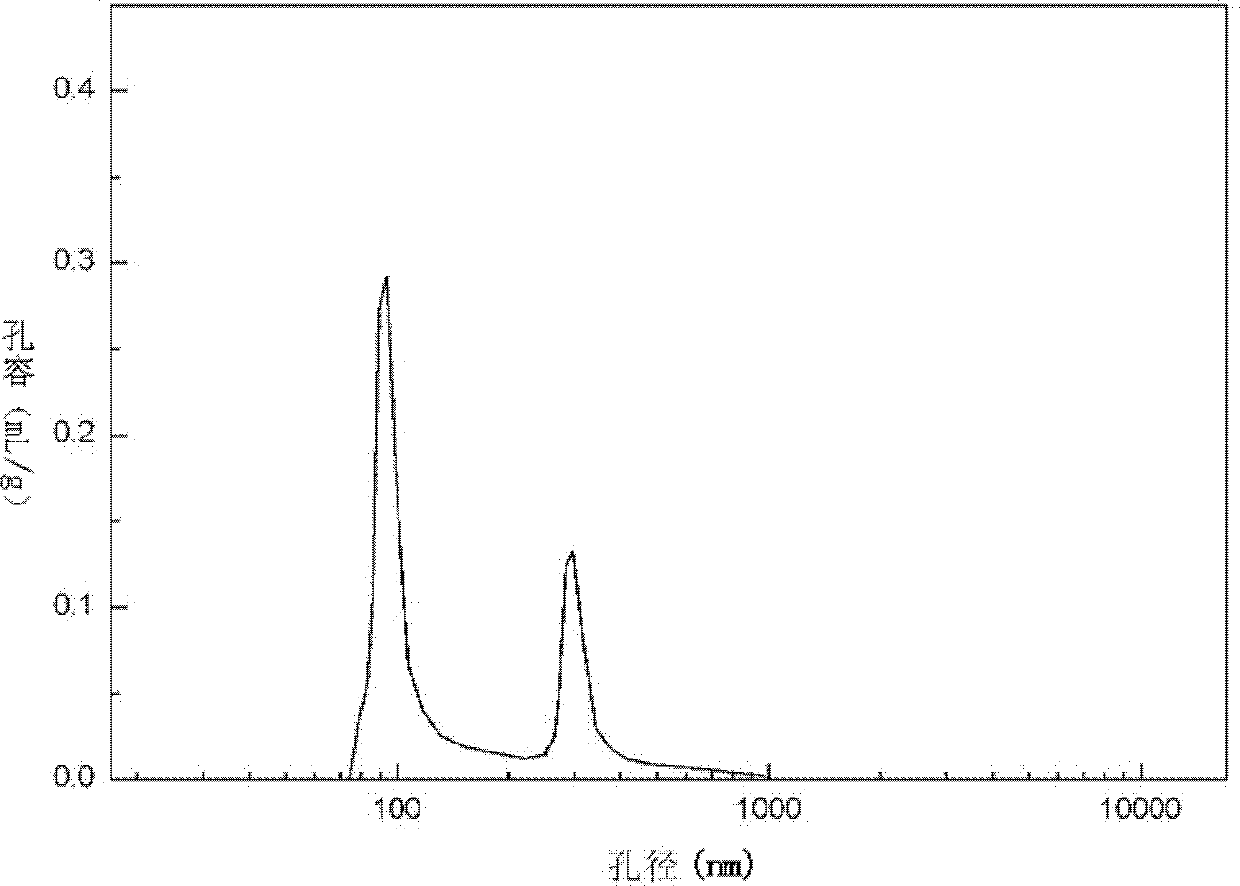
[0039] 700g of alumina, 150g of zirconia, 150g of titanium oxide, 20g of citric acid and 30g of carbon black were stirred in a mechanical stirrer, extruded into strips of Φ4.2mm, dried at 110°C for 5 hours, and then calcined at 1250°C After 4 hours, the alumina-zirconia-zirconia-titania mixed carrier was obtained, with a pore volume of 0.421ml / g, a bulk density of 0.92g / ml, and a specific surface area of 12.4m 2 / g (mercury intrusion method); the carrier has a bimodal distribution at 95nm and 310nm, and the average pore size is 150nm; the carrier pore size distribution is as follows: 1% for less than 10nm; 71.16% for 10-100nm; 27.66% for greater than 100nm and less than or equal to 1000nm ; greater than 1000nm is 0.18%.
[0040] Take 10ml palladium ions containing palladium nitrate solution with a concentration of 0.04g / ml and 990ml water, mix well, impregnate 1000g carrier, dry at 150°C for 4 hours, and roast at 450°C for 5 hours to obtain an impregnated catalyst. Take 10m...
Embodiment 3
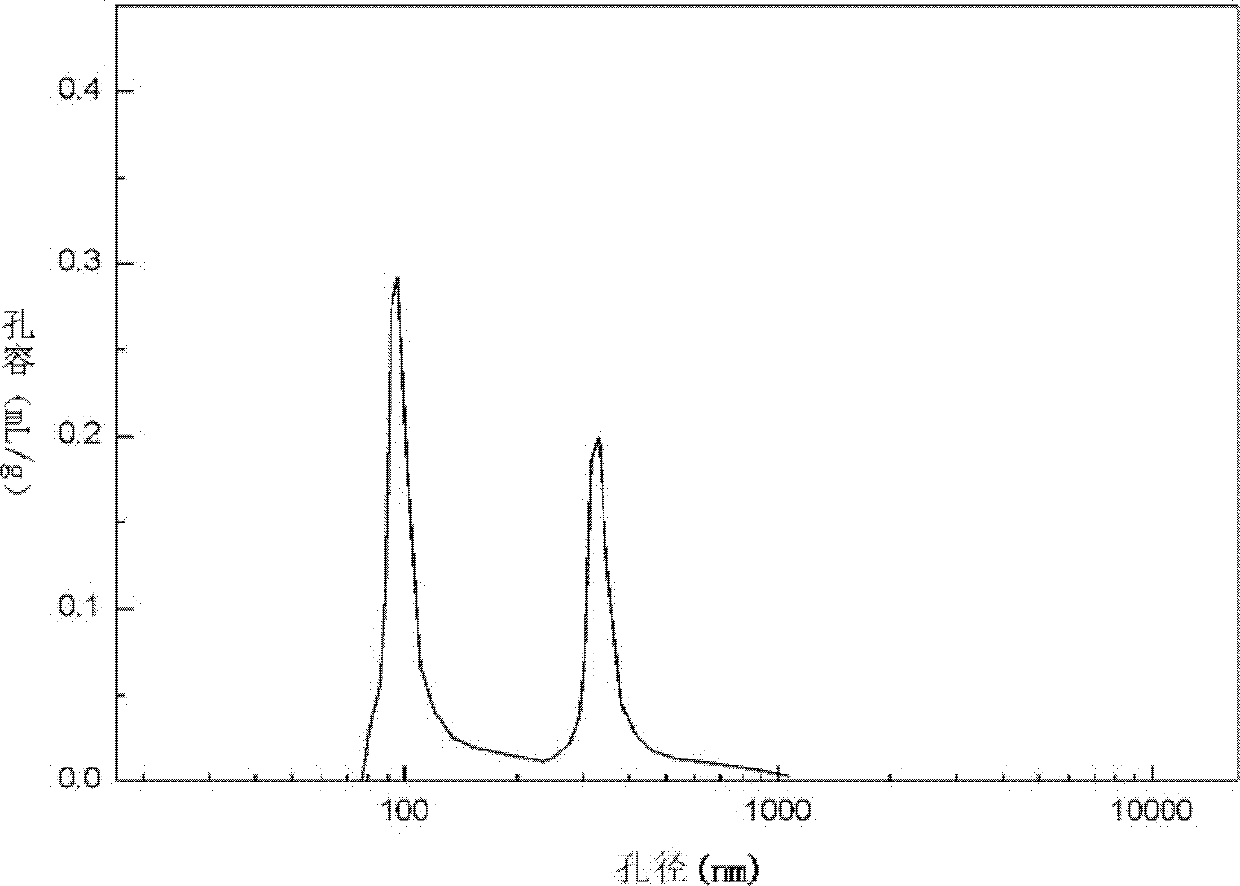
[0047] Under stirring, containing 402g NaAlO 2 solution and containing 473g of ZrCl 4 , 594g of TiCl 4 The solution was mixed at 50°C, then neutralized with KOH solution, aluminum-zirconium-titanium hydroxide co-precipitated, stirred for 10 hours to make the aluminum-zirconium-titanium hydroxide form uniform fine particles, and the product was filtered and washed with deionized distilled water to remove Na + and Cl - ions, adding 15% polyvinyl alcohol as a pore-expanding agent, rolling the ball after kneading, drying at 130°C for 2 hours, and then calcining at 1350°C for 6 hours to obtain an alumina-zirconia-titania composite carrier, in which α-Al 2 o 3 and TiO 2 , ZrO 2 The weight ratio is 2:1:1, the bulk density is 1.04g / ml, the pore volume is 0.337ml / g, and the specific surface area is 6.8m 2 / g, the carrier has a bimodal distribution at 105nm and 355nm, and the average pore size is 190nm. The carrier pore size distribution is as follows: less than 10nm is 0%; 10-10...
PUM
| Property | Measurement | Unit |
|---|---|---|
| specific surface area | aaaaa | aaaaa |
| pore size | aaaaa | aaaaa |
| pore size | aaaaa | aaaaa |
Abstract
Description
Claims
Application Information
 Login to View More