
Purification method of 3-azabicyclo-octane hydrochloride
A technology of cyclooctane hydrochloride and purification method, which is applied in the field of solid purification of 3-azabicyclo[3.3.0]octane hydrochloride, and can solve the problems of unfavorable transportation, low purity and low content, etc.
Patent Information
- Authority / Receiving Office
- CN · China
- Current Assignee / Owner
- Publication Date
- 2013-07-03
- Estimated Expiration
- Not applicable · inactive patent
Smart Images
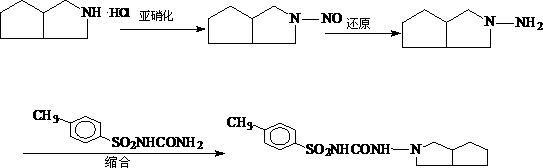
Figure 1 
Figure 2
Abstract
Description
technical field
[0001] The invention relates to a method for purifying solid 3-azabicyclo[3.3.0]octane hydrochloride, belonging to the technical field of purification of pharmaceutical intermediates. Background technique
[0002] 3-Azabicyclo[3.3.0]octane hydrochloride (also known as azabicyclo) is shown in Formula I. It is a very valuable pharmaceutical intermediate, especially an important intermediate for the synthesis of gliclazide. The azabicyclic is nitrosated, reduced, and condensed to generate gliclazide. The reaction process is as follows:
[0003]
[0004] Grecht
[0005]
[0006] (I) Azabicyclo
[0007] Gliclazide (Gliclazide, GZ) is a second-generation oral sulfonylurea hypoglycemic drug, suitable for non-insulin-dependent diabetes, obese diabetes, senile diabetes and diabetes with cardiovascular complications. Since Gliclazide was successfully developed by the French company Servier and launched in the market in 1972, due to its obvious hypoglycemic ef...
Examples
Embodiment 1
[0018] Put 60g potassium borohydride, 176g anhydrous zinc chloride, 415g dried toluene, and 138g THF into a 2000mL reaction flask at room temperature, mix and protect with nitrogen, and add 50g 1,2-cyclopentadicarboximide in batches , Mix and stir, slowly increase the temperature to 70°C for 4 hours, then slowly increase the temperature to 95~105°C, keep reflux and react for 10 hours to complete the reaction, change the distillation device to evaporate 35% of the organic solvent, then cool to 40°C and add slowly NaOH solution (30%) 800g to pH 13~14, steam distilled to distillate PH=7~8, fractions were extracted three times with 600ml toluene, combined toluene layer was acidified with refined hydrochloric acid to pH=1.5~2, heating Atmospheric reflux to remove the water in the toluene layer, cooling and suction filtration to obtain the crude azabicyclic solid. The crude product was heated and refluxed with a mixed solvent of 100g of ethanol and 100g of methyl acetate to obtain 51...
Embodiment 2
[0020] Put 60g potassium borohydride, 176g anhydrous zinc chloride, 415g dried toluene, and 104g THF into a 2000mL reaction flask at room temperature, mix and protect with nitrogen, and add 50g 1,2-cyclopentadicarboximide in batches , Mix and stir, slowly heat up to 75°C for 4h, keep warm at 95~105°C and reflux for 10 hours to complete the reaction, change the distillation device to evaporate 35% of the organic solvent, then cool down to 40°C, add slowly NaOH solution (30%) 800g to pH 13~14, steam distilled until the distillate PH=7~8, the fractions were extracted three times with 600ml xylene, the combined xylene layer was acidified with refined hydrochloric acid to pH=1.5~2 , The water in the toluene layer was removed by reflux at normal pressure at elevated temperature, and the crude azabicyclic solid product was obtained by suction filtration at lower temperature. The crude product was heated and refluxed for 30 minutes with a mixed solvent of 10g methanol and 100g ethyl ac...