Method for determination of aluminum ion content by alizarin red S complexation spectrophotometry
A technology of spectrophotometry and aluminum ions, which is applied in the field of analysis and detection, can solve the problems of high cost, long period, and cumbersome test procedures, and achieve the effects of good reproducibility and precision, simple operation, and a wide range of concentration concentrations
- Summary
- Abstract
- Description
- Claims
- Application Information
AI Technical Summary
Problems solved by technology
Method used
Image


Examples
Embodiment 1
[0029] Example 1: Pre-preparation of solutions
[0030] 1. Preparation of Alizarin Red S solution (0.25g / L) Weigh 0.025g of Alizarin Red S, dissolve in 50mL of absolute ethanol, dilute with distilled water to 100mL.
[0031] 2. Preparation of aluminum ion standard solution (1.0mg / mL): weigh 0.89g AlCl 3 .6H 2 O (aluminum content is 0.1g), dissolved in deionized water and adjusted to 100mL.
[0032] 3. Preparation of disodium hydrogen phosphate-citric acid buffer solution (pH4.6): Accurately pipette 46.75 mL of 0.2 mol / L disodium hydrogen phosphate solution and 53.25 mL of 0.1 mol / L citric acid solution, and mix to 100 mL.
Embodiment 2
[0033] Embodiment 2: Determination of reaction system and maximum absorption peak
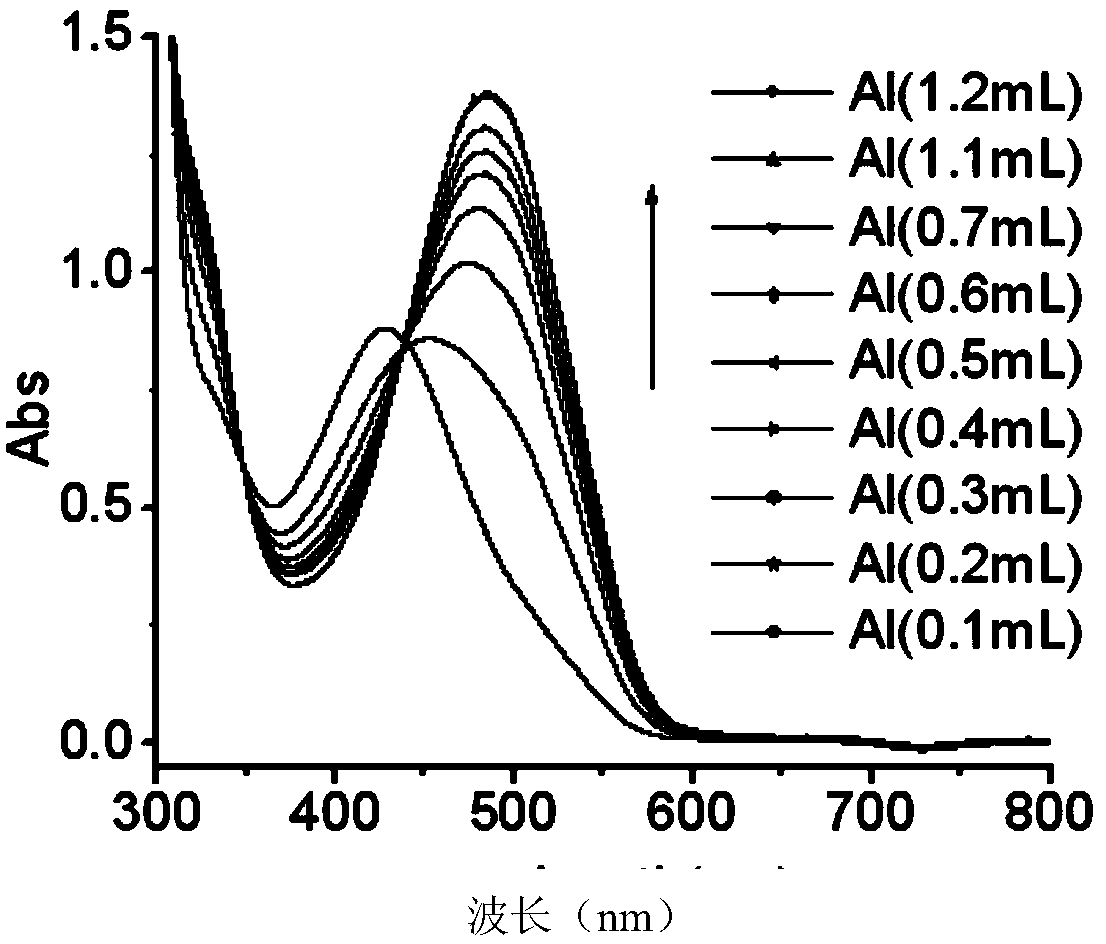
[0034] The natural color of Alizarin Red S solution is yellow. In the acidic medium of disodium hydrogen phosphate-citric acid at pH 4.6, it forms a stable complex water-soluble substance with a certain concentration of aluminum ions. The color is red. Before and after the solution was scanned at full wavelength, the results are shown in figure 1 with figure 2 .
[0035] figure 1 The results showed that the maximum light absorption peak of Alizarin Red S solution was at 420nm, figure 2 The results showed that the maximum absorption peak of the solution was at 490nm after reacting with aluminum ions.
[0036] Therefore, the components of the reaction system were determined to be: pH4.6 disodium hydrogen phosphate-citric acid buffer solution, alizarin red S solution and aluminum ion solution, and the detection wavelength was 490nm.
Embodiment 3
[0037] Embodiment 3: Optimization of reaction system components and conditions
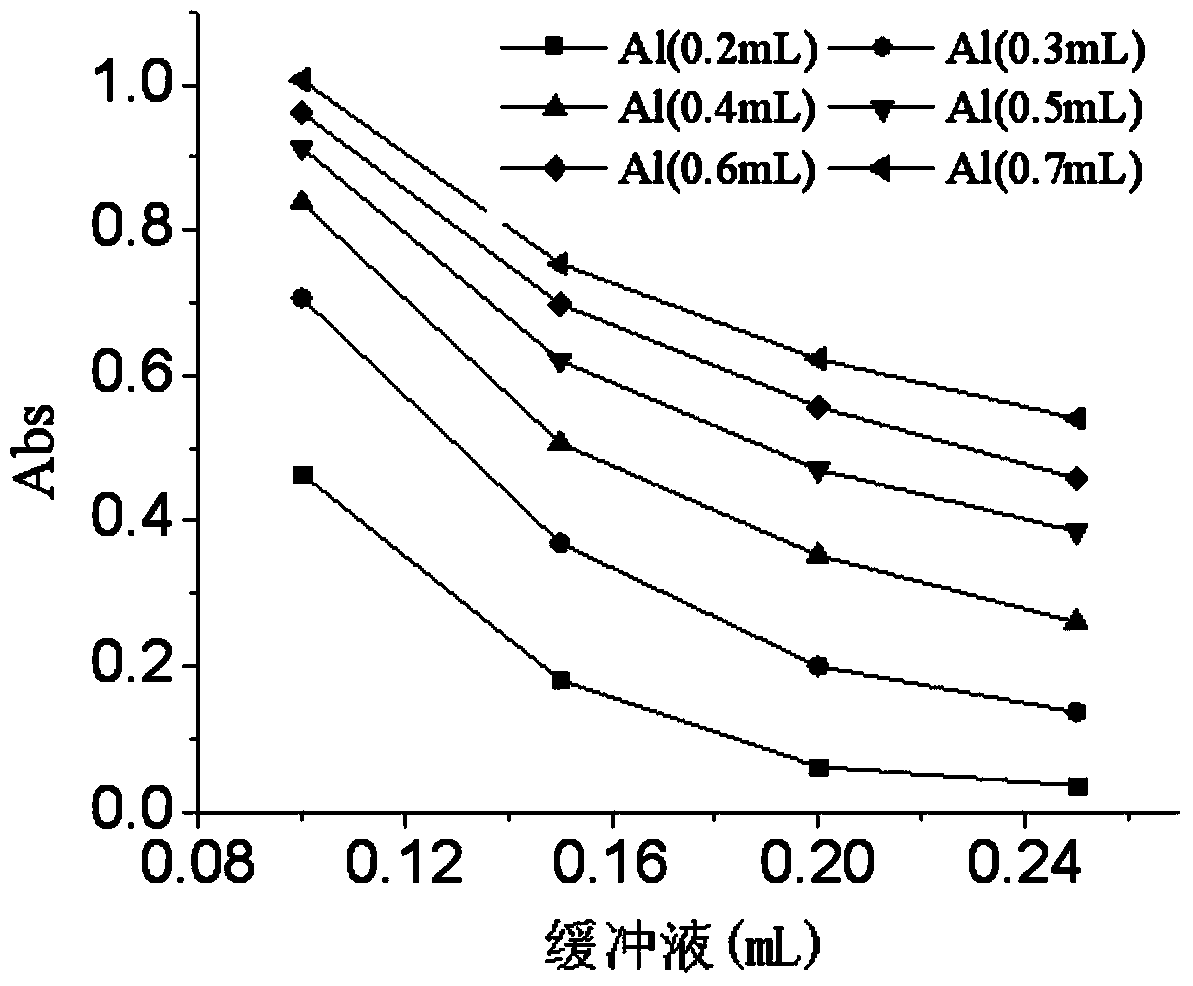
[0038]On the basis of Example 2, the reaction system and reaction conditions were optimized, and different additions of 0.25g / L Alizarin Red S solution (0.8mL, 1.0mL, 1.2mL, 1.5mL, 1.8mL and 2.0mL ), pH4.6 disodium hydrogen phosphate-citric acid buffer (0.1mL, 0.15mL, 0.20mL and 0.25mL,) and 1.0mg / mL aluminum ion standard solution addition (0.1mL, 0.2mL, 0.3mL , 0.4mL, 0.5mL, 0.6mL, 0.7mL, 0.8mL, 0.9mL and 1.0mL) on the sensitivity and accuracy of the detection method.
[0039] see results Figure 3-5 :
[0040] Depend on image 3 It can be seen that at 490nm, under different aluminum concentration gradients (0.2-0.7mL), when the buffer addition amount is 0.15mL, the absorbance value range is relatively wide and the sensitivity is good, so 0.15mL is selected as the addition amount;
[0041] Depend on Figure 4 It can be seen that at 490nm, under different aluminum concentration gradients (0.2...
PUM
 Login to View More
 Abstract
Description
Claims
Application Information
 Login to View More
 - R&D
- Intellectual Property
- Life Sciences
- Materials
- Tech Scout
- Unparalleled Data Quality
- Higher Quality Content
- 60% Fewer Hallucinations
Browse by: Latest US Patents, China's latest patents, Technical Efficacy Thesaurus, Application Domain, Technology Topic, Popular Technical Reports.
© 2025 PatSnap. All rights reserved.Legal|Privacy policy|Modern Slavery Act Transparency Statement|Sitemap|About US| Contact US: help@patsnap.com