Method and system for continuously preparing polyoxymethylene dimethyl ether by utilizing ionic liquid catalyst

A polymethoxydimethyl ether, ionic liquid technology, applied in chemical instruments and methods, preparation of organic compounds, chemical recovery, etc., can solve the problems of low catalyst activity, complex process, difficult industrialization, etc., and achieve conversion rate. High, process simplification, and the effect of solving the problem of recycling

CN104016839AInactive Publication Date: 2014-09-03SHANGHAI PAN MA CHEM ENG TECH
6 Cites 2 Cited by

Patent Information

Authority / Receiving Office
CN · China
Current Assignee / Owner
Publication Date
2014-09-03
Estimated Expiration
Not applicable · inactive patent

Smart Images

  • Figure 1
    Figure 1
  • Figure 2
    Figure 2
  • Figure 3
    Figure 3
Patent Text Reader

Abstract

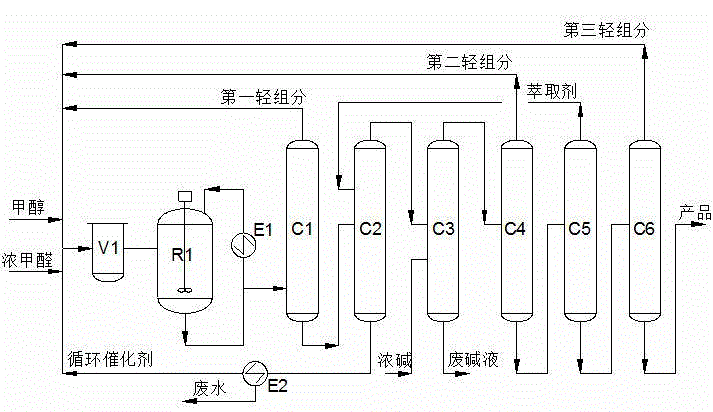
The invention discloses a method and a system for continuously preparing polyoxymethylene dimethyl ether by utilizing an ionic liquid catalyst. The system mainly comprises two areas, i.e., a reaction area and a refining area. The method comprises the following steps: firstly, carrying out an acetalation reaction on methyl alcohol and concentrated formaldehyde in the presence of the ionic liquid catalyst so as to generate the polyoxymethylene dimethyl ether; and then, rectifying the polyoxymethylene dimethyl ether in the refining area. According to the method and the system which are disclosed by the invention, an aqueous solution of the polyoxymethylene dimethyl ether is taken as an initial reaction raw material on which the continuous acetalation reaction is carried out so as to prepare the polyoxymethylene dimethyl ether, so that compared with other industrial devices, the system and the method are simple in process, low in energy consumption, simple in catalyst separation due to the adoption of an extractive distillation mode and the like, high in separation efficiency and high in polyoxymethylene dimethyl ether purity. A novel tank reactor is adopted, so that the method and the system which are disclosed by the invention are suitable for large-scale industrial production.
Need to check novelty before this filing date? Find Prior Art

Description

technical field

[0001] The invention relates to a method and system for continuously preparing polyoxymethylene dimethyl ether by using an ionic liquid catalyst. Background technique

[0002] With the dwindling of oil resources and the increasing demand for fuel oil in various countries around the world, all countries have intensified their efforts in research and development of new energy sources.

[0003] Polyoxymethylene dimethyl ether is a low molecular weight acetal polymer with methoxy as the main chain, and the general formula is CH 3 (OCH 2 ) n OCH 3 , a colorless liquid with a high boiling point, can be used as a modifier, solvent, plasticizer and release agent for phenolic resins. The compound with n=3~6 is a kind of diesel oxygen enhancer with excellent performance. Its physical properties are similar to diesel oil. It not only has a high cetane number, but also has a high oxygen content. Adding 15% to diesel It can significantly improve the combustion charac...

Examples

Embodiment 1

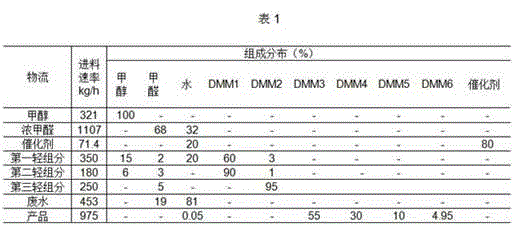
[0043] After product and each component reaction reached equilibrium, sampling was carried out, and quantitative analysis was carried out by gas chromatography, and the results were shown in Table 1 below:

[0044] Reaction temperature: 120°C;

[0045] Reaction pressure: 2.0 MPaG;

[0046] Feed ratio of concentrated formaldehyde to methanol: 2.5:1;

[0047] Catalyst dosage: 4%;

[0048]

Embodiment 2

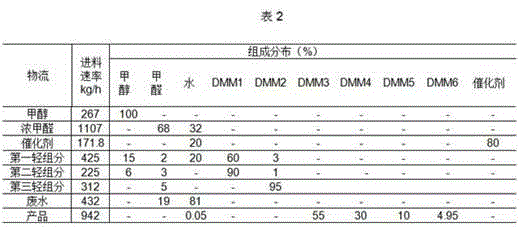
[0050] Product and each component reaction are sampled after reaching equilibrium, are quantitatively analyzed by gas chromatograph, and its result is as shown in table 2 below:

[0051] Reaction temperature: 130°C;

[0052] Reaction pressure: 3.0 MPaG;

[0053] Feed ratio of concentrated formaldehyde to methanol: 3:1;

[0054] Catalyst dosage: 10%;

[0055]

Embodiment 3

[0057] Product and each component reaction are sampled after reaching equilibrium, and quantitatively analyzed by gas chromatography, and the results are shown in Table 3 below:

[0058] Reaction temperature: 110°C;

[0059] Reaction pressure: 1.0 MPaG;

[0060] Feed ratio of concentrated formaldehyde to methanol: 1:1;

[0061] Catalyst dosage: 1%;

[0062]