A preparing method of a chenodeoxycholic acid derivative
What is AI technical title?
AI technical title is built by Patsnap AI team. It summarizes the technical point description of the patent document.
A compound and oxidation reaction technology, applied in the field of preparation of chenodeoxycholic acid derivatives, can solve the problems of 6ECDCA that need to be improved, low product yield, long process route, etc.
Active Publication Date: 2015-09-02
HUBEI BIO PHARMA IND TECHCAL INST
View PDF3 Cites 22 Cited by
Summary
Abstract
Description
Claims
Application Information
AI Technical Summary
This helps you quickly interpret patents by identifying the three key elements:
Problems solved by technology
Method used
Benefits of technology
Problems solved by technology
The process route is long and the resulting product yield is low
[0006] Therefore, the current method for preparing 6ECDCA still needs to be improved
Method used
the structure of the environmentally friendly knitted fabric provided by the present invention; figure 2 Flow chart of the yarn wrapping machine for environmentally friendly knitted fabrics and storage devices; image 3 Is the parameter map of the yarn covering machine
View more
Image
Smart Image Click on the blue labels to locate them in the text.
Viewing Examples
Smart Image
Click on the blue label to locate the original text in one second.
Reading with bidirectional positioning of images and text.
Smart Image
Examples
Experimental program
Comparison scheme
Effect test
Embodiment 1
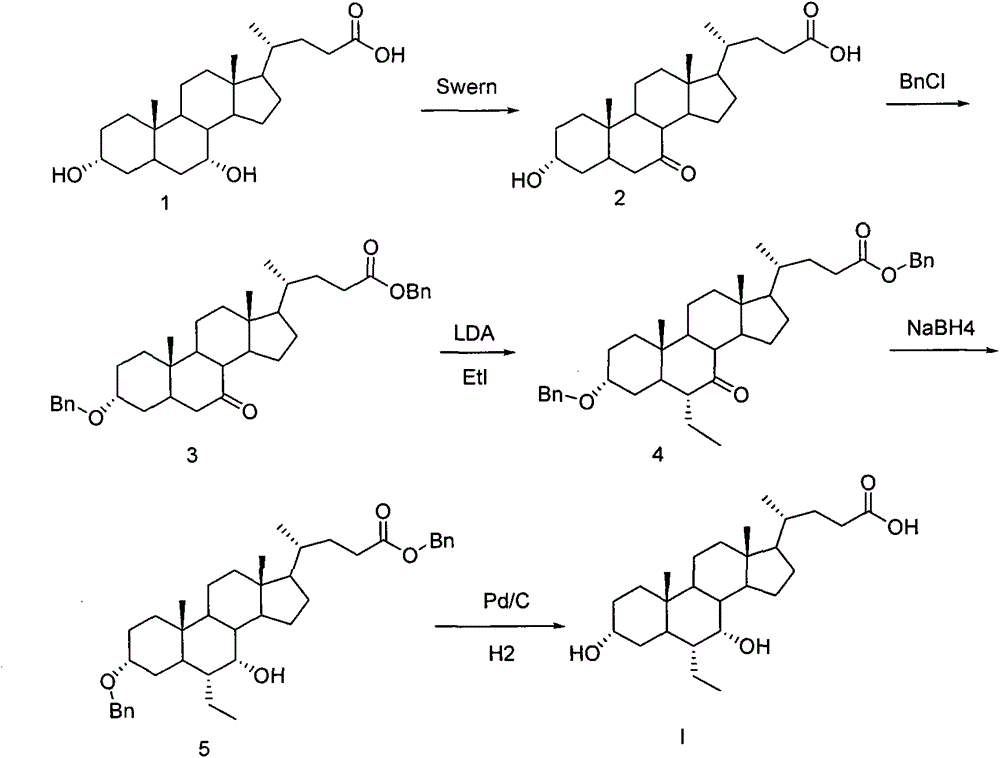
[0038] Compound 1 (5 g, 12.7 mmol) was added to the reaction flask, and 50 mL of dichloromethane, DMSO (1.12 g, 14.3 mmol), and triethylamine (4.2 g, 41.5 mmol) were added. The reaction temperature was lowered to -30°C, trifluoroacetic anhydride (3.2 g, 15.2 mmol) was added dropwise thereto, and after 1.5 h of heat preservation reaction, 10 mL of water was added, stirred to rise to room temperature, left to separate liquids, and the water phase was dichloromethaneMethane was extracted twice, 20ml each time, the organic phases were combined, washed once with saturated sodiumchloride solution, dried over anhydroussodiumsulfate, filtered, and the organic phase was concentrated to dryness to obtain compound 2. The yield was 4.89g, and the yield was 98.6%. .
[0042] Compound 1 (5 g, 12.7 mmol) was added to the reaction flask, and 50 mL of dichloromethane, DMSO (1.0 g, 12.8 mmol), and triethylamine (3.5 g, 34.6 mmol) were added. The reaction temperature was lowered to -50°C, trifluoroacetic anhydride (2.7g, 12.8mmol) was added dropwise thereto, and after the heat preservation reaction for 0.5h, the post-treatment was the same as in Example 1 to obtain compound 2 with a yield of 4.80g and a yield of 96.8 %.
Embodiment 3
[0044] Compound 1 (5 g, 12.7 mmol) was added into the reaction flask, and 50 mL of dichloromethane, DMSO (3 g, 38.1 mmol), and triethylamine (4.2 g, 41.5 mmol) were added. The reaction temperature was lowered to -70°C, and trifluoroacetic anhydride (8 g, 38.1 mmol) was added dropwise thereto. After 3 hours of heat preservation, the post-treatment was the same as in Example 1 to obtain compound 2 with a yield of 4.76 g and a yield of 96.0%.
the structure of the environmentally friendly knitted fabric provided by the present invention; figure 2 Flow chart of the yarn wrapping machine for environmentally friendly knitted fabrics and storage devices; image 3 Is the parameter map of the yarn covering machine
Login to View More
PUM
Login to View More
Abstract
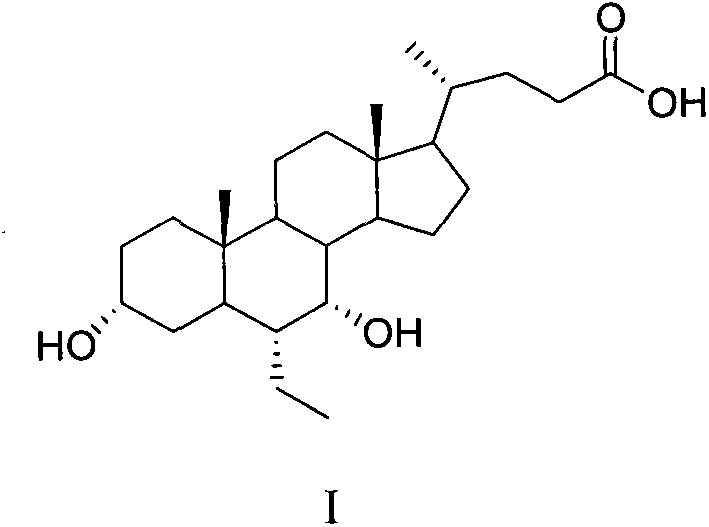
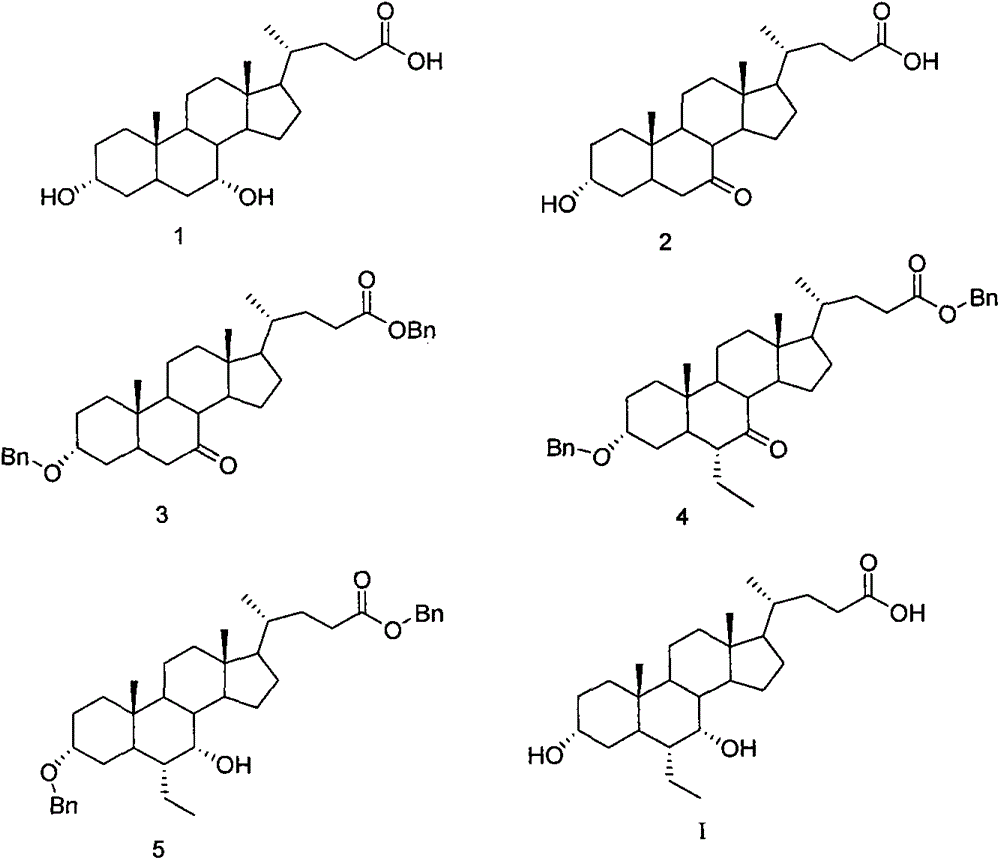
The invention relates to a preparing method of a chenodeoxycholic acid derivative, and particularly relates to a preparing method of a compound shown as a formula I. The method includes (1) subjecting a compound shown as a formula 1 to Swern oxidation to obtain a compound shown as a formula 2; (2) subjecting the compound shown as the formula 2 to hydroxy protection to obtain a compound shown as a formula 3; (3) bringing the compound shown as the formula 3 into contact with iodoethane to obtain a compound shown as a formula 4; (4) subjecting the compound shown as the formula 4 to a reduction reaction to obtain a compound shown as a formula 5; and (5) bringing the compound shown as the formula 5 into contact with hydrogen under the existence of palladium / carbon that is a catalyst to obtain the compound shown as the formula I. The method is short in steps, simple in operation, and suitable for industrial production, and raw materials are easily available.
Description
technical field [0001] The invention belongs to the field of medicine, in particular to a preparation method of a compound, more specifically, to a preparation method of a chenodeoxycholic acid derivative (6ECDCA). Background technique [0002] 6ECDCA (alias 6α-ethyl chenodeoxycholic acid, INT-747, obeticholic acid, compound shown in formula I) is a derivative of chenodeoxycholic acid (CDCA). Chenodeoxycholic acid is a common gallstone drug in clinic, and 6ECDCA has been proved to be a highly active farnesoid X receptoragonist. On January 9, 2014, Intercept Pharmaceuticals announced that the Phase III clinical trial of 6ECDCA in the treatment of nonalcoholic steatohepatitis (NASH) reached the primary clinical endpoint. In addition, Intercept's research on the treatment of primary biliary cirrhosis with 6ECDCA is currently in phase III clinical trials in the United States. [0003] [0004] Donna Yu et al. (Steroids, 2012, 77(13): 1335-1338) disclosed that chenodeoxycho...
Claims
the structure of the environmentally friendly knitted fabric provided by the present invention; figure 2 Flow chart of the yarn wrapping machine for environmentally friendly knitted fabrics and storage devices; image 3 Is the parameter map of the yarn covering machine
Login to View More
Application Information
Patent Timeline
Application Date:The date an application was filed.
Publication Date:The date a patent or application was officially published.
First Publication Date:The earliest publication date of a patent with the same application number.
Issue Date:Publication date of the patent grant document.
PCT Entry Date:The Entry date of PCT National Phase.
Estimated Expiry Date:The statutory expiry date of a patent right according to the Patent Law, and it is the longest term of protection that the patent right can achieve without the termination of the patent right due to other reasons(Term extension factor has been taken into account ).
Invalid Date:Actual expiry date is based on effective date or publication date of legal transaction data of invalid patent.


 Login to View More
  Login to View More