TC4 titanium alloy plate machining method

A processing method and technology for titanium alloy plates, applied in the field of metal material processing, can solve problems such as product quality decline, and achieve the effects of good weldability, good corrosion resistance and good thermoplasticity

CN105032973AInactive Publication Date: 2015-11-11BAOJI CITY FUYUANTONG IND & TRADE
6 Cites 4 Cited by

Patent Information

Authority / Receiving Office
CN · China
Current Assignee / Owner
Publication Date
2015-11-11
Estimated Expiration
Not applicable · inactive patent

Smart Images

  • Figure 1
    Figure 1
Patent Text Reader

Abstract

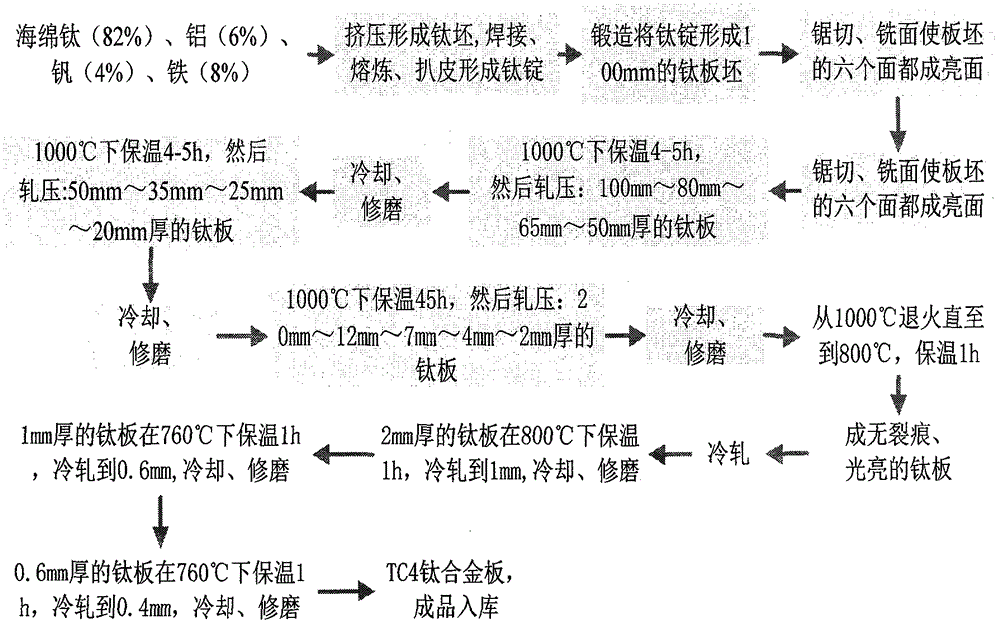
The invention discloses a TC4 titanium alloy plate machining method. The method includes the following steps that firstly, sponge titanium, aluminum powder, vanadium powder and iron powder are mixed according to the mass percent and extruded to form titanium blank, and then the titanium blank is welded, smelted and scalped to form a titanium ingot; secondly, cogging and forging are carried out on the titanium ingot to form a titanium slab, and then a smooth titanium slab with the thickness being smaller than or equal to 100 mm is formed through sawing and milling; thirdly, the smooth titanium slab is hot-rolled and ground at least three times after hot rolling to form a titanium plate with the thickness being smaller than or equal to 2 mm, annealing is conducted at the temperature of 800 DEG C, and heat is preserved for 0.8-1.2 hours to form a smooth titanium plate without cracks; and fourthly, cold rolling is conducted, and the smooth titanium plate is cold-rolled into the titanium plate with the thickness being smaller than or equal to 0.4 mm under at least three times of different annealing temperature conditions. The method reduces oxide skin formed during heating, has the advantages of being good in corrosion resistance, small in density, high in specific strength and good in toughness and welding performance, and is widely used in aerospace, petrifaction, shipbuilding and the automobile industry.
Need to check novelty before this filing date? Find Prior Art

Description

technical field

[0001] The invention belongs to the technical field of metal material processing, relates to titanium alloy processing, in particular to a TC 4 Alloy plate processing method. Background technique

[0002] People take advantage of the high strength and strong corrosion resistance of titanium plates to use titanium plates in heat exchanger components, camera bodies, kitchen equipment and other civilian products, motorcycles, automobiles and other transportation machinery components, and home appliances and other exterior materials. With the improvement of people's quality of life, plate heat exchangers with high heat exchange efficiency are becoming more and more widely used. However, if high heat exchange efficiency is to be satisfied, it must be processed into a corrugated shape by extrusion to increase the surface area. Therefore, the processing of titanium plates into components of various products has higher requirements for their formability and cleanin...

Examples

Embodiment Construction

[0017] The present invention will be described in detail below in combination with specific embodiments.

[0018] A TC 4 The processing method of titanium alloy plate includes the following steps: the first step is to mix titanium sponge, aluminum powder, vanadium powder and iron powder according to a certain proportion, extrude to form a titanium billet, and then weld, smelt and peel the titanium billet to form a titanium ingot ;The second step is to open the titanium ingot and forge it to form a thickness of 100mm, and then go through sawing and milling to form a bright titanium slab; the third step is hot rolling, and finally make it into a 2mm thick titanium slab after three times of grinding , and then annealed at 800°C, and held for 1 hour to form a crack-free, bright titanium plate; the fourth step is cold rolling, and the titanium plate is cold-rolled to a thickness of 0.4mm at three different annealing temperatures.

[0019] According to the mass percentage ratio, th...