Method for synthesizing lithium ion battery high-potential positive electrode material
A technology for lithium ion batteries and cathode materials, applied in the field of materials, can solve problems such as poor rate performance, many oxygen vacancies, and many impurities, and achieve the effects of good reproducibility and convenient operation
- Summary
- Abstract
- Description
- Claims
- Application Information
AI Technical Summary
Problems solved by technology
Method used
Image

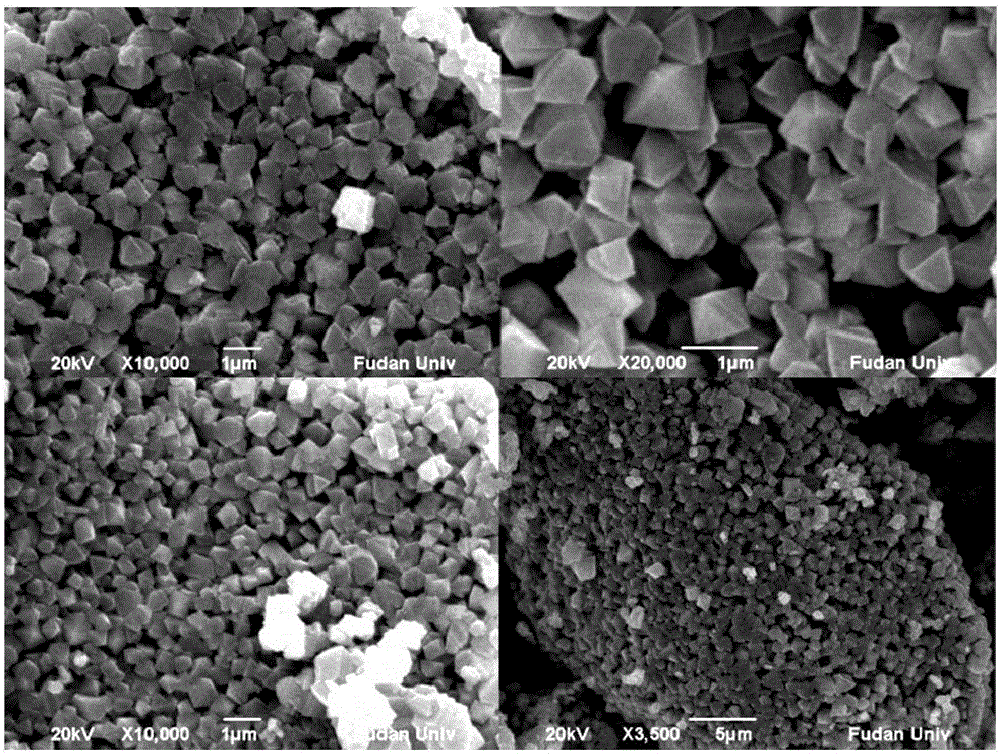


Examples
preparation example Construction
[0026] A method for synthesizing a high-potential cathode material for a lithium-ion battery according to an embodiment of the present invention, the specific steps are:
[0027] Step 1, prepare nickel manganese oxide Ni 0.5 mn 1.5 o x ,include:
[0028] Step 1.1, nickel acetate, manganese acetate and citric acid are fully dissolved in water, the total amount of nickel acetate and manganese acetate is the same as that of citric acid, stir, adjust the pH to 7-8 with ammonia water, evaporate to dryness, and obtain xerogel, in vacuum Bake in an oven at 100-120°C for 10-12 hours;
[0029] Step 1.2, calcining the xerogel in the air at 450-500°C to obtain nickel manganese oxide Ni 0.5 mn 1.5 o x .
[0030] Step 2, nickel manganese oxide Ni 0.5 mn 1.5 o x , potassium chloride molten salt and lithium hydroxide mixed, nickel manganese oxide Ni 0.5 mn 1.5 o x The molar ratio with potassium chloride is 1:0.5~4, nickel manganese oxide Ni 0.5 mn 1.5 o x The molar ratio to l...
Embodiment 1
[0037]Weigh 0.05 mol of nickel acetate and 0.15 mol of manganese acetate, ultrasonically disperse them in water for 10 minutes, then add an aqueous solution containing 0.2 mol of citric acid, and adjust the pH to 7-8 with ammonia water. Under constant stirring at 80°C, the solution gradually turned into a green gel. The obtained gel was dried in a vacuum oven at 120° C. for 12 hours.
[0038] The above dry gel was calcined at 500° C. for 4 hours to obtain a nickel manganese oxide precursor. The precursor was mixed with 0.4mol potassium chloride and 0.1mol lithium hydroxide, ground evenly, and pre-calcined at 800°C for 30 minutes in oxygen. Keeping the oxygen flow rate, the temperature was raised to 900°C for 12 hours of calcination.
[0039] After natural cooling, take out the sample, filter the sample under distilled water cleaning, until the filtrate is tested by 0.1mol / L silver nitrate solution and no white precipitate appears, and then do ICP test on the sample to detect...
PUM
 Login to View More
 Abstract
Description
Claims
Application Information
 Login to View More