

A method of loading carbon nanotubes on the surface of carbon fiber
A carbon nanotube and carbon fiber technology, which is applied to the field of carbon nanotubes on the surface of carbon fibers, can solve the problems of insufficient grafting efficiency of carbon nanotubes, failure to reflect the advantages of large-scale production, and difficulty in large-scale production. The effect of obvious efficiency, low cost and easy industrial production
- Summary
- Abstract
- Description
- Claims
- Application Information
AI Technical Summary
Problems solved by technology
Method used
Image

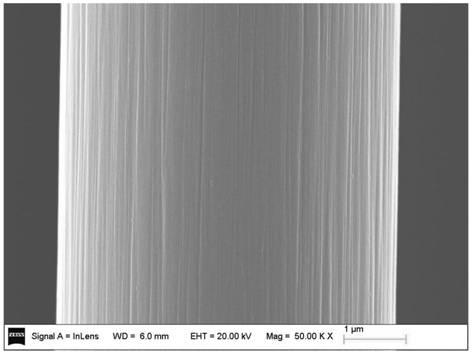
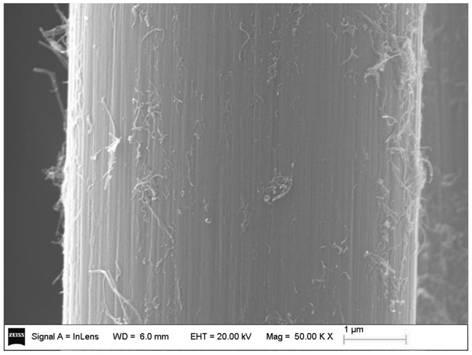
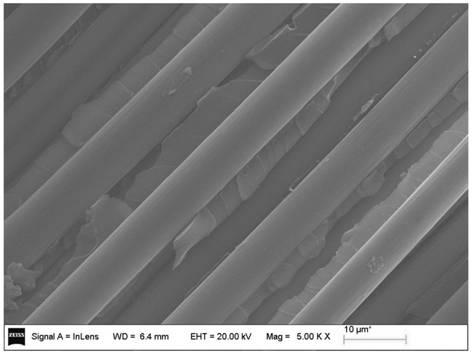
Examples
Embodiment 1
[0027] Set up a washing tank in the washing section of the carbon fiber tow. The washing tank contains a solution of aminated carbon nanotubes. The diameter of the carbon nanotubes is 10nm to 20nm, and the length is ≤5μm. It is ultrasonically dispersed in deionized water to make a concentration of 0.05wt. .% solution; a carbon nanotube dust chamber is set between the sizing and drying sections of the carbon fiber tow, the air velocity in the dust chamber is 2m / s, and the feeding speed is 0.001g / min. After the production process conditions are set, a carbon fiber product with carbon nanotubes loaded on the surface is obtained in a continuous production process.
[0028] Prepare epoxy resin-based composite material with this carbon fiber product, carbon fiber volume content is controlled at 65%, and the composite material interlaminar shear strength that obtains reaches 94MPa, and in the split surface of composite material, a large amount of resin ( Figure 4 ), indicating that ...
Embodiment 2
[0030] Set up a washing tank in the washing section of the carbon fiber tow. The washing tank contains an aminated carbon nanotube solution with a diameter of 10nm-20nm and a length of ≤5μm, which is ultrasonically dispersed in deionized water to make a concentration of 0.03wt. .% solution; a carbon nanotube dust chamber is set between the sizing and drying sections of the carbon fiber tow, the air velocity in the dust chamber is 1.5m / s, and the feeding speed is 0.001g / min. After the production process conditions are set, a carbon fiber product with carbon nanotubes loaded on the surface is obtained in a continuous production process.
[0031] The carbon fiber product is used to prepare an epoxy resin-based composite material, and the carbon fiber volume content is controlled at 70%, and the interlaminar shear strength of the obtained composite material reaches 97MPa; the interlaminar shear strength of the carbon fiber epoxy resin-based composite material without carbon nanotub...
Embodiment 3
[0033] Set up a washing tank in the washing section of the carbon fiber tow. The washing tank contains a solution of carboxylated carbon nanotubes. The diameter of the carbon nanotubes is 10nm-20nm and the length is ≤5μm. It is ultrasonically dispersed in deionized water to make a concentration of 0.05wt. % solution; a carbon nanotube dust chamber A is set between the sizing and drying sections of the carbon fiber tow, the air velocity in the dust chamber A is 2.5m / s, and the feeding speed is 0.002g / min. After the production process conditions are set, a carbon fiber product with carbon nanotubes loaded on the surface is obtained in a continuous production process.
[0034] The carbon fiber product is used to prepare epoxy resin-based composite materials, the carbon fiber volume content is controlled at 60%, and the interlaminar shear strength of the obtained composite material reaches 89MPa; Cut to 79MPa.
PUM
| Property | Measurement | Unit |
|---|---|---|
| diameter | aaaaa | aaaaa |
| length | aaaaa | aaaaa |
| diameter | aaaaa | aaaaa |
Abstract
Description
Claims
Application Information
 Login to View More