
Process for improving structure and property uniformity of manganin sintered damping alloy
A damping alloy and uniformity technology is applied in the field of atmospheric sintered porous structure manganese-copper high damping alloys, which can solve the problems of residual oxygen embrittlement in the alloy and achieve good uniformity.
- Summary
- Abstract
- Description
- Claims
- Application Information
AI Technical Summary
Problems solved by technology
Method used
Image

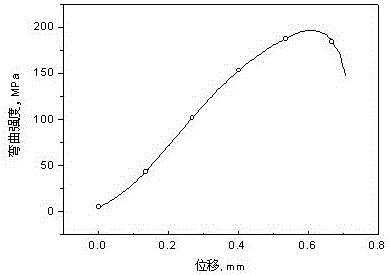
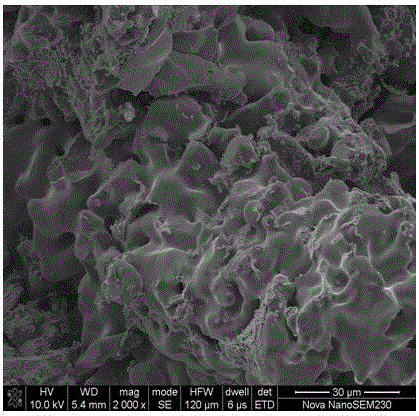
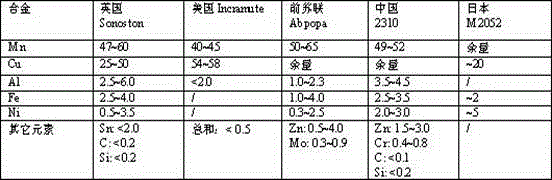
Examples
Embodiment 1
[0033] Manganese, copper, nickel, aluminum, tin, carbon, silicon and other powders and copper oxalate are batched according to the ingredients in Example 1 of Table 2. Place the prepared powder in a ball mill tank for dry milling, and the ball milling time is about 2 hours until the powder is uniform.
[0034] Table 2 Composition range (mass percentage) of the manganin-copper damping alloy of the embodiment
[0035] alloy element Example 1 Example 2 Example 3 Example 4 Example 5 Example 6 Example 7 Example 8 Example 9 mn 59.3 47.2 60 52 52 75 76.6 40 45 Cu 30 35 35.4 34.9 35.0 17.2 13 56 49 Cu* 3 4 0.5 1.0 0.7 0.8 4.0 2.0 5.0 Al 3.0 6.0 2.0 1.0 4.0 / / 2.0 1.0 Fe 2.4 3.2 1.0 4.0 3.0 2 1.8 / / Ni 0.8 3.2 0.3 2.2 2.5 5 4.6 / / sn 0.18 1.2 / / / / / / / Cr / / / / 0.6 / / / / Mo / / 0.2 0.9 / / / / / Zn / / 0.6 4.0 2.0 / ...
Embodiment 2
[0043] Powders such as manganese, copper, nickel, aluminum, tin, carbon, silicon and copper oxalate are batched according to the ingredients in Example 2 of Table 2. Put the prepared powder into a ball mill tank for dry milling, and the ball milling time is about 3 hours until the powder is uniform.
[0044] The mixed powder was pressed into a green compact under a pressure of 300 MPa using a circular die.
[0045] Pyrolysis, reduction and sintering under the protection of flowing dry hydrogen, the specific steps are 330°C for 4 hours; 600°C for 4 hours; 850°C for 4 hours; heating rate 5°C / min. With the cooling of the furnace, the sintered manganese copper is subjected to solid solution and aging treatment to obtain the product. The properties of the obtained sintered compacts are listed in Table 3.
Embodiment 3
[0047] Manganese, copper, nickel, aluminum, molybdenum, zinc powder and copper oxalate are batched according to the ingredients in Table 2 Example 3. Put the prepared powder into a ball mill tank for dry milling, and the ball milling time is about 0.5h until the powder is uniform.
[0048] The mixed powder was pressed into a compact under a pressure of 500 MPa using a circular pressing die.
[0049] Pyrolysis, reduction and sintering under the protection of flowing dry hydrogen, the specific steps are 400°C for 2 hours; 700°C for 2 hours; then 920°C for 2 hours, and the heating rate is 8°C / min. With the cooling of the furnace, the sintered manganese copper is subjected to solid solution and aging treatment to obtain the product. The properties of the obtained sintered compacts are listed in Table 3.
PUM
 Login to View More
 Abstract
Description
Claims
Application Information
 Login to View More