Method for producing M acid by catalytic hydrogenation method
A catalytic hydrogenation and catalyst technology, which is applied in chemical instruments and methods, physical/chemical process catalysts, metal/metal oxide/metal hydroxide catalysts, etc. Time and other issues, to achieve the effect of no three waste pollution, low cost and good product quality
- Summary
- Abstract
- Description
- Claims
- Application Information
AI Technical Summary
Problems solved by technology
Method used
Image

Examples
Embodiment 1
[0017] Taking 400 kg of 3,5-dinitro-2,4,6-trimethylbenzenesulfonic acid as an example, the catalyst used is a self-made catalyst loaded with precious metals, and the total amount of catalyst used in the production process is 0.1-5% of the raw material ( 0.4-20 kg), the total amount of water is 3-10 times of the raw material (1200-4000 kg), before hydrogenation, 3,5-dinitro-2,4,6-trimethylbenzenesulfonic acid, water and The order in which the catalyst is put into the kettle is as follows:
[0018] 1. Put 400 kg of 3,5-dinitro-2,4,6-trimethylbenzenesulfonic acid and 1200-4000 kg of water into the reaction kettle, and add sodium hydroxide, potassium hydroxide, potassium carbonate or sodium carbonate etc., adjust the pH value of the reaction solution to 7-8, and replace the gas.
[0019] 2. Introduce hydrogen to start the hydrogenation reaction, control the reaction temperature to 50-100°C, and control the reaction pressure to 0.3-1.0Mpa.
[0020] 3, the reaction finishes filter...
Embodiment 2
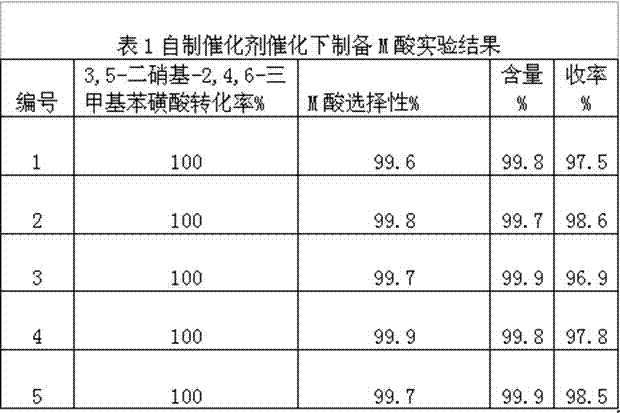
[0023] Taking 400 kilograms of 3,5-dinitro-2,4,6-trimethylbenzenesulfonic acid to produce M acid as an example, the catalyst used in the production process is a self-made catalyst loaded with precious metals, and the dosage is 3,5-di Nitro-2,4,6-trimethylbenzenesulfonic acid 0.1-5% (0.4-20 kg), the total amount of water is 3-10 times of the raw material (1200-4000 kg), in continuous production, 3, 5-Dinitro-2,4,6-trimethylbenzenesulfonic acid, water and catalyst were added in the order of (1). In order to investigate the stability of the process, five consecutive experiments were carried out. The results are shown in Table 1 as follows :
[0024]
[0025] Reaction conditions: temperature 50-100°C, pressure 0.3-1.0Mpa, ph7-8.
[0026] As seen from the table, 3,5-dinitro-2,4,6-trimethylbenzenesulfonic acid conversion rate is 100%, the selectivity of M acid is more than 99.5%, and the finished product content is more than 99.7%, and the yield The rate is above 97%.
Embodiment 3
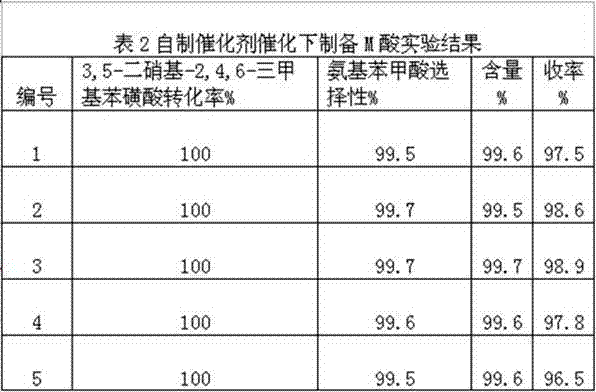
[0028] Taking 400 kg of 3,5-dinitro-2,4,6-trimethylbenzenesulfonic acid to produce M acid as an example, the catalyst used in the production process is a self-made catalyst loaded with precious metals, and the dosage is 3,5-dinitro- 0.1-5% (0.4-10 kg) of 2,4,6-trimethylbenzenesulfonic acid, the total amount of water is 3-10 times (1200-4000 kg) of the raw material, in continuous production, according to Example 1 The production process reacts, and the difference is that the catalyst is recycled. After the reaction in each kettle is completed, after the catalyst is filtered by pressure, the catalyst is blown back into the reaction kettle, and 0.1-1.0 kg of catalyst is added, and the catalyst is recycled. After the catalyst started to be used mechanically, the amount of new catalyst added was greatly reduced, only 5%-25% of the original, which greatly reduced the cost. After mass production experiments, this catalyst can be used continuously for more than ten times.
[0029] In...
PUM
 Login to View More
 Abstract
Description
Claims
Application Information
 Login to View More
 - R&D
- Intellectual Property
- Life Sciences
- Materials
- Tech Scout
- Unparalleled Data Quality
- Higher Quality Content
- 60% Fewer Hallucinations
Browse by: Latest US Patents, China's latest patents, Technical Efficacy Thesaurus, Application Domain, Technology Topic, Popular Technical Reports.
© 2025 PatSnap. All rights reserved.Legal|Privacy policy|Modern Slavery Act Transparency Statement|Sitemap|About US| Contact US: help@patsnap.com