
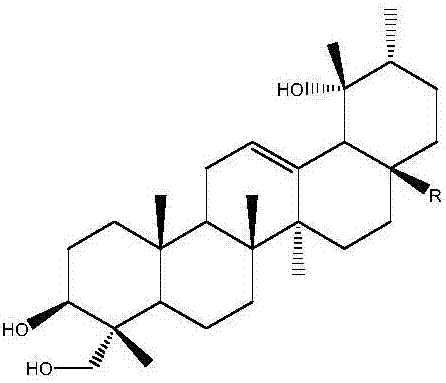
Applications of rotundic acid in preparation of anti-influenza virus drugs
A kind of anti-influenza virus, influenza virus technology, applied in the field of anti-influenza acid to achieve the effect of reducing lung index
- Summary
- Abstract
- Description
- Claims
- Application Information
AI Technical Summary
Problems solved by technology
Method used
Image

Examples
Embodiment 1
[0012] The preparation of embodiment 1 rescue must be medicinal material extract
[0013] Get an appropriate amount of Bing medicinal materials, crush them, pass through a No. 1 sieve, add 8 times the amount of 70% (volume fraction) ethanol to the medicinal materials, heat and reflux for extraction twice, each time for 1 hour, filter, combine the extracts, put them in a rotary evaporator, Concentrate under reduced pressure at 80°C to a thick paste. Transfer the concentrated liquid to a decompression drying oven, continue drying and crushing at 80°C, and obtain the extract of the rescued Bing medicinal material.
Embodiment 2
[0014] Example 2 In vitro Influenza Virus Inhibition Experiment
[0015] 1. Experimental materials
[0016] 1.1 The drug under test: basic acid (extracted from basic acid, purity > 98%).
[0017] 1.2 Control drug: ribavirin, oleanolic acid, extract of the medicinal material of Qubing (see Example 1)
[0018] 1.3 Virus strain: Influenza A H1N1 influenza virus murine lung adaptation strain (FM / 1 / 47 strain). Passage chicken embryos, test in BSL-3 (Biosafety Laboratory Level 3), subpackage, and store at -80°C.
[0019] 1.4 Cell model: dog kidney cell MDCK cell
[0020] The above drugs were fully dissolved in dimethyl sulfoxide (DMSO) and stored at -20°C for later use.
[0021] 2. Experimental method
[0022] 2.1 Determination of virus virulence
[0023] MDCK cells were divided into 5 × 10 4 Inoculate a 96-well culture plate at a concentration of / mL, 100 μl per well, 37°C, 5% CO 2 Culture to form a confluent monolayer of cells. 100 μl of 10-fold serial dilution of the vir...
Embodiment 3
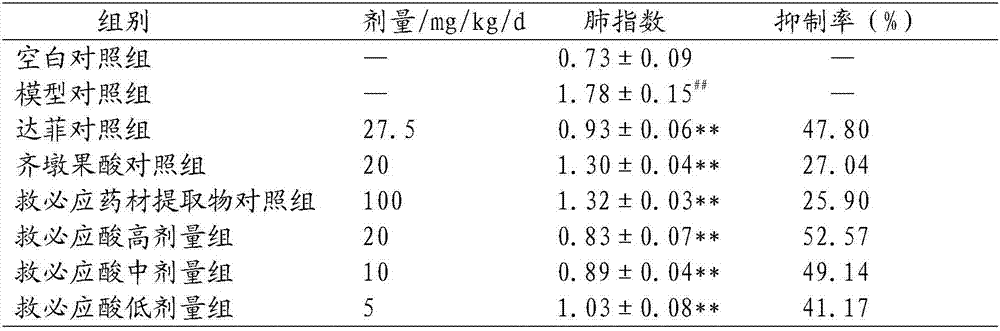
[0032] Example 3 In vivo Influenza Suppression Experiment
[0033] 1. Experimental materials
[0034] 1.1 The drug under test: basic acid (extracted from basic acid, purity > 98%).
[0035] 1.2 Control drug: Tamiflu, oleanolic acid, extract of the medicinal material of Qubing (see Example 1)
[0036] 1.3 Virus: Mouse lung-adapted strain of influenza A H1N1 virus (FM / 1 / 47 strain). Passage chicken embryos, test in BSL-3 (Biosafety Laboratory Level 3), subpackage, and store at -80°C.
[0037] 2. Experimental animals
[0038] 80 BALB / c mice weighing 18g-22g were purchased from Guangdong Experimental Animal Center.
[0039] 3. Experimental method
[0040] The BALB / c mice were randomly divided into 8 groups, namely, the blank control group, the model control group, the Tamiflu control group, the oleanolic acid group, the medicinal material extract group of BALB, and the high, medium and low levels of BALB. 3 dosage groups, 10 rats in each group. Except for the blank control g...
PUM
 Login to View More
 Abstract
Description
Claims
Application Information
 Login to View More