
Preparation method of titanium phosphate/germanium-aluminum-lithium solid electrolyte
A technology of solid electrolyte and titanium phosphate, applied in the direction of solid electrolyte, non-aqueous electrolyte, chemical instruments and methods, etc., can solve the problems of unfavorable industrial production, materials are easy to contain impurities, high heat treatment temperature, etc., and achieve convenient industrial production, ion conductivity The effect of high efficiency and stable product quality
Patent Information
- Authority / Receiving Office
- CN · China
- Current Assignee / Owner
- Publication Date
- 2017-10-20
- Estimated Expiration
- Not applicable · inactive patent
Smart Images
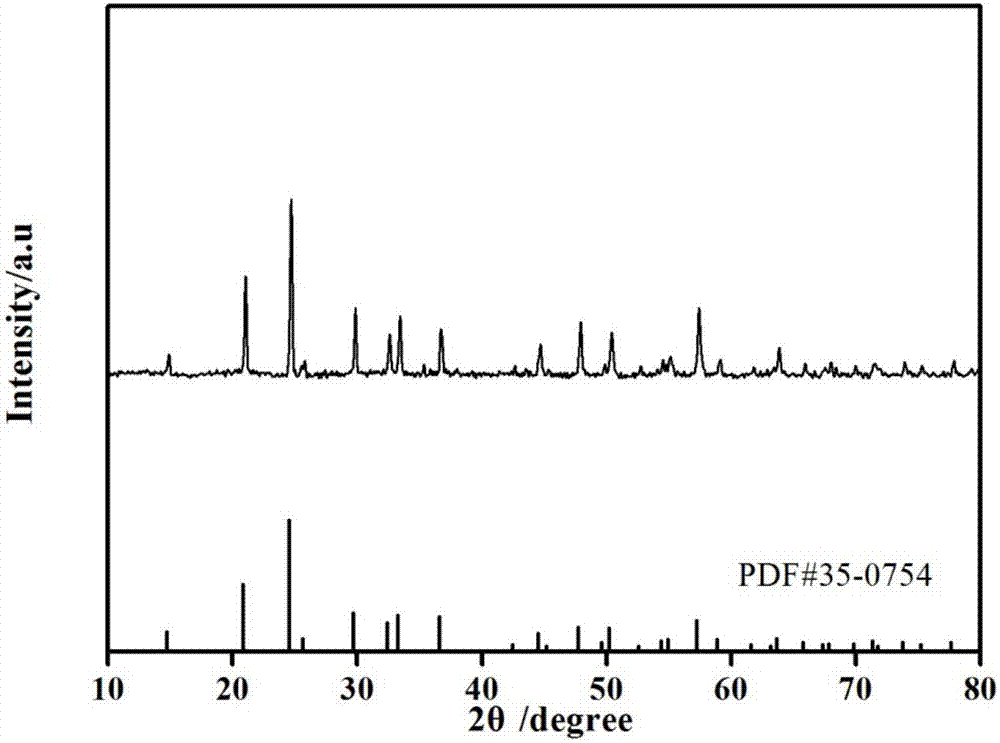
Figure 1 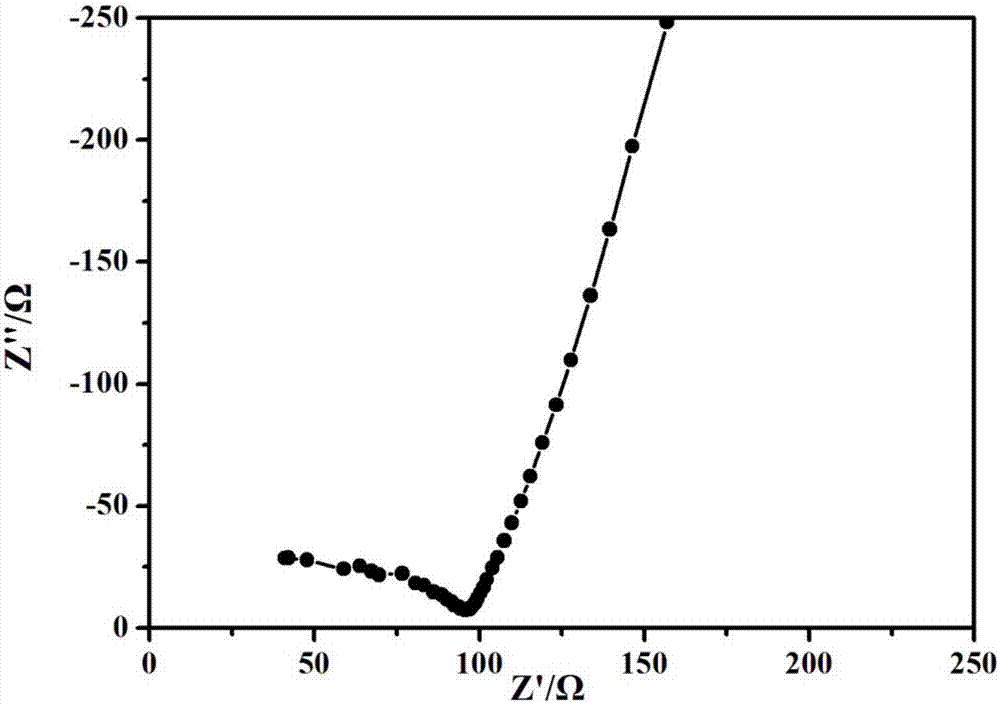
Figure 2
Abstract
Description
technical field
[0001] The invention belongs to the technical field of solid electrolytes, in particular to a preparation method of a titanium phosphate / germanium aluminum lithium type solid electrolyte. Background technique
[0002] Lithium-ion batteries have been developed rapidly due to their light weight, high energy density and long cycle life, and are widely used in electronic products, energy storage, automobiles and other fields. However, most traditional lithium-ion batteries use organic solvents as electrolytes, which have potential safety hazards such as leakage and flammability, which limit their large-scale application. Therefore, it is a fundamental solution to find all-solid electrolytes to replace organic electrolytes.
[0003] In the past two decades, several solid electrolytes such as NASICON-type Li 1+x al x m 2-x (PO 4 ) 3 (M=Ti,Ge), perovskite Li 3x La 2 / 3-x TiO 3 , sulfide, garnet-type Li 7 La 3 Zr 2 o 12 have received widespread attention. ...
Examples
Embodiment 1
[0033] A kind of Li 1+x al x m 2-x (PO 4 ) 3 The preparation method of the solid electrolyte adopts the molten salt assisted solid phase method, and utilizes the molten salt to become a molten state to provide a liquid environment, which is conducive to the full mixing of the precursors and obtaining Li 1+x al x m 2-x (PO 4 ) 3 x=0-0.7, M=Ti, Ge type solid electrolyte material.
[0034] Specific preparation process:
[0035] Lithium nitrate (LiNO 3 ), aluminum oxide (Al 2 o 3 ), titanium dioxide (TiO 2 ), ammonium dihydrogen phosphate (NH 4 h 2 PO4 ) and molten salt urea (CH 4 N 2 O) Prepare according to the mole fraction ratio of 1.3:0.15:1.7:3:3.
[0036] Put the above materials in a corundum crucible and mix them evenly. Put the powder mixture into a muffle furnace, keep the temperature at 150°C for 3h, then raise the temperature to 700°C for 4h. The obtained powder was put into a high-energy ball mill jar, and ball milled at 150r / min for 2h. The powder ...
Embodiment 2
[0038] A kind of Li 1+x Al x m 2-x (PO 4 ) 3 The preparation method of the solid electrolyte adopts the molten salt assisted solid phase method, and utilizes the molten salt to become a molten state to provide a liquid environment, which is conducive to the full mixing of the precursors and obtaining Li 1+x Al x m 2-x (PO 4 ) 3 x=0-0.7, M=Ti, Ge type solid electrolyte material.
[0039] Specific preparation process:
[0040] Lithium nitrate (LiNO 3 ), aluminum oxide (Al 2 o 3 ), titanium dioxide (TiO 2 ), ammonium dihydrogen phosphate (NH 4 h 2 PO 4 ) and molten salt urea (CH 4 N 2 O) Prepare according to the mole fraction ratio of 1.3:0.15:1.7:3:6, and other process parameters are the same as in Example 1.
Embodiment 3
[0042] A kind of Li 1+x Al x m 2-x (PO 4 ) 3 The preparation method of the solid electrolyte adopts the molten salt assisted solid phase method, and utilizes the molten salt to become a molten state to provide a liquid environment, which is conducive to the full mixing of the precursors and obtaining Li 1+x al x m 2-x (PO 4 ) 3 x=0-0.7, M=Ti, Ge type solid electrolyte material.
[0043] Specific preparation process:
[0044] Lithium nitrate (LiNO 3 ), aluminum oxide (Al 2 o 3 ), titanium dioxide (TiO 2 ), ammonium dihydrogen phosphate (NH 4 h 2 PO 4 ) and molten salt urea (CH 4 N 2 O) Prepare according to the mole fraction ratio of 1.3:0.15:1.7:3:9, and other process parameters are the same as in Example 1.