
Method for preparing high polymer by dissolving fermentation bacteria residue in ionic liquid solvent system
An ionic liquid solvent, ionic liquid technology, applied in the preparation method of peptide, chemical instrument and method, production of bulk chemicals, etc., can solve the problems of low realization value and low utilization rate of organic matter of fermentation residue
- Summary
- Abstract
- Description
- Claims
- Application Information
AI Technical Summary
Problems solved by technology
Method used
Image

Examples
Embodiment 1
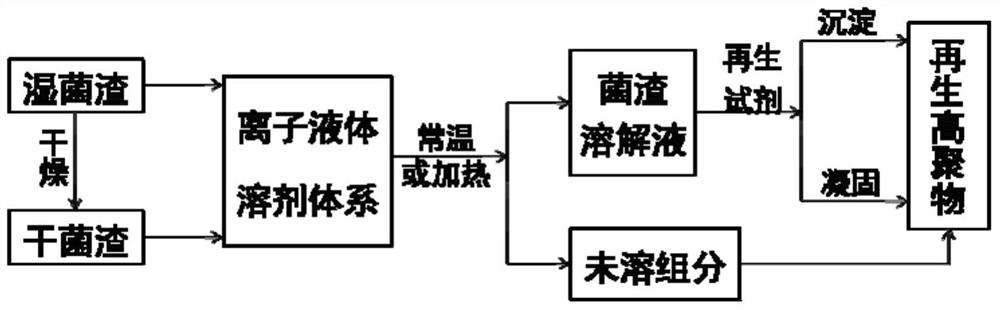
[0070] A method for preparing high polymers by dissolving fermentation scum in an ionic liquid solvent system, comprising the steps of:
[0071] (1) Take 20 g of wet penicillin fermented bacteria residue, mix it with a single ionic liquid system (1-butyl-3-methylimidazolium chloride salt) at a mass ratio of 1:0.01, and dissolve it at 10°C for 600 minutes to obtain a solution of bacteria residue and undissolved components;
[0072] (2) The anhydrous salt solution and the bacterial residue solution are mixed evenly at a volume ratio of 0.1:1, so that the solute is precipitated to obtain a regenerated polymer; the undissolved components are washed in the order of n-butanol-water-n-butanol to remove residual ions Liquid, after drying at 10°C, a uniform white polymer powder is obtained.
[0073] The extraction rate of the high polymer was 47.9%.
Embodiment 2
[0075] A method for preparing high polymers by dissolving fermentation scum in an ionic liquid solvent system, comprising the steps of:
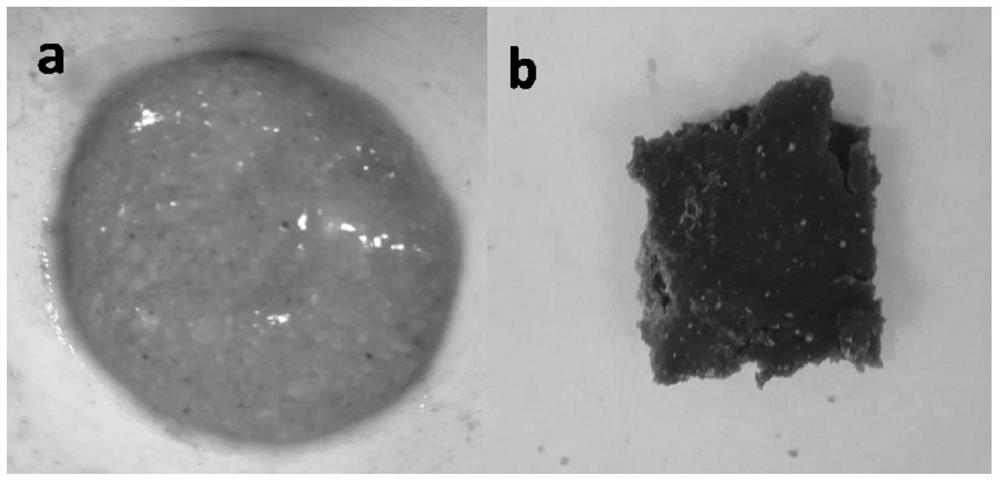
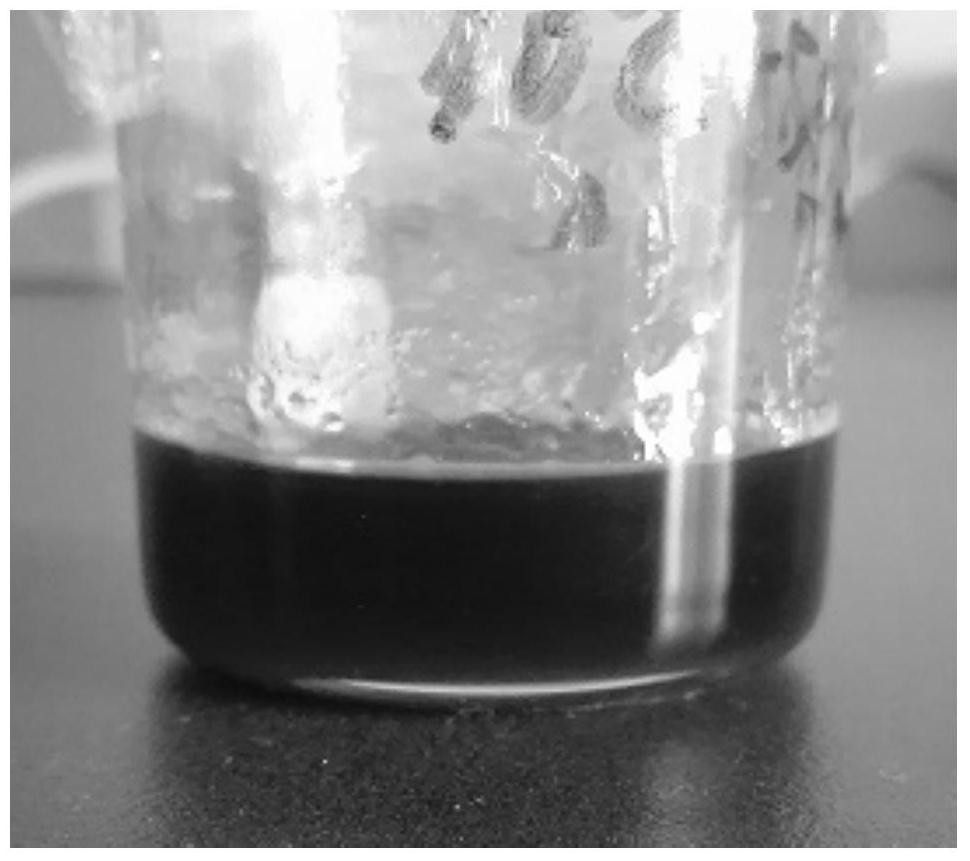
[0076] (1) Get wet penicillin fermentation slag (such as figure 2 Shown in a) 20g, after washing with 20mL municipal tap water, suction filtration, the bacterial residue that suction filtration obtains (such as figure 2 Shown in b) dried at 80°C to constant weight; the dried bacteria residue was mixed with a single ionic liquid system (1-butyl-3-methylimidazole acetate) at a mass ratio of 1:10, and dissolved at 90°C 720min to get the bacterium residue solution (such as image 3 shown);
[0077] (2) Methanol, water mixed solution and bacterial residue solution are mixed evenly at a volume ratio of 1:1 to precipitate the solute and obtain a regenerated polymer (such as Figure 4 shown).
[0078] The extraction rate of the high polymer was 48.0%.
Embodiment 3
[0080] A method for preparing high polymers by dissolving fermentation scum in an ionic liquid solvent system, comprising the steps of:
[0081] (1) Take 20 g of wet penicillin fermented bacteria residue, wash with 20 mL of anhydrous salt water and then suction filter, and dry the bacteria residue obtained by suction filtration to constant weight at 160 ° C; dry bacteria residue and single ionic liquid system (choline acetate) Mix at a mass ratio of 1:0.5, and dissolve at 90°C for 600 minutes to obtain a solution of fungus residue;
[0082] (2) Methanol and bacterial residue solution are mixed evenly at a volume ratio of 2:1 to precipitate the solute to obtain a regenerated polymer; the undissolved components are washed in the order of n-butanol-water-n-butanol to remove residual ionic liquid , and dried at 30°C to obtain a white polymer powder (such as Figure 6 shown).
[0083] The extraction rate of the high polymer was 48.1%.
PUM
 Login to View More
 Abstract
Description
Claims
Application Information
 Login to View More