Check patentability & draft patents in minutes with Patsnap Eureka AI!

Hydrosilylation reaction using recyclable platinum compound as catalyst

A technology of hydrosilylation reaction and platinum compound is applied in the field of highly selective bis[platinum dichloride] as a catalyst, which can solve the problem that the catalytic system is difficult to separate and recycle, it is difficult to apply to industrialization, and the catalytic reaction activity is not high. High-level problems, to achieve the effect of high selectivity, high conversion rate, and simple product separation operation

Active Publication Date: 2018-03-30
浙江欣世辰新材料有限公司
View PDF2 Cites 2 Cited by
  • Summary
  • Abstract
  • Description
  • Claims
  • Application Information

AI Technical Summary

Problems solved by technology

But for certain types of hydrosilylation reactions, such as the hydrosilylation of olefins and alkoxysilanes, transition metals (Pt, Rh, etc.) are used as catalysts, and the catalytic activity is not high (Bogdan Marciniec, and Jacek Ski, J. Organomet. Chem., 1983, 253, 349-362)
At the same time, the above catalytic system is difficult to separate, recover and reuse from the reaction system
Chen Yuanyin et al. (Meng Lingzhi, Ke Aiqing, Chen Yuanyin, Applied Chemistry, 1997, 14, 1, 107-109; Liu Ying, Chen Yuanyin, Sheng Rongsheng, Molecular Catalysis, 1997, 11, 5, 394-400; Dai Yanfeng, Xiao Bin, Li Fengyi, Ru Xiang, Chemical Reagent, 2005, 27, 12, 707-709) studied the application of Pt on polymer compounds for hydrosilylation reactions, but the preparation of catalysts in this method is complicated and the reactivity is not high, so it is difficult to Difficult to apply to industrialization

Method used

the structure of the environmentally friendly knitted fabric provided by the present invention; figure 2 Flow chart of the yarn wrapping machine for environmentally friendly knitted fabrics and storage devices; image 3 Is the parameter map of the yarn covering machine
View more

Image

Smart Image Click on the blue labels to locate them in the text.
Viewing Examples
Smart Image
  • Hydrosilylation reaction using recyclable platinum compound as catalyst
  • Hydrosilylation reaction using recyclable platinum compound as catalyst
  • Hydrosilylation reaction using recyclable platinum compound as catalyst

Examples

Experimental program
Comparison scheme
Effect test

Embodiment 1

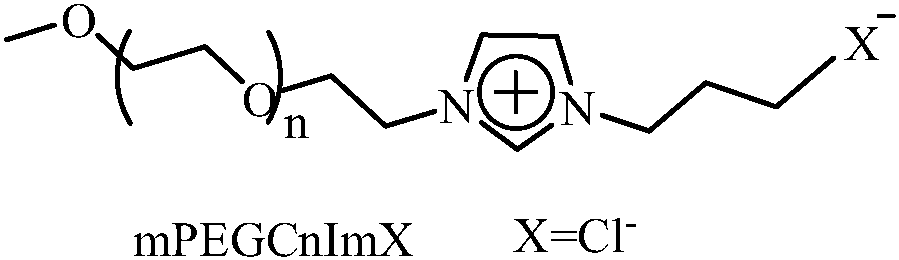
[0021] Catalyst 1 preparation: under the protection of argon, use a low-temperature constant temperature reactor, the reaction temperature is controlled at -78 ° C, and n-butyllithium ( n BuLi 3.0mmol, 15% n-hexane solution) was added dropwise to the CH of mPEG (350)MImCl (3.0mmol) 2 Cl 2 (20mL) solution (in advance with P 4 o 10 Dry CH 2 Cl 2 )middle. After the dropwise addition, continue to stir at -78°C for 45 minutes at the reaction temperature, and then use about 20 minutes to mix the Ph 2 PCl (3.0 mmol) was added dropwise to the previous reaction solution. After the dropwise addition was completed, stirring was continued for 20 minutes, the reaction temperature was slowly raised to room temperature, and the reaction was completed overnight after stirring. After the product was washed three times with deoxygenated water (3*10mL), the organic phase was washed with Na 2 SO 4 Drying, spin-drying solvent, obtain solid product quantitatively, in N 2 Under protection, ...

Embodiment 2

[0024] Catalyst 2 preparation: under the protection of argon, use a low temperature constant temperature reactor, the reaction temperature is controlled at -78 ° C, and n-butyllithium ( n BuLi 3.0mmol, 15% n-hexane solution) was added dropwise to the CH of mPEG (550)MImCl (3.0mmol) 2 Cl 2 (20mL) solution (in advance with P 4 o10 Dry CH 2 Cl 2 )middle. After the dropwise addition, continue to stir at -78°C for 45 minutes at the reaction temperature, and then use about 20 minutes to mix the Ph 2 PCl (3.0 mmol) was added dropwise to the previous reaction solution. After the dropwise addition was completed, stirring was continued for 20 minutes, the reaction temperature was slowly raised to room temperature, and the reaction was completed overnight after stirring. After the product was washed three times with deoxygenated water (3*10mL), the organic phase was washed with Na 2 SO 4 Drying, spin-drying solvent, obtain solid product quantitatively, in N 2 Under protection, in...

Embodiment 3

[0027] Catalyst 3 preparation: under the protection of argon, use a low-temperature constant temperature reactor, the reaction temperature is controlled at -78 ° C, and n-butyllithium ( n BuLi 3.0mmol, 15% n-hexane solution) was added dropwise to the CH of mPEG (750)MImCl (3.0mmol) 2 Cl 2 (20mL) solution (in advance with P 4 o 10 Dry CH 2 Cl 2 )middle. After the dropwise addition, continue to stir at -78°C for 45 minutes at the reaction temperature, and then use about 20 minutes to mix the Ph 2 PCl (3.0 mmol) was added dropwise to the previous reaction solution. After the dropwise addition was completed, stirring was continued for 20 minutes, the reaction temperature was slowly raised to room temperature, and the reaction was completed overnight after stirring. After the product was washed three times with deoxygenated water (3*10mL), the organic phase was washed with Na 2 SO 4 Drying, spin-drying solvent, obtain solid product quantitatively, in N 2 Under protection, ...

the structure of the environmentally friendly knitted fabric provided by the present invention; figure 2 Flow chart of the yarn wrapping machine for environmentally friendly knitted fabrics and storage devices; image 3 Is the parameter map of the yarn covering machine
Login to View More

PUM

No PUM Login to View More

Abstract

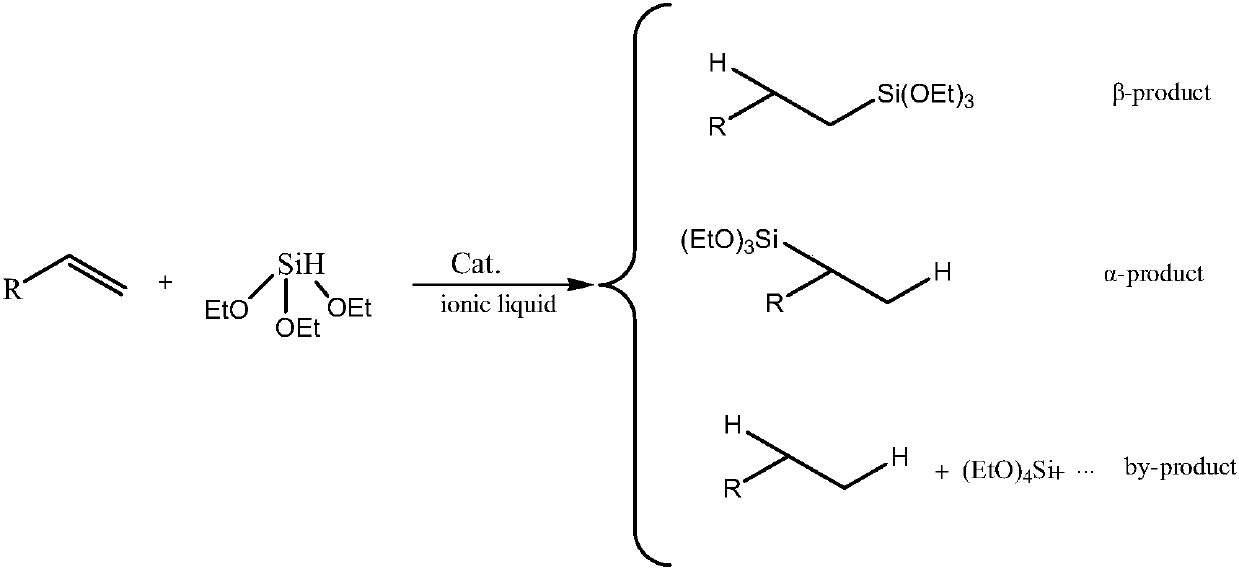
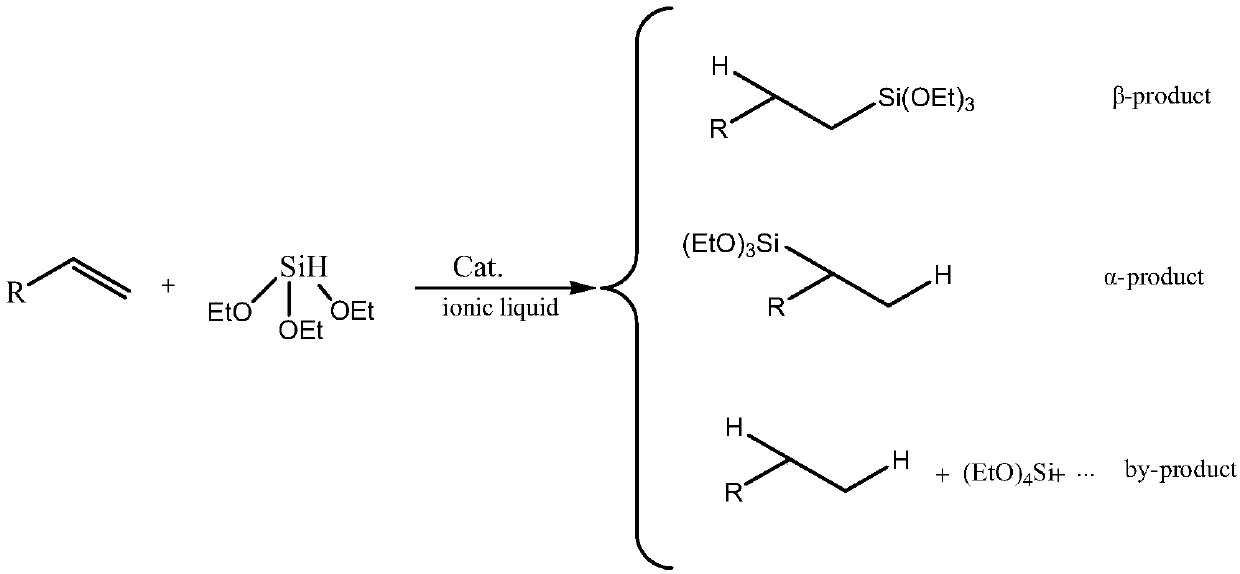
The present invention relates to the field of organic chemistry. In order to solve the problems existing in catalysts for a hydrosilylation reaction, the present invention provides a hydrosilylation reaction method. The method comprises the steps of using an olefin and triethoxysilane as raw materials and taking bis[(1-mPEG-3-alkyl-2-diphenylphosphinous imidazolium halide)platinum dichloride] as acatalyst, performing heating to 50-90 DEG C, performing a stirring reaction for 4-6 hours, performing filtration, performing vacuum distillation, and collecting fractions to obtain a hydrosilylationproduct. The reaction conditions of the method are mild and safe, the reaction conversion rate is high, the selectivity of a beta addition product is high, separation of the products and the catalystis convenient, and the catalyst can be recovered and reused.

Description

technical field [0001] The present invention relates to the field of organic chemistry, in particular to a preparation of highly selective bis[(1-mPEG-3- Alkyl-2-diphenylphosphinoimidazole halide) platinum dichloride] as a catalyst, the method of carrying out hydrosilylation reaction. Background technique [0002] Catalytic olefin hydrosilylation is one of the most important ways to synthesize functional organosilicon compounds and organosilicon coupling agents and polymers (Leslie D.Field, Antony J.Ward, J.Organomet.Chem, 2003, 681, 91 -97), occupies an important position in organosilicon chemistry, before the present invention, the most used in industry is chloroplatinic acid, Castel catalyst, although this catalytic system has higher activity, it is difficult to from the reaction system Separation and recovery in the medium, and the reaction cost is relatively high (Chisso Corp. JP., 8204995, 1982). Later, through the study of various transition metal complexes, it was ...

Claims

the structure of the environmentally friendly knitted fabric provided by the present invention; figure 2 Flow chart of the yarn wrapping machine for environmentally friendly knitted fabrics and storage devices; image 3 Is the parameter map of the yarn covering machine
Login to View More

Application Information

Patent Timeline
no application Login to View More
IPC IPC(8): C07F7/18C07F7/04B01J31/24
CPCB01J31/2404B01J2231/323B01J2531/828C07F7/04C07F7/1804C07F7/1876Y02P20/584
Inventor 厉嘉云彭家建白赢
Owner 浙江欣世辰新材料有限公司
Features
  • R&D
  • Intellectual Property
  • Life Sciences
  • Materials
  • Tech Scout
Why Patsnap Eureka
  • Unparalleled Data Quality
  • Higher Quality Content
  • 60% Fewer Hallucinations
Social media
Patsnap Eureka Blog
Learn More