Mercury ion detection method
A mercury ion, quantitative detection technology, applied in the field of mercury ion detection, can solve the problems of complex synthesis, insufficient selectivity, and insufficient response speed, and achieves the effects of simple synthesis, good stability, and favorable promotion and application.
- Summary
- Abstract
- Description
- Claims
- Application Information
AI Technical Summary
Problems solved by technology
Method used
Image


Examples
Embodiment 1
[0033]
[0034] (Scheme 1) The first step is to dissolve resorcinol and 4-ethylamino ketoacid in trifluoroacetic acid solution and heat to reflux for 24 hours, then add ethyl acetate to reflux for 15 minutes after rotary evaporation, and obtain a red solid by suction filtration. Dissolve 387mg (1mmol) of the product of the first step and 430.16mg (4mmol) of dimethylaminothioformyl chloride in dichloromethane, add DIPEA and stir at room temperature for 20h. Use the dichloromethane system for column chromatography to obtain 370mg of an orange solid , and the yield was 74%.
[0035] (Scheme 2) The first step is to dissolve resorcinol and 4-ethylamino ketoacid in trifluoroacetic acid solution and heat to reflux for 24 hours. After rotary evaporation, ethyl acetate is added to reflux for 15 minutes, and a red solid is obtained by suction filtration. Dissolve 387mg (1mmol) of the product of the first step and 645.24mg (6mmol) of dimethylaminothioformyl chloride in dichloromethane...
Embodiment 2
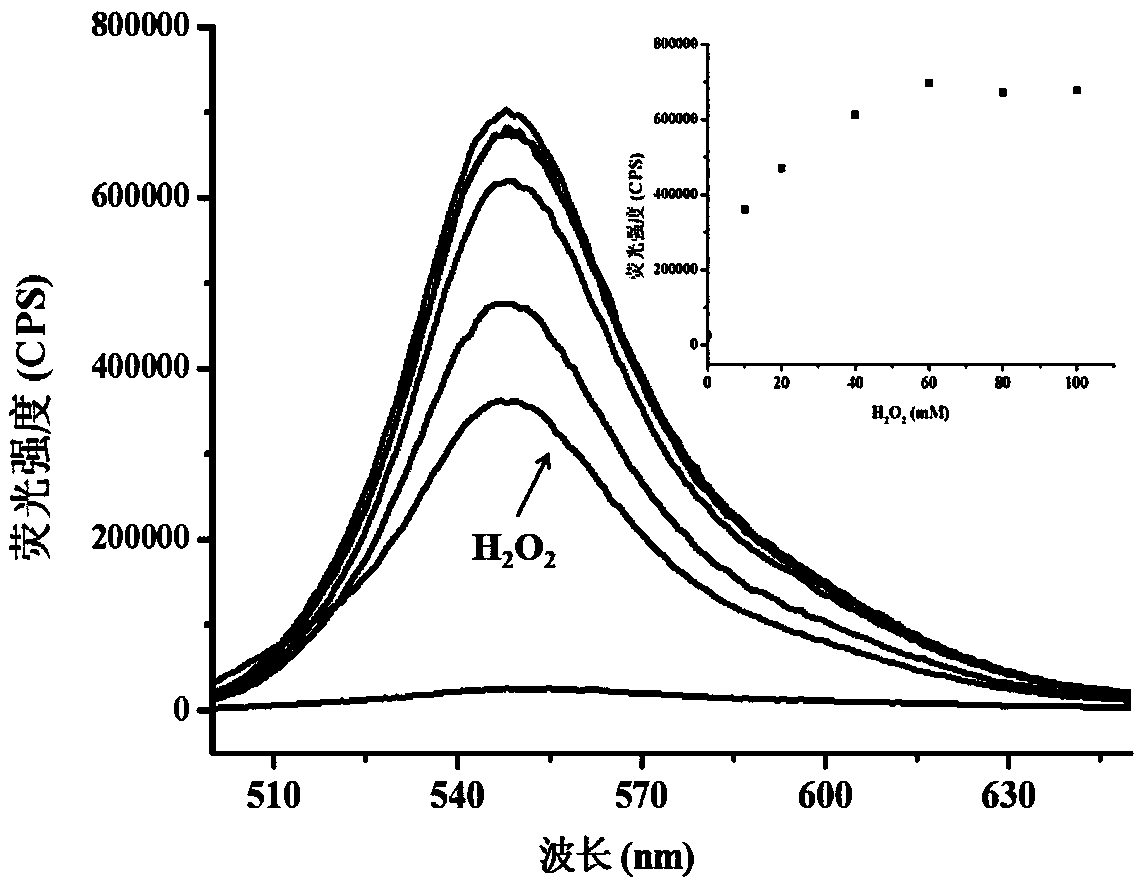
[0041] figure 1 is the probe (5μM) added with Hg 2+ (5μM) and H 2 o 2 (0,10,20,40,60,80,100mM) fluorescence spectrum. The above determinations were carried out in 5mM HEPES, pH 7.4 aqueous solution, the probe used was the probe prepared in Example 1, and all spectral tests were measured at 25°C. From the illustration, we can see that the fluorescence changes significantly after adding different concentrations of hydrogen peroxide in the presence of mercury ions. It shows that the probe has a good response to mercury ions under the catalysis of 60mM hydrogen peroxide.
Embodiment 3
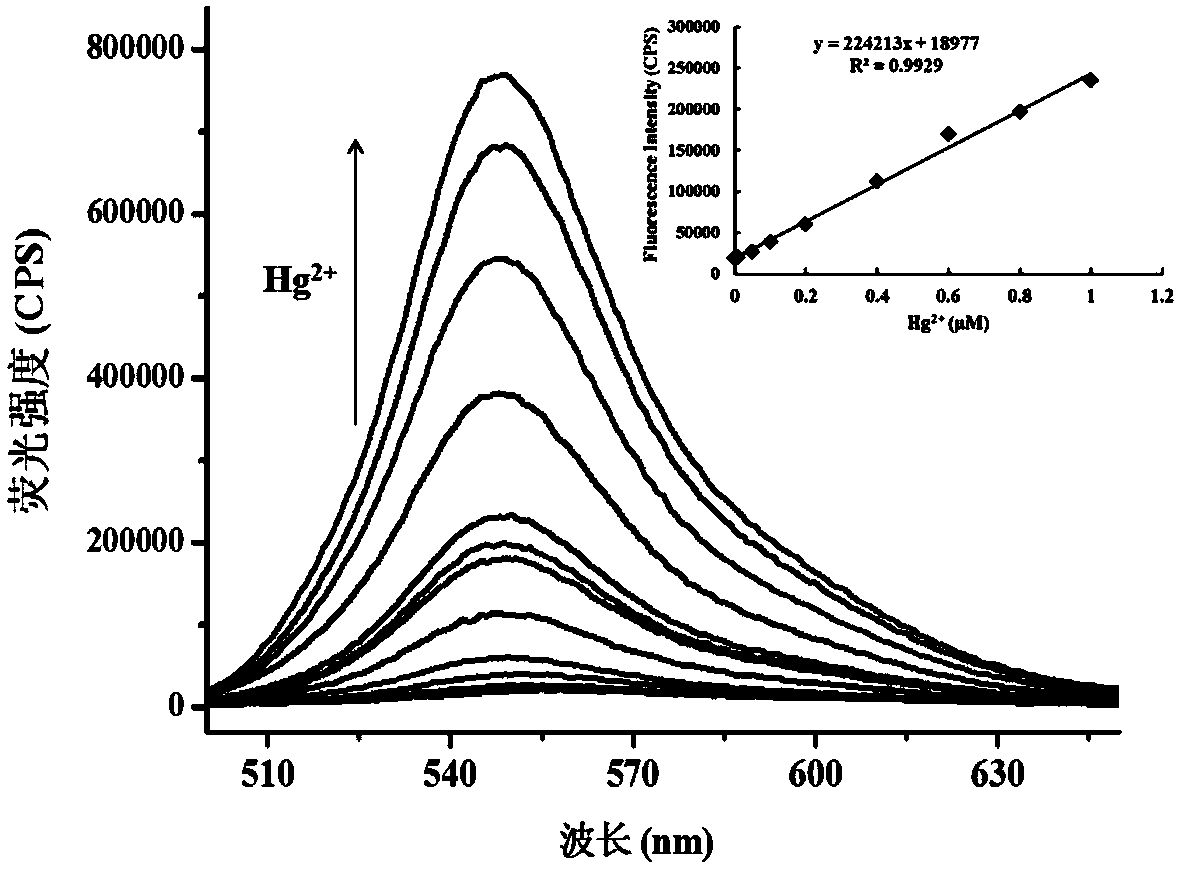
[0043] figure 2 is the probe (5μM) added with Hg 2+ (5μM) and H 2 o 2 (60mM) fluorescence spectrum.
[0044] From the illustration, we can see that the fluorescence signals of only adding mercury ions or hydrogen peroxide are basically unchanged, and only under the catalytic conditions of hydrogen peroxide, mercury ions have a very obvious response to the probe. It shows that the probe can detect mercury ions sensitively.
PUM
 Login to View More
 Abstract
Description
Claims
Application Information
 Login to View More