Primer probe composition for detecting BRAF gene mutation and application thereof
A primer probe and mutation detection technology, applied in the field of molecular biology, can solve the problems of difficult mutation detection, high detection cost, and long turnaround time, and achieve the effects of prolonging survival time, high sensitivity, and improving sensitivity
- Summary
- Abstract
- Description
- Claims
- Application Information
AI Technical Summary
Problems solved by technology
Method used
Image

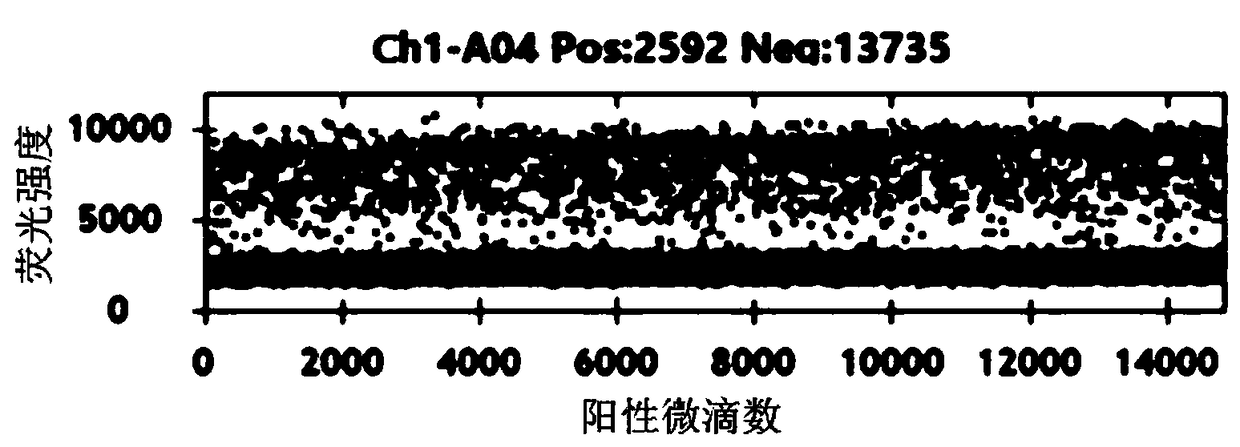


Examples
Embodiment 1
[0073] The assembly of embodiment 1 kit
[0074] The design of the primer probe combination, the specific sequence is shown in Table 1 below:
[0075] Table 1 Sequence of primer probe
[0076]
sequence
SEQ ID NO.1
5'-TCATAATGCTTGCTCTGATAGGA-3'
SEQ ID NO.2
5'-GGCCAAAAATTTAATCAGTGGA-3'
specific probe
SEQ ID NO.3
FAM-GAACAGAGAAAG-MGB
[0077] Negative quality control: sterile water;
[0078] Positive quality control product: a BRAF gene fragment containing a mutation site, the nucleotide sequence of the gene fragment is shown in SEQID NO.4;
[0079] BRAF gene fragment (SEQ ID NO.4) containing the mutation site: AATTCATACAGAACAATCCCAAATGCATATACATCT;
[0080] Auxiliary reagents: Taq enzyme, dNTPs, MgCl 2 and PCR reaction buffer;
[0081] Assemble the above components, instructions and centrifuge tubes into the kit;
[0082] The verification results of positive quality con...
Embodiment 2
[0083] Example 2 BRAF gene mutation detection
[0084] (1) Design specific primers based on the upstream and downstream regions of V600E of the BRAF gene, and the obtained upstream and downstream specific primer sequences are as follows:
[0085] SEQ ID NO.1:5'-TCATAATGCTTGCTCTGATAGGA-3';
[0086] SEQ ID NO.2:5'-GGCCAAAAATTTAATCAGTGGA-3';
[0087] The specific probe of the V600E mutation site of the BRAF gene adds FAM group and MGB group to the 5' and 3' ends respectively, and the obtained specific probe sequence is as follows:
[0088] Specific probe (SEQ ID NO.3): FAM-GAACAGAGAAAG-MGB.
[0089] (2) Prepare the quantitative reaction system of the probe method, oscillate and mix, and centrifuge to remove air bubbles. The reaction system is shown in Table 2:
[0090] Table 2 Preparation of PCR reaction system
[0091] components
Volume / μL
template DNA
4
10×PCR buffer
2.5
dNTP
2
upstream primer
0.5
downstream primer...
Embodiment 3
[0098] Compared with Example 2, except that the PCR reaction conditions are pre-denaturation at 98°C for 3min, 93°C for 45s; annealing at 55°C for 45s; extension at 75°C for 30s, cycled 45 times, and finally 70°C for 12min, other conditions are the same as in Example 2 .
PUM
 Login to View More
 Abstract
Description
Claims
Application Information
 Login to View More