After-treatment method for QLED device
A technology of device and heat treatment, which is applied in the manufacture of electric solid-state devices, semiconductor devices, semiconductor/solid-state devices, etc., and can solve problems affecting the long-term efficiency and life of devices
- Summary
- Abstract
- Description
- Claims
- Application Information
AI Technical Summary
Problems solved by technology
Method used
Image

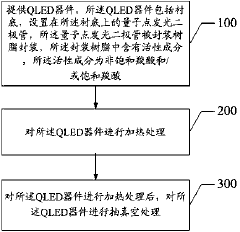
Examples
Embodiment 1
[0050] Example 1: The quenching effect of carboxylic acid on the luminous efficiency of quantum dots
[0051] 1) Prepare a n-hexane solution of CdSe / ZnS quantum dots with a concentration of 15 mg / mL. The luminescence peak wavelength of quantum dots in n-hexane solution is 621 nm, and the quantum yield is 62%;
[0052] 2) Add 10, 50, 100, 200, 2000 ppm acetic acid by volume to the above CdSe / ZnS quantum dot n-hexane solution and mix thoroughly;
[0053] 3) Test the luminescence quantum yield of the mixed solution of quantum dots and acetic acid respectively, as shown in Table 1 below:
[0054] Table 1. Solution luminescence quantum yield
[0055] Acetic acid addition system percentage (ppm)
[0056] It can be seen from the above table that a very small amount of acetic acid directly contacts the quantum dots, which will have a significant luminous efficiency quenching effect on the quantum dots.
Embodiment 2
[0057] Example 2: Acceleration of Heating on the Beneficial Effect of Active Components in Improving Device Efficiency
[0058] 1) Add 20% by weight acrylic acid to the encapsulation resin;
[0059] 2) Encapsulate the existing green QLED with the above encapsulation resin and UV cure;
[0060] 3) In a nitrogen atmosphere, place the above green QLEDs at room temperature and heat them at 50°C and 90°C respectively;
[0061] 4) Observe the change (%) of the external quantum efficiency of green QLED with the change of processing time, as shown in Table 2 below:
[0062] Table 2. External quantum efficiency of green QLEDs
[0063] processing conditions
[0064] As can be seen from the above table, compared with QLED devices placed at room temperature, heating treatment can effectively increase the rate of device efficiency growth; and the higher the heating temperature and the longer the heating time, the more obvious the acceleration effect.
Embodiment 3
[0065] Example 3: Effects of Different Active Ingredient Concentrations on Device Efficiency Improvement under the Same Heating Conditions
[0066] 1) Add 5, 10, 20, 30, 40% by weight acrylic acid to the encapsulation resin;
[0067] 2) Encapsulate the existing green QLED with the above encapsulation resin and UV cure;
[0068] 3) All the above green QLEDs were heat treated at 50°C for 1 day in a nitrogen atmosphere;
[0069] 4) Observe the change in external quantum efficiency (%) of green QLED over time, as shown in Table 3 below:
[0070] Table 3. External quantum efficiency of green QLEDs
[0071] Acrylic acid concentration (%)
[0072] It can be seen from the above table that the addition concentration of acrylic acid in the range of 5-40% and combined with heat treatment can produce different degrees of beneficial effects of improving device efficiency.
PUM
 Login to View More
 Abstract
Description
Claims
Application Information
 Login to View More