
Low temperature plasma reactor and method for decomposing hydrogen sulfide
A low-temperature plasma and reactor technology, applied in the field of ion chemistry, can solve the problems of high decomposition energy consumption and low hydrogen sulfide conversion rate, and achieve the effects of flexible temperature control, high continuity and stability, and long-term operation.
- Summary
- Abstract
- Description
- Claims
- Application Information
AI Technical Summary
Problems solved by technology
Method used
Image

Examples
specific Embodiment approach
[0083] Nitrogen gas is introduced into the inner cylinder of the low-temperature plasma reactor from the reactor inlet to remove the air in the discharge area, and the gas is drawn out from the product outlet. At the same time, the heat transfer medium is introduced into the outer cylinder from the heat transfer medium inlet, and the introduced heat transfer medium is led out from the heat transfer medium outlet. The temperature of the heat transfer medium is maintained at the temperature required by the system reaction. Then feed the raw material gas containing hydrogen sulfide into the inner cylinder of the low-temperature plasma reactor from the inlet of the reactor, and turn on the high-voltage power supply after the raw material gas flow is stable, and form a plasma discharge between the center electrode and the ground electrode by adjusting the voltage and frequency field. The hydrogen sulfide gas is ionized in the discharge area and decomposed into hydrogen and element...
Embodiment 1
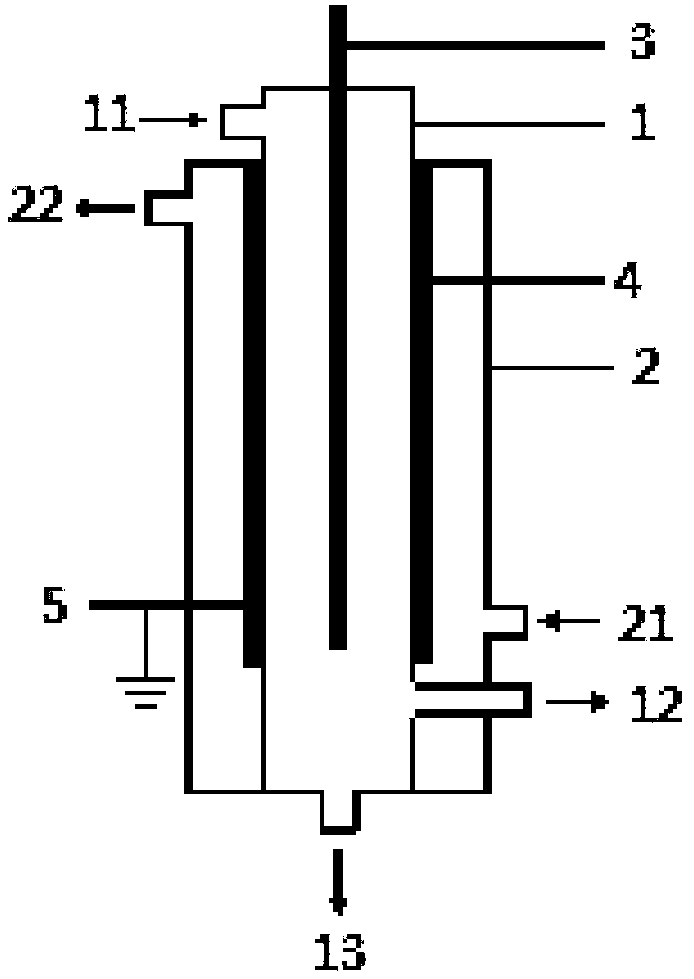
[0094] use figure 1 The shown low-temperature plasma reactor performs hydrogen sulfide decomposition reaction, and the specific structure and structural parameters of the low-temperature plasma reactor are as follows:
[0095] The reactor includes:
[0096] An inner cylinder, the inner cylinder is respectively provided with a reactor inlet, a gas product outlet and a liquid product outlet, wherein all side walls of the inner cylinder are formed by a barrier medium, and the material forming the barrier medium is hard glass ;
[0097] An outer cylinder, the outer cylinder is nested outside the inner cylinder, and the outer cylinder is respectively provided with a heat transfer medium inlet and a heat transfer medium outlet;
[0098] A central electrode, the central electrode is arranged at the central axis of the inner cylinder, and the material forming the central electrode is a stainless steel metal rod;
[0099] A ground electrode, the ground electrode is wrapped on the ou...
Embodiment 2
[0126] The present embodiment adopts the plasma reactor similar to embodiment 1 to carry out the decomposition reaction of hydrogen sulfide, the difference is, in the present embodiment:
[0127] All side walls of the inner cylinder are formed by grounding electrodes, and the material for forming the grounding electrodes is stainless steel metal foil;
[0128] The blocking medium is arranged around the inner wall of the inner cylinder;
[0129] The distance L between the outer sidewall of the center electrode and the inner sidewall of the barrier medium 1 with the thickness of the barrier dielectric D 1 The ratio is 20:1;
[0130] h 1 and the length L of the discharge region containing the barrier dielectric 2 The proportional relationship between is: H 1 :L 2 =1:100.
[0131] In this embodiment, H is introduced into the inner cylinder of the low-temperature plasma reactor from the reactor inlet. 2 S / Ar mixed gas, where H 2 The volume fraction of S is 30%, and the flo...
PUM
 Login to View More
 Abstract
Description
Claims
Application Information
 Login to View More