Preparation method of acrylic resin for flexible plastics
What is AI technical title?
AI technical title is built by Patsnap AI team. It summarizes the technical point description of the patent document.
A technology of acrylic resin and flexible plastic, which is applied in the field of resin to achieve the effect of improving flexibility, increasing reaction and good hydrolysis resistance
Inactive Publication Date: 2019-12-20
HUALUN NALU NEW MATERIALS
View PDF1 Cites 2 Cited by
Summary
Abstract
Description
Claims
Application Information
AI Technical Summary
This helps you quickly interpret patents by identifying the three key elements:
Problems solved by technology
Method used
Benefits of technology
Problems solved by technology
There are few such products on the market
Method used
the structure of the environmentally friendly knitted fabric provided by the present invention; figure 2 Flow chart of the yarn wrapping machine for environmentally friendly knitted fabrics and storage devices; image 3 Is the parameter map of the yarn covering machine
View more
Image
Smart Image Click on the blue labels to locate them in the text.
Viewing Examples
Smart Image
Click on the blue label to locate the original text in one second.
Reading with bidirectional positioning of images and text.
Smart Image
Examples
Experimental program
Comparison scheme
Effect test
Embodiment 1
[0021] (1) First, put caprolactone and hydroxyethyl acrylate in an equimolar ratio into the reaction kettle, feed N2 protection to start stirring, and raise the temperature to 140-150°C to maintain this temperature;
[0022] (2) add an appropriate amount of organotin catalyst, maintain at this temperature for 5 hours, lower the temperature and cool down, and obtain intermediate B;
[0024] (4) Add 35% xylene into the reaction kettle, raise the temperature to 130±2°C, drop the monomer in the head tank into the reaction kettle at a constant speed for 3 hours, keep it for 1 hour, add the initiator, and keep it for another 2 hours, and check the acid value of the resin , viscosity, and pass the test, dilute it with xylene to the required solid content, cool ...
Embodiment 2
[0026] (1) First, put caprolactone and hydroxyethyl acrylate in an equimolar ratio into the reaction kettle, feed N2 protection to start stirring, and raise the temperature to 140-150°C to maintain this temperature;
[0027] (2) add an appropriate amount of organotin catalyst, maintain at this temperature for 5 hours, lower the temperature and cool down, and obtain intermediate B;
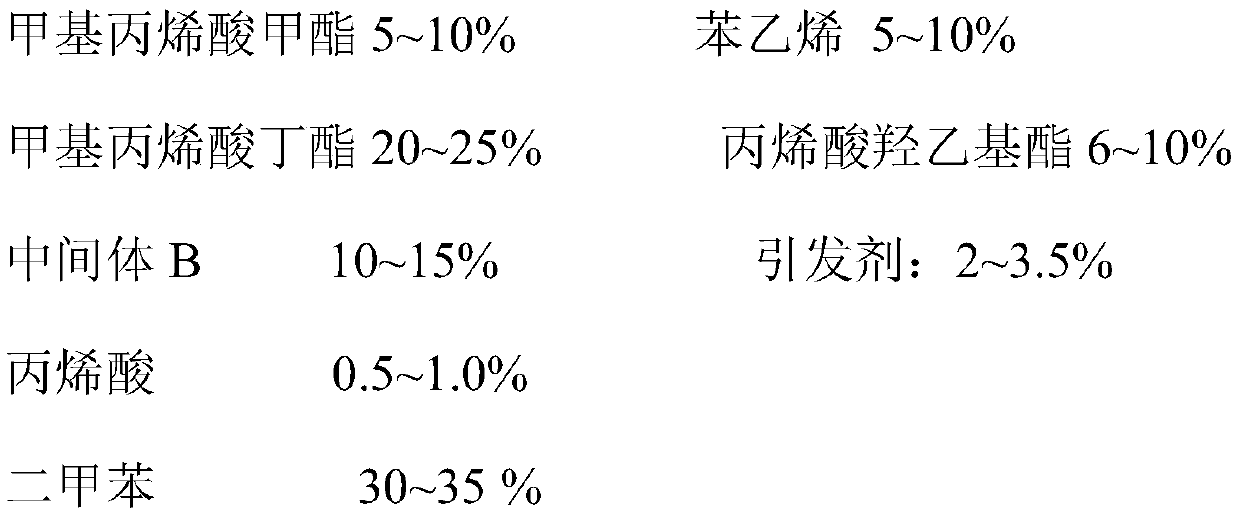
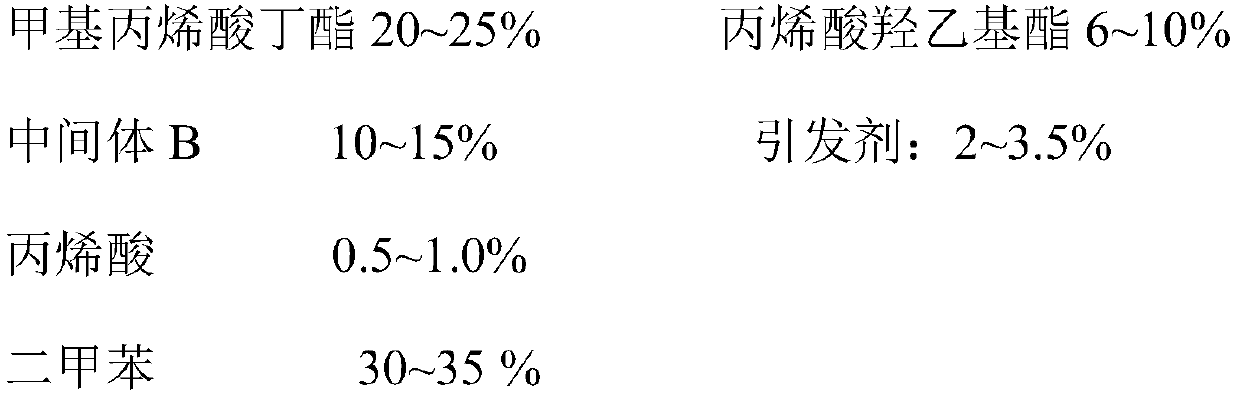
[0028] (3) 15% intermediate B, 8.2% (meth)methyl acrylate, 22% butyl methacrylate, 10% styrene, 8% hydroxyethyl acrylate, 1.3% acrylic acid, 2.5% initiator, Throw it into the high-level tank to dissolve safely and stir evenly;
[0029] (4) Add 33% xylene into the reaction kettle, raise the temperature to 130±2°C, drop the monomer in the head tank into the reaction kettle at a constant speed for 3 hours, keep it for 1 hour, add the initiator, and keep it for another 2 hours, and check the acid value of the resin , viscosity, and pass the test, dilute it with xylene to the required solid content, co...
the structure of the environmentally friendly knitted fabric provided by the present invention; figure 2 Flow chart of the yarn wrapping machine for environmentally friendly knitted fabrics and storage devices; image 3 Is the parameter map of the yarn covering machine
Login to View More
PUM
Login to View More
Abstract
The invention discloses acrylic resin for flexible plastics. The acrylic resin is prepared by modifying acrylic acid with aprolactone. The synthesis method comprises the following steps: (1) firstly,putting caprolactone and hydroxyethyl acrylate with equal molar ratios into a reaction kettle, introducing N2 for protection, starting stirring, carrying out heating to 140-150 DEG C, and maintainingthe temperature; and (2) adding a proper amount of an organotin catalyst, maintaining the temperature for 5 hours, and then carrying out cooling to obtain an intermediate B. The method has the beneficial effects: 1, caprolactone groups are introduced into acrylic resin, and flexibility, impact strength, hardness and the like of a coating film can be improved to different degrees by selecting different types and adding different reaction amounts. At the same time, caprolactone groups can enable the polymer to have good hydrolysis resistance, chemical resistance and compatibility, and can crosslink with curing agents such as melamineformaldehyde resin, isocyanate, epoxy resin and the like capable of reacting with hydroxyl.
Description
technical field [0001] The invention belongs to the field of resins, in particular to an acrylic resin for flexible plastics. Background technique [0002] Acrylic resin is a very important variety of coating resins. Its synthesis process is highly controllable, and it also has excellent weather resistance and pigment dispersibility, and its proportion in coating resins is increasing. At present, there are three types of acrylic resins commonly used in the market: 1. Thermosetting acrylic resins that can be baked and cross-linked with amino resins; 2. Hydroxyl acrylic amino resins that react with NCO; [0003] With the increasing use of plastic products, the market has higher and higher requirements for plastic coating protection. With the rapid development of electronic products and high-performance plastic products, the demand for flexible plastics has increased rapidly. However, plastic coatings on the market are mainly aimed at protecting the surface of high-hardness pl...
Claims
the structure of the environmentally friendly knitted fabric provided by the present invention; figure 2 Flow chart of the yarn wrapping machine for environmentally friendly knitted fabrics and storage devices; image 3 Is the parameter map of the yarn covering machine
Login to View More
Application Information
Patent Timeline
Application Date:The date an application was filed.
Publication Date:The date a patent or application was officially published.
First Publication Date:The earliest publication date of a patent with the same application number.
Issue Date:Publication date of the patent grant document.
PCT Entry Date:The Entry date of PCT National Phase.
Estimated Expiry Date:The statutory expiry date of a patent right according to the Patent Law, and it is the longest term of protection that the patent right can achieve without the termination of the patent right due to other reasons(Term extension factor has been taken into account ).
Invalid Date:Actual expiry date is based on effective date or publication date of legal transaction data of invalid patent.



 Login to View More
  Login to View More