
Anti-icing hydrogel bonding material as well as preparation method and application thereof
A technology for bonding materials and ice water, applied in chemical instruments and methods, and other chemical processes, can solve the problems of irreversible bonding, inability to resist ice and anti-ice hydrogel, etc., and achieve easy large-scale production and universal The effect of adaptability and simple preparation method
Patent Information
- Authority / Receiving Office
- CN · China
- Patent Type
- Applications(China)
- Current Assignee / Owner
- Publication Date
- 2020-06-05
- Estimated Expiration
- Not applicable · inactive patent
Smart Images
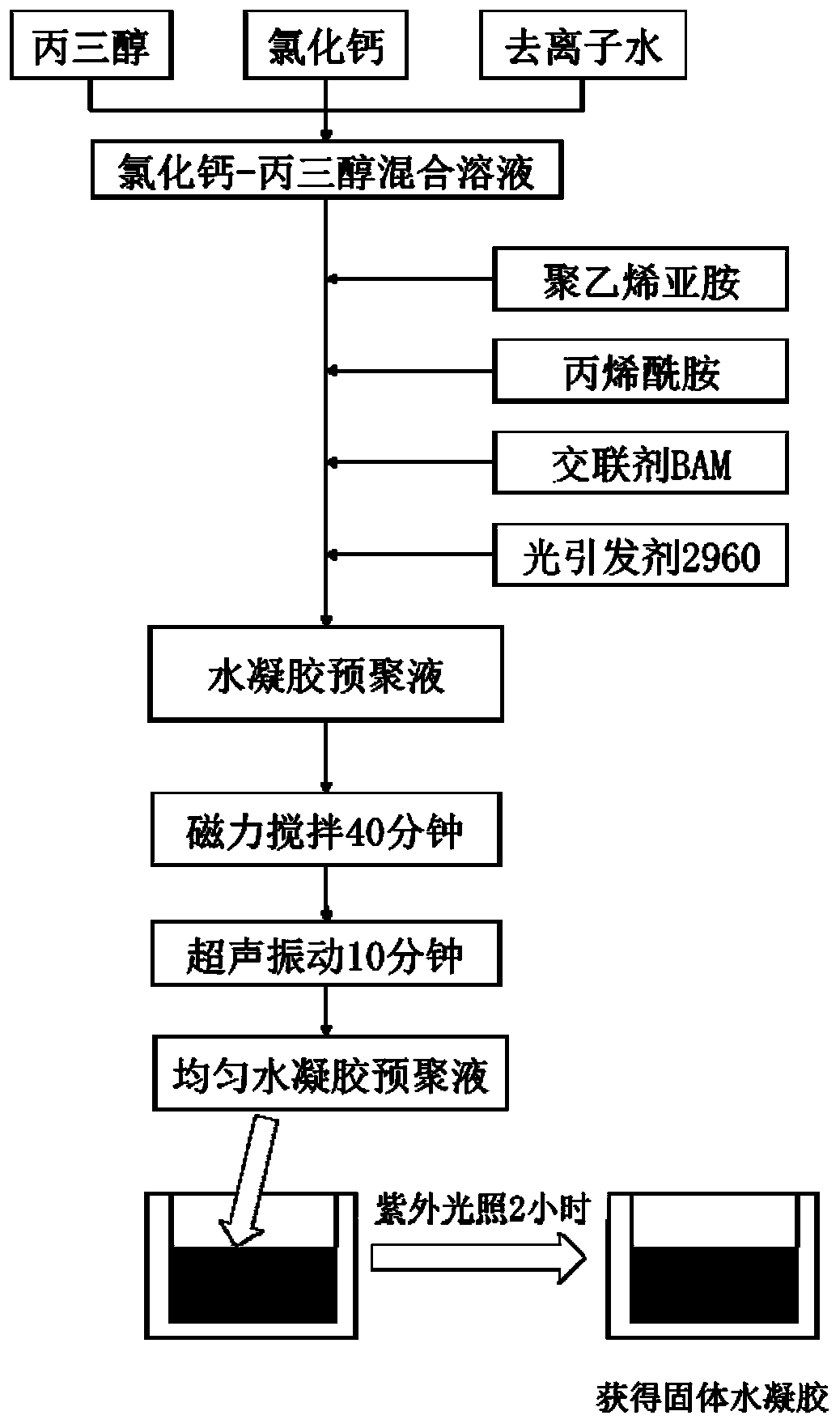
Figure 1 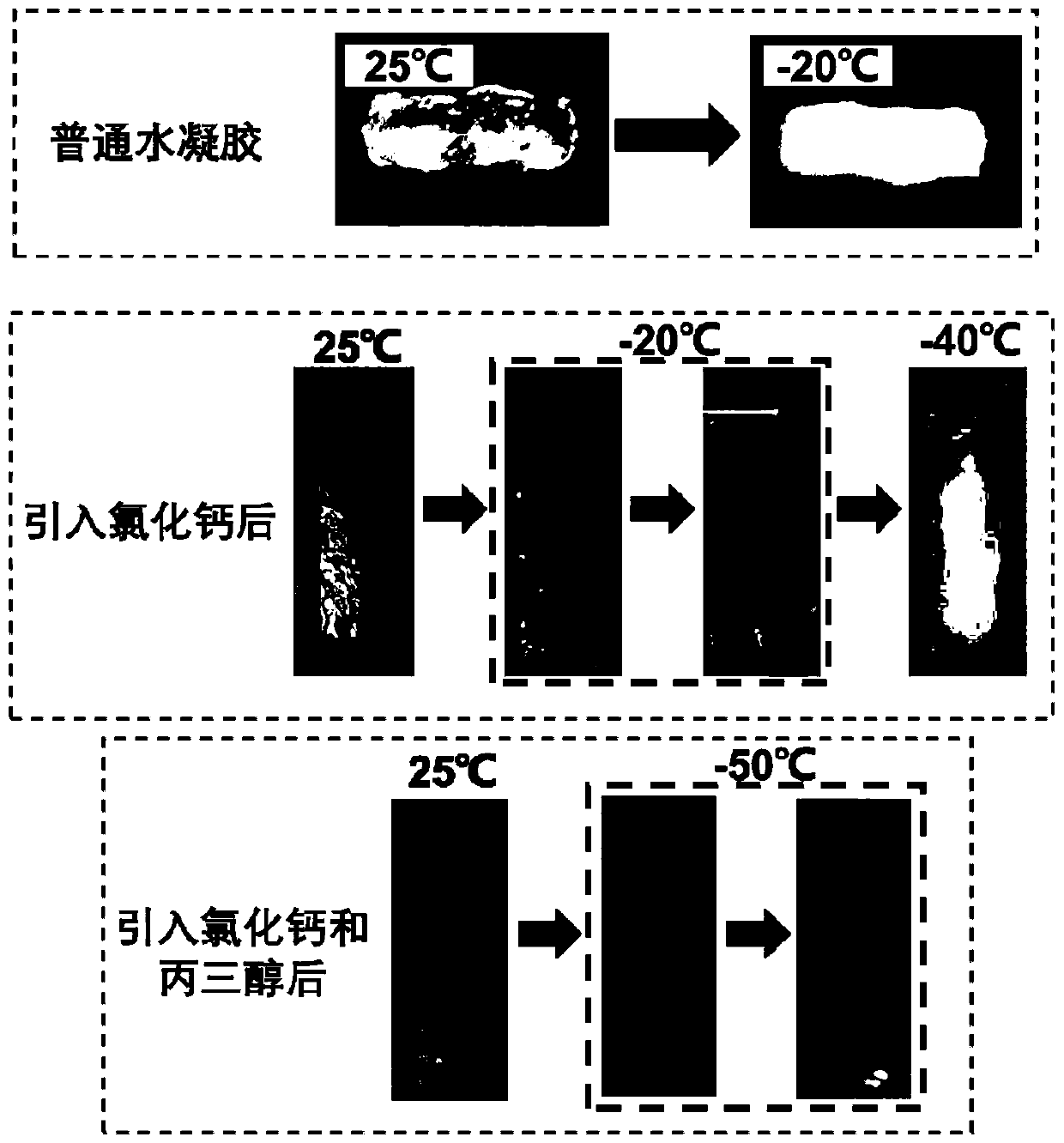
Figure 2 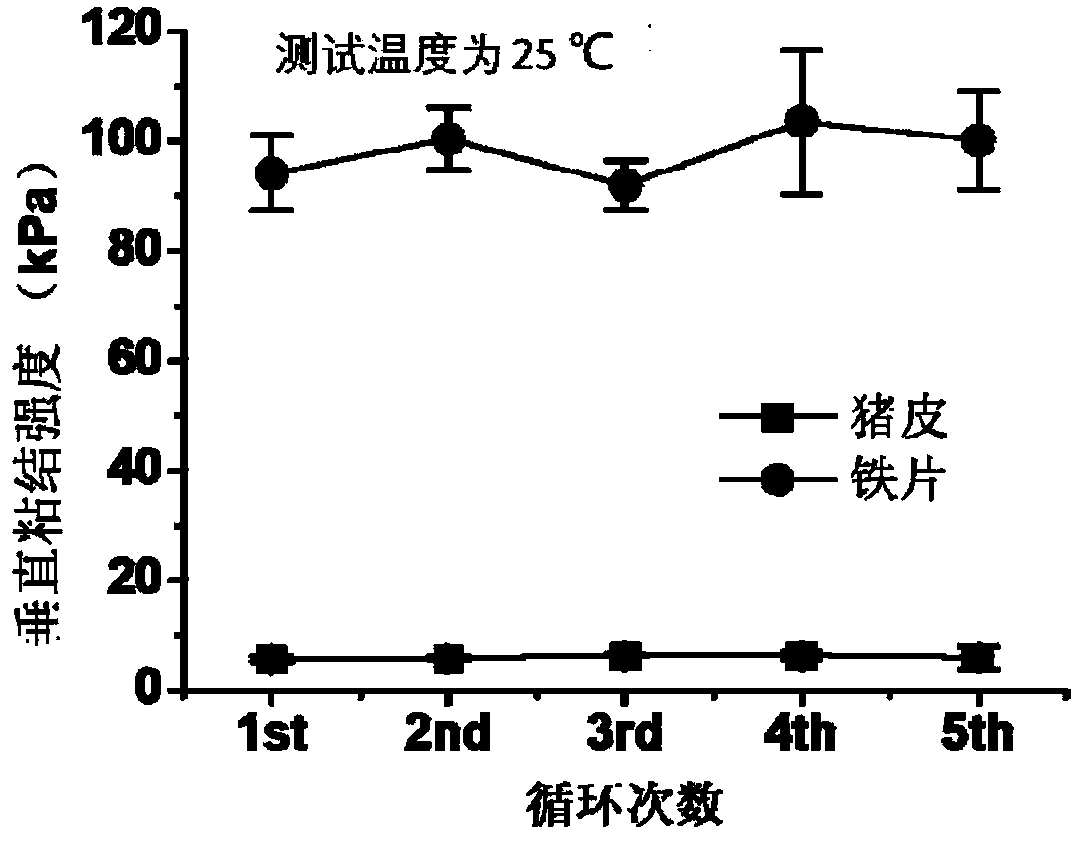
Figure 3
Abstract
Description
technical field
[0001] The invention belongs to the technical field of hydrogel preparation, and in particular relates to an ice-resistant hydrogel bonding material suitable for low temperature environments and capable of realizing reversible bonding, and a preparation method and application of the material. Background technique
[0002] The information disclosed in this background section is only intended to increase the understanding of the general background of the present invention, and is not necessarily taken as an acknowledgment or any form of suggestion that the information constitutes the prior art already known to those skilled in the art.
[0003] Hydrogel adhesive materials have potential applications in many fields, such as flexible electronics, wearable devices, wound healing, and cartilage repair. However, when the temperature is below zero, such as in the cold environment of the Arctic and Antarctic, ordinary hydrogel materials will be frozen, making it diffi...
Examples
preparation example Construction
[0043] The present invention also provides the preparation method of this ice-resistant hydrogel adhesive material, such as figure 1 Shown, described preparation method comprises the following steps:
[0044] (1) glycerol and calcium chloride are dissolved in deionized water to make calcium chloride-glycerol mixed solution;
[0045] (2) Polyethyleneimine, acrylamide, cross-linking agent N, N-methylenebisacrylamide (BAM) and photoinitiator 2960 are dissolved in the calcium chloride-glycerol mixed solution to make a hydraulic gel Glue prepolymer solution;
[0046] (3) Stir the hydrogel pre-polymerization liquid for 40 minutes by magnetic force and ultrasonically stir for 10 minutes to obtain a uniform hydrogel pre-polymerization liquid;
[0047] (4) Pour the uniform hydrogel pre-polymerization solution into a mold, and irradiate with ultraviolet rays for 2 hours to obtain the solid ice-resistant hydrogel bonding material.
[0048] In the step (1), the selected ratio of water an...
Embodiment 1
[0056] 21.62 g of glycerol and 7.57 g of calcium chloride were dissolved in 9.81 g of deionized water to prepare a calcium chloride-glycerol solution. Then add 9g of acrylamide monomer, 2g of 50% PEI aqueous solution (containing 1g of PEI, which is a branched chain polymer with a molecular weight of 70000), 0.0054g of N,N-methylenebisacrylamide and 0.18g of photoinitiator 2960 made of hydrogel pre-polymerization liquid. Then magnetic stirring for 40 minutes and ultrasonic stirring for 10 minutes to obtain a uniform hydrogel pre-polymerization solution. Pour the uniform hydrogel pre-polymerization solution into a mold, and irradiate it with ultraviolet rays with a wavelength of 365nm and a power of 8W for 2 hours to obtain a hydrogel solid.
[0057] Taking iron as a test sample, this example is used to conduct a vertical bond test at room temperature (25° C.), and the measured bond strength is 90-100 kPa.
[0058] image 3 It is the cycle test result of the ice-resistant hyd...
Embodiment 2
[0064] 21.62 g of glycerol and 7.57 g of calcium chloride were dissolved in 10.56 g of deionized water to prepare a calcium chloride-glycerol solution. Then add 9.75g of acrylamide monomer, 0.5g of 50% PEI aqueous solution (containing 0.25g of PEI, which is a branched polymer with a molecular weight of 70000), 0.00585g of N,N-methylenebisacrylamide and 0.195g Photoinitiator 2960 is used to make hydrogel prepolymerization solution. Then magnetic stirring for 40 minutes and ultrasonic stirring for 10 minutes to obtain a uniform hydrogel pre-polymerization liquid. Pour the uniform hydrogel pre-polymerization solution into a mold, and irradiate it with ultraviolet rays with a wavelength of 365nm and a power of 8W for 2 hours to obtain a hydrogel solid.
[0065] Taking iron as a test sample, this example is used to conduct a vertical bond test at room temperature (25° C.), and the measured bond strength is 85-90 kPa.