
Method for cladding nanometer starch microspheres through atomic layer deposition
A technique of atomic layer deposition and nano-starch, which is applied in nanotechnology, nanomagnetism, nanotechnology, etc. for materials and surface science, and can solve the problems of being easily infected by organisms, difficult to control the particle size of magnetic particles, and low magnetic content, etc. problems, to achieve the effects of stability, particle size distribution range reduction, and increase in magnetic content
- Summary
- Abstract
- Description
- Claims
- Application Information
AI Technical Summary
Problems solved by technology
Method used
Image

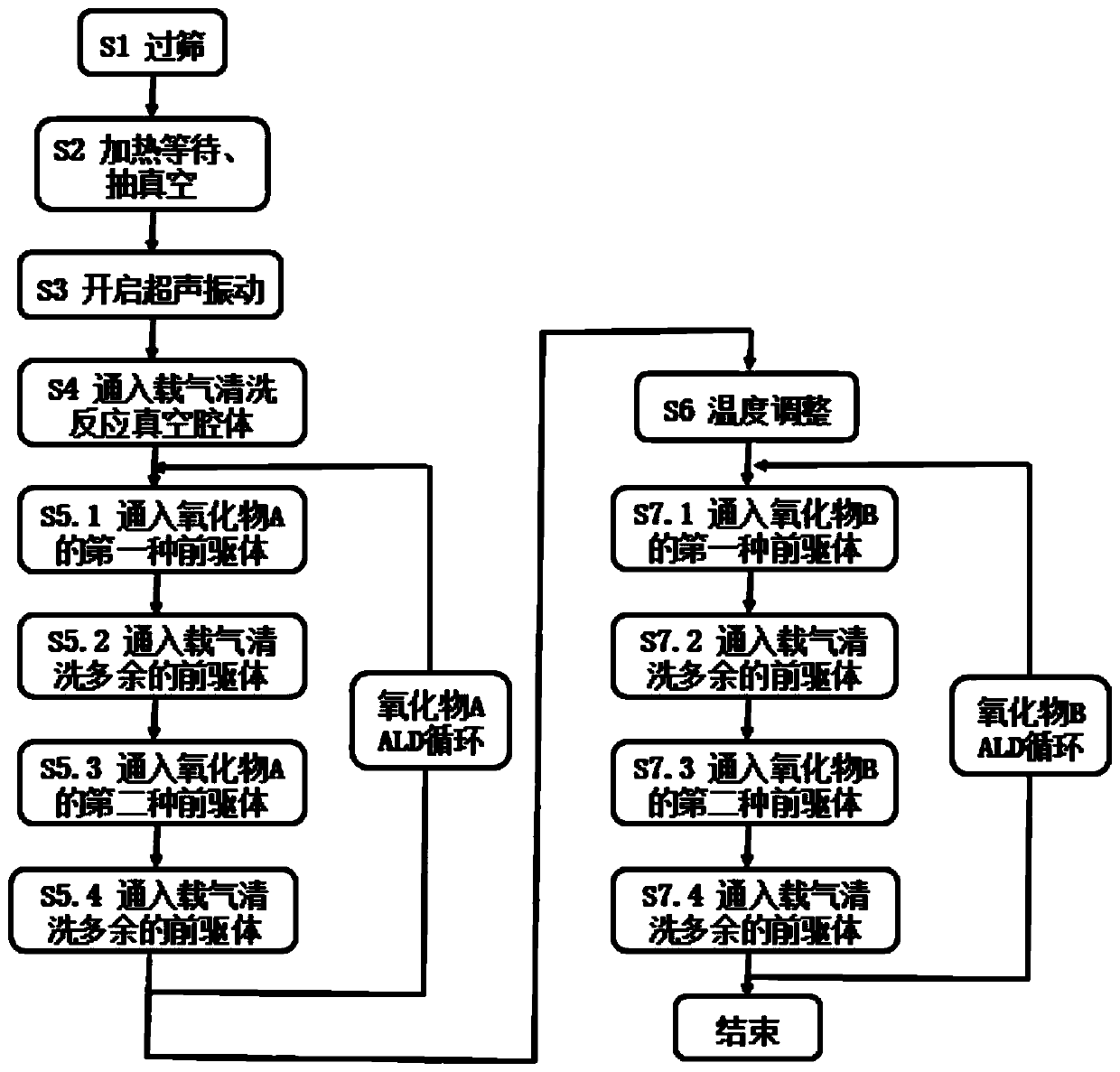
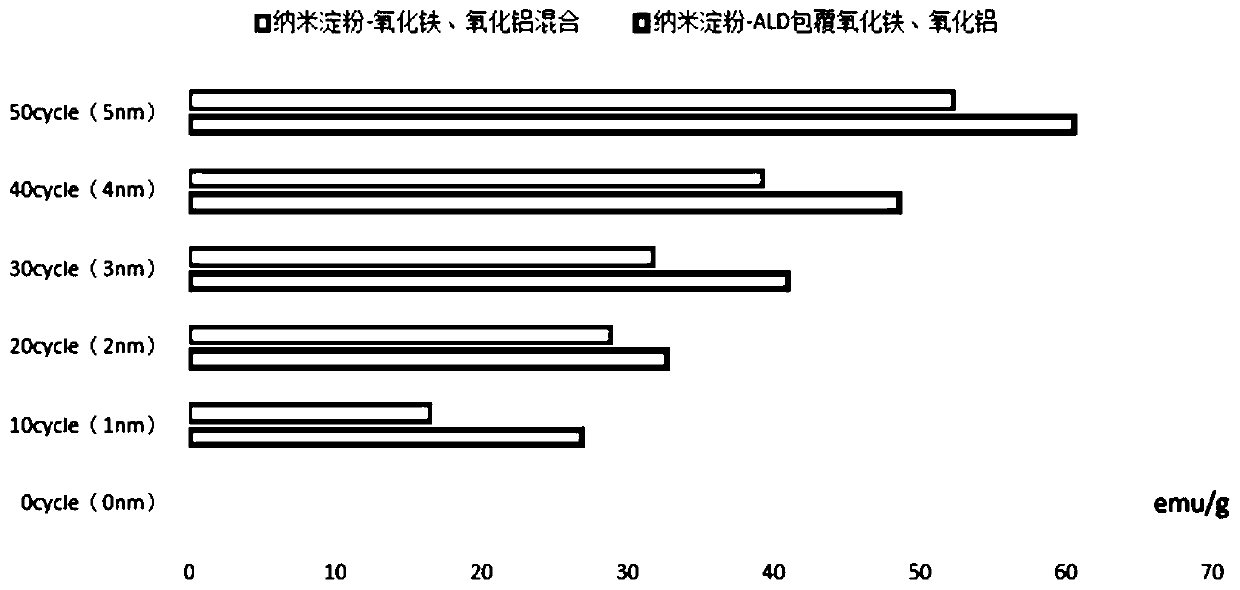
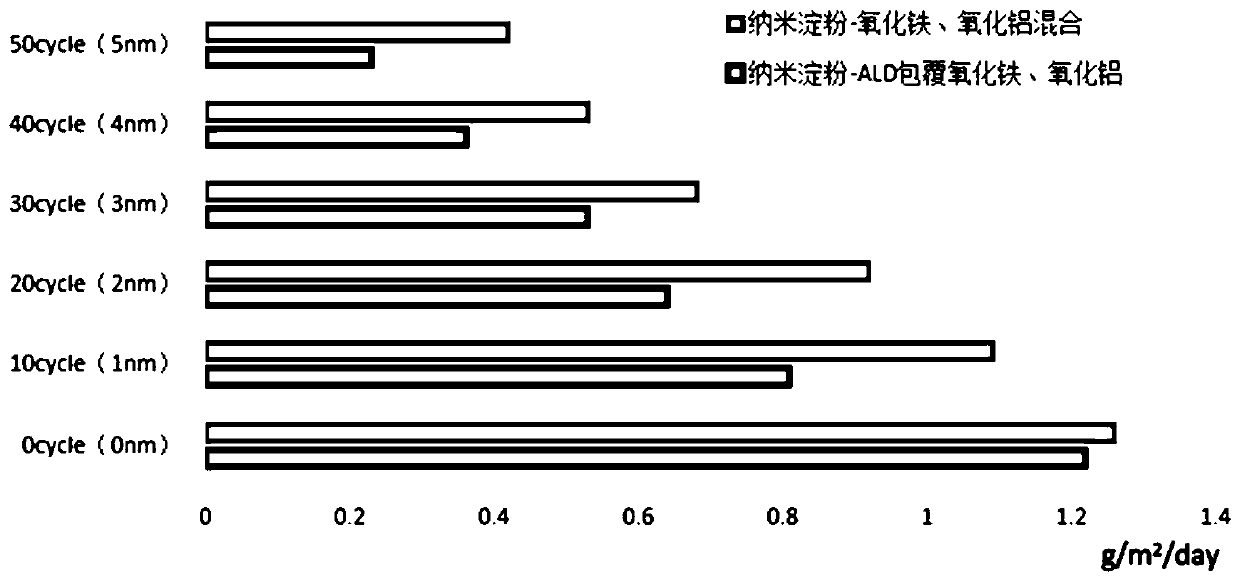
Examples
Embodiment 1
[0034] A method of coating nano-starch microspheres by atomic layer deposition, surface modification of nano-starch microspheres with a particle size of 20nm, coating 5nm Fe 2 o 3 Thin films and 1nm Al 2 o 3 Thin film, where C is selected 10 h 10 Fe / O 3 , Al(CH 3 ) 3 / H 2 O is a precursor, which specifically includes the following steps:
[0035] (1) Iron oxide coating:
[0036] 1.1 After passing the nano-starch microspheres through the 800-mesh screen, weigh 5 mg and place it in the powder container of the atomic layer deposition equipment, put the powder container into the cavity, and evacuate to 10Pa;
[0037]1.2 Turn on the ultrasonic vibration, set the ultrasonic frequency to 20KHz, the working time of the ultrasonic vibration is 60s, and the intermittent time is 5s;
[0038] 1.3 Heat the cavity, and at the same time, feed the carrier gas to clean the surface of the nano-starch microspheres for 30 minutes and disperse them. The flow rate of the carrier gas is se...
Embodiment 2
[0053] A method of coating nano-starch microspheres by atomic layer deposition, surface modification of nano-starch microspheres with a particle size of 20nm, coating 5nm Fe 2 o 3 Thin films and 1nm Al 2 o 3 Thin film, where C is selected 10 h 10 Fe / O 3 , Al(CH 3 ) 3 / H 2 O is a precursor, which specifically includes the following steps:
[0054] (1) Iron oxide coating:
[0055] 1.1 After passing the nano starch microspheres through the 800 mesh screen, weigh 100g and place it in the powder container of the atomic layer deposition equipment, put the powder container into the cavity, and evacuate to 10Pa;
[0056] 1.2 Turn on the ultrasonic vibration, set the ultrasonic frequency to 40KHz, the working time of the ultrasonic vibration is 5min, and the intermittent time is 5s;
[0057] 1.3 Heat the cavity, and at the same time, pass the carrier gas to clean the surface of the nano-starch microspheres for 50 minutes and disperse them, and select the flow rate of the carr...
Embodiment 3
[0072] A method of coating nano-starch microspheres by atomic layer deposition, surface modification of nano-starch microspheres with a particle size of 10 μm, and coating with 5nm Fe 2 o 3 Thin films and 1nm SiO 2 Thin film, where C is selected 10 h 10 Fe / O 3 、SiCl 4 / H 2 O is a precursor, which specifically includes the following steps:
[0073] (1) Iron oxide coating:
[0074] 1.1 After passing the nano starch microspheres through the 800 mesh screen, weigh 200g and place it in the powder container of the atomic layer deposition equipment, put the powder container into the cavity, and evacuate to 10Pa;
[0075] 1.2 Turn on the ultrasonic vibration, set the ultrasonic frequency to 40KHz, the working time of the ultrasonic vibration is 10min, and the intermittent time is 5s;
[0076] 1.3 Heat the cavity, and at the same time pass the carrier gas to clean the surface of the nano-starch microspheres for 50 minutes and disperse them. The flow rate of the carrier gas is s...
PUM
| Property | Measurement | Unit |
|---|---|---|
| thickness | aaaaa | aaaaa |
| particle diameter | aaaaa | aaaaa |
| thickness | aaaaa | aaaaa |
Abstract
Description
Claims
Application Information
 Login to View More