DOA estimation method based on machine learning algorithm XGBoost
What is AI technical title?
AI technical title is built by PatSnap AI team. It summarizes the technical point description of the patent document.
A machine learning and DOA technology, applied in the field of signal processing, can solve the problems of slow operation speed, large amount of neural network data, weak interpretability, etc. Effect
Active Publication Date: 2020-07-10
XIDIAN UNIV
View PDF3 Cites 6 Cited by
Summary
Abstract
Description
Claims
Application Information
AI Technical Summary
This helps you quickly interpret patents by identifying the three key elements:
Problems solved by technology
Method used
Benefits of technology
Problems solved by technology
[0004] However, the MUSIC algorithm needs to search for spectral peaks, and the ESPRIT algorithm needs to estimate the multiplicity of small eigenvalues, and both algorithms need to perform a large number of matrix operations, which further increases the computational complexity and reduces the speed; and supports Vector machines need complex kernel function calculations. When the amount of data is too large, the calculation speed is slow, and the estimation accuracy needs to be improved; the amount of data required by neural networks is too large, and the interpretability is weak
Method used
the structure of the environmentally friendly knitted fabric provided by the present invention; figure 2 Flow chart of the yarn wrapping machine for environmentally friendly knitted fabrics and storage devices; image 3 Is the parameter map of the yarn covering machine
View more
Image
Smart Image Click on the blue labels to locate them in the text.
Viewing Examples
Smart Image
Click on the blue label to locate the original text in one second.
Reading with bidirectional positioning of images and text.
Smart Image
Examples
Experimental program
Comparison scheme
Effect test
Embodiment 1
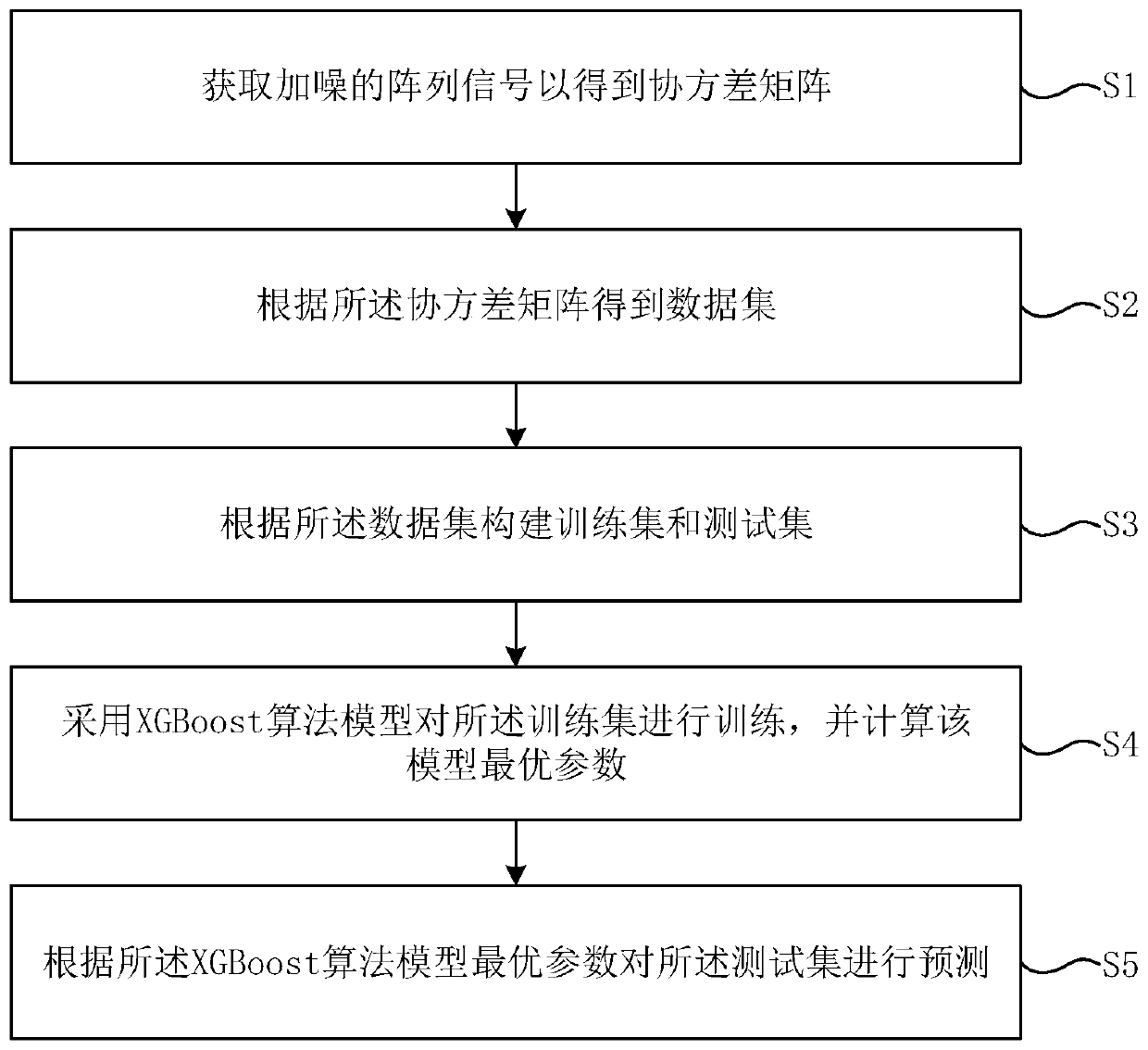
[0052] See figure 1 , figure 1 It is a schematicflowchart of a DOA estimation method based on the machine learning algorithm XGBoost provided by an embodiment of the present invention, including:
[0053] S1: Obtain the noise-added array signal to obtain the covariance matrix;
[0054] Specifically, suppose that M incoherent narrowband signals are incident on a linear array of N identical array elements uniformly arranged with an array element spacing d (M1 ,θ 2 ,...,θ M ], then the signal received by the i-th antenna element at time t is:
[0057] Further, it is expressed in matrix form as:
[0058] X(t)=A(θ)S(t)+N(t);
[0059] In the formula, A(θ) is an N×M-dimensional direction matrix; S(t) is an M×1-dimensional signal vector containing complex amplitude information; N(t) is an N×1-dimensional noise vec...
Embodiment 2
[0125] The effect of the present invention will be further illustrated by simulation experiments below.
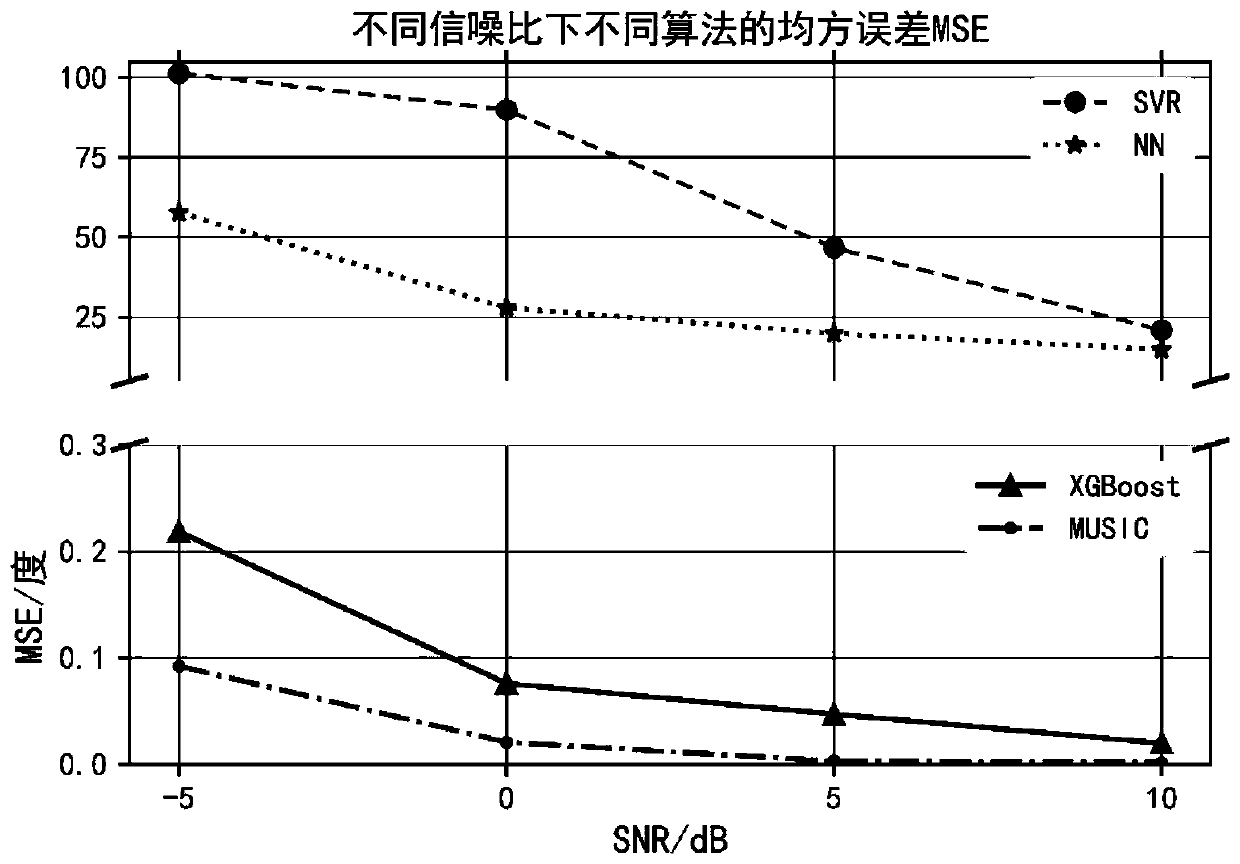
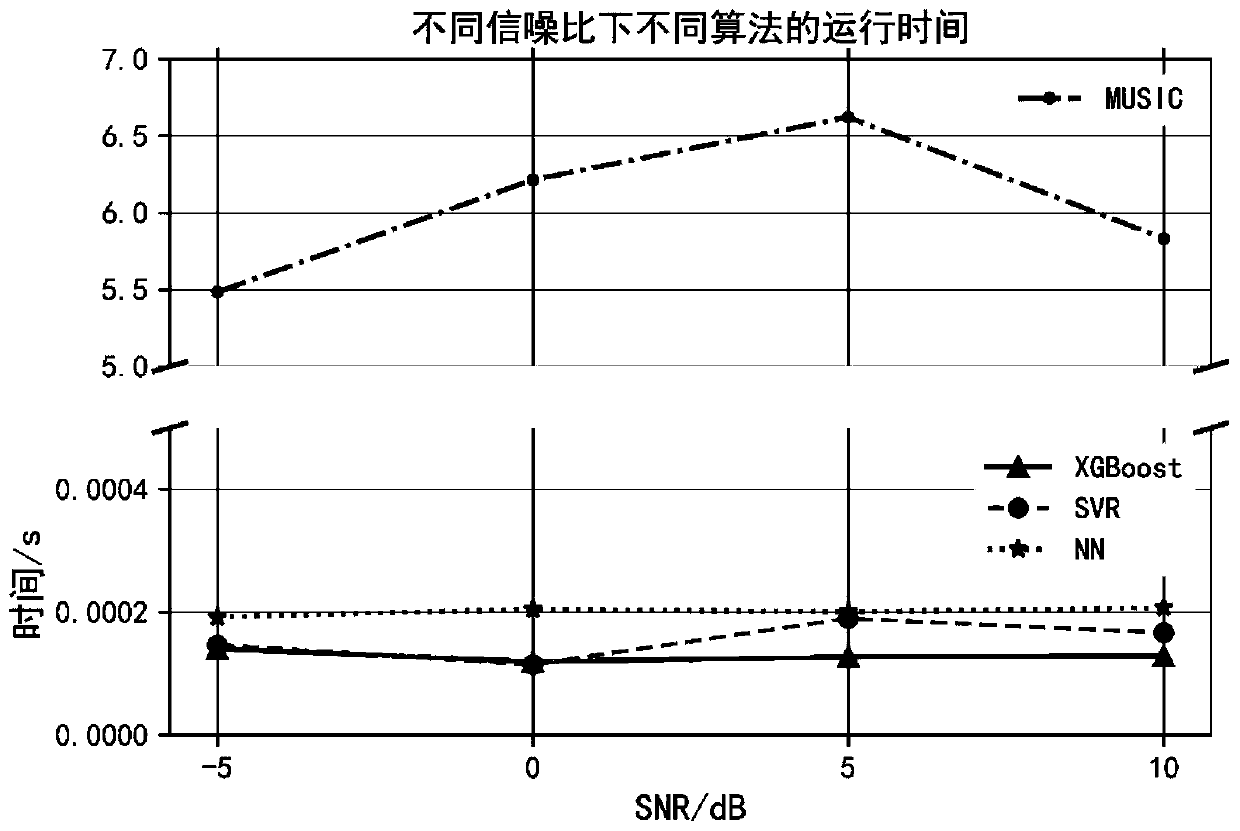
[0127] Set the number of arrays to 8, the array element spacing is 0.5m, the number of snapshots is 512, and the incident angle is a random value from -85° to 85°.
[0130] The traditional MUSIC algorithm, neural network algorithm (NN), support regression algorithm (SVR) in the support vector machine and the XGBoost algorithm of the present invention are experimentally compared.
[0131] First, construct the training set; specifically, it is randomly generated from the incident angle -85°~85°, the signal-to-noise ratio SNR=-5dB, 0dB, 5dB, 10dB, and 12000 training samples are randomly generated under different signal-to-noise ratios.
[0132] Then the test set is constructed; specifically, it is randomly generated from the incident angle -85°~85°, the signal-to-noise ratio SNR=-5dB, 0dB, 5dB...
the structure of the environmentally friendly knitted fabric provided by the present invention; figure 2 Flow chart of the yarn wrapping machine for environmentally friendly knitted fabrics and storage devices; image 3 Is the parameter map of the yarn covering machine
Login to View More
PUM
Login to View More
Abstract
The invention discloses a DOA estimation method based on a machine learning algorithm XGBoost. The DOA estimation method comprises the following steps: acquiring a noisy array signal to obtain a covariance matrix; obtaining a data set according to the covariance matrix; constructing a training set and a test set according to the data set; training the training set by adopting an XGBoost algorithmmodel, and calculating optimal parameters of the model; and predicting the test set according to the optimal parameters of the XGBoost algorithm model. According to the DOA estimation method based onthe machine learning algorithm XGBoost provided by the invention, the prediction speed and precision are improved; meanwhile, the method has the advantages that the method is not easily influenced byabnormal values, a large amount of training data is not needed and the model interpretability is good.
Description
Technical field [0001] The invention belongs to the technical field of signalprocessing, and specifically relates to a DOA estimation method based on a machine learning algorithm XGBoost. Background technique [0002] Direction of arrival (DOA) is an important branch of array signalprocessing. Array signal processing is to form a group of sensors into a sensor array and receive spatial signals to obtain spatial discrete observation data of the spatial signal source. Compared with the traditional single directional sensor, the sensor array has the advantages of flexible beam control, higher signal gain, strong interference suppression capability and high spatial resolution capability. However, due to the non-ideal sensor design and manufacturing process, array installation errors, mutual interference between sensors and background radiation, various defects may exist in the array system, and the model can only be simplified to describe the effects of various defects, resulting i...
Claims
the structure of the environmentally friendly knitted fabric provided by the present invention; figure 2 Flow chart of the yarn wrapping machine for environmentally friendly knitted fabrics and storage devices; image 3 Is the parameter map of the yarn covering machine
Login to View More
Application Information
Patent Timeline
Application Date:The date an application was filed.
Publication Date:The date a patent or application was officially published.
First Publication Date:The earliest publication date of a patent with the same application number.
Issue Date:Publication date of the patent grant document.
PCT Entry Date:The Entry date of PCT National Phase.
Estimated Expiry Date:The statutory expiry date of a patent right according to the Patent Law, and it is the longest term of protection that the patent right can achieve without the termination of the patent right due to other reasons(Term extension factor has been taken into account ).
Invalid Date:Actual expiry date is based on effective date or publication date of legal transaction data of invalid patent.



 Login to View More
  Login to View More