Method for manufacturing sintered magnet, and sintered magnet
A sintered magnet and magnetic technology, applied in the direction of magnetic objects, magnetic materials, transportation and packaging, etc., can solve the problems of the reduction of the saturation magnetic polarization of the compound and the reduction of the residual magnetic flux density, and achieve the effect of high density
- Summary
- Abstract
- Description
- Claims
- Application Information
AI Technical Summary
Problems solved by technology
Method used
Image

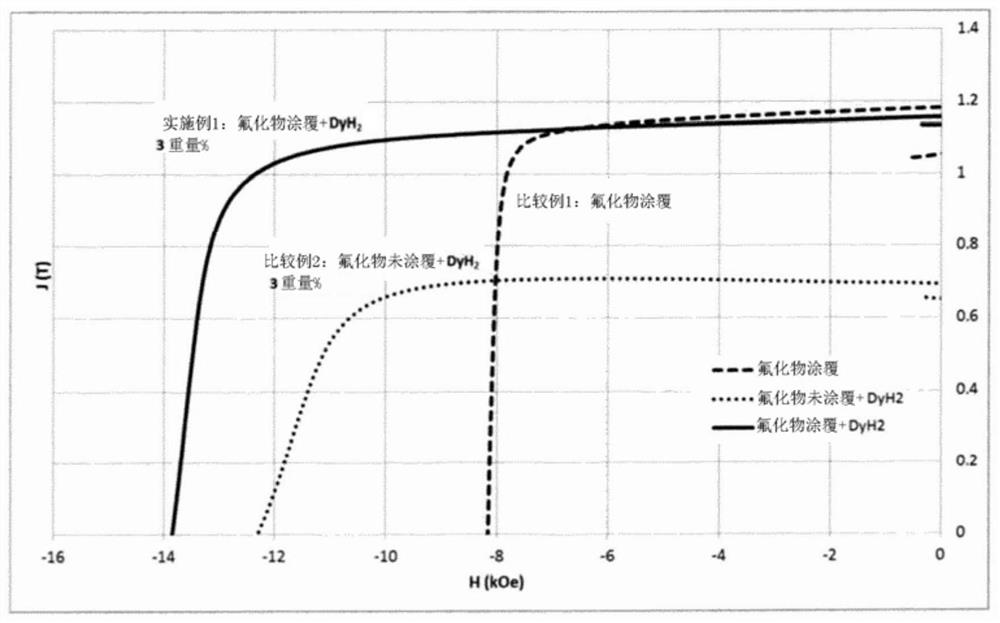
Examples
Embodiment 1
[0057] Example 1: ammonium fluoride (NH 4 F) coating
[0058] Add 34.35g Nd 2 O 3 , 69.50g Fe, 1.05g B, 0.0309g Cu, 0.262g Al and 18.412g Ca were uniformly mixed with alkali metals Na and K in a sealed plastic container to control the particle size. Thereafter, it was uniformly placed in a stainless steel container, and reacted in a tubular electric furnace at a temperature of 920℃ to 950℃ for 30 minutes to 6 hours in an inert gas (Ar) atmosphere. Then, the reaction product is pulverized by an automatic pulverizer, and the residual calcium compounds are removed by using organic solvents such as ethanol or methanol and ammonium nitrate. Thereafter, 10g of the pulverized reaction product was mixed with 0.375g of ammonium nitrate, 125ml of methanol, and 50g of zirconia balls, and then pulverized and dried for 1 to 2 hours using a turbula mixer. In this way, Nd-Fe-B powder was prepared.
[0059] After ammonium nitrate and methanol are removed from Nd-Fe-B powder, 0.05g to 0.10g ammon...
PUM
 Login to View More
 Abstract
Description
Claims
Application Information
 Login to View More