Temperature-resistant polymer microsphere with double cross-linked structure and preparation method thereof
A double cross-linking and polymer technology, applied in the direction of drilling compositions, chemical instruments and methods, etc., can solve the problems of poor stability of the profile control system and lower recovery effect, and achieve good swelling performance, single The effect of good dispersion and good application prospects
- Summary
- Abstract
- Description
- Claims
- Application Information
AI Technical Summary
Problems solved by technology
Method used
Image



Examples
Embodiment 1
[0075] The preparation of the temperature-resistant polymer microsphere of embodiment 1 double crosslinking structure
[0076] (1) Add the emulsifier (Tween60 and Span80, the mass ratio of which is 3.62:8.38) to 10# white oil to obtain the oil phase; put the oil phase in a 250mL three-necked flask in a water bath at 50°C, connect the device, and adjust The stirring speed is 300rpm, and the temperature of the water bath is adjusted to 20°C after 30 minutes;
[0077] (2) Prepare the water phase; weigh the monomers (N-vinylpyrrolidone (NVP), 2-acrylamide-2-methylpropanesulfonic acid (AMPS) and acrylamide (AM)), N,N'- Methylbisacrylamide (MBA) and cross-linking agent 2 (organometallic cross-linking agent or polyethyleneimine (PEI)), dissolved in deionized water, adding potassium persulfate (KPS), stirring until clear, to obtain the water phase ;
[0078] (3) Adjust the stirring speed of the oil phase in step (1), then add the water phase dropwise to the oil phase, stir and emuls...
Embodiment 2
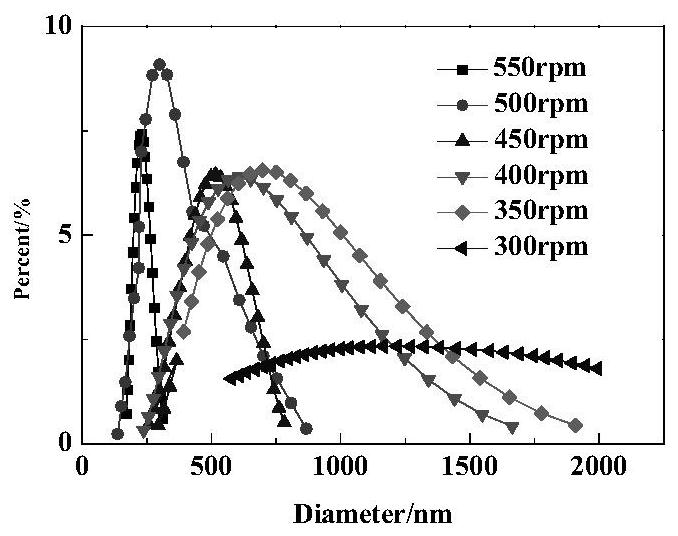
[0080] 1. Selection of stirring speed
[0081] Under the same situation of other reaction conditions (oil-water mass ratio 2:1, emulsifier 10%, monomer 17%, crosslinking agent MBA0.05%, zirconium citrate 1.0%, KPS 0.2%, NaHSO 3 0.2%,), only change the stirring speed of step (3) in the embodiment 1, have selected six different stirring speeds (300,350,400,450,500,550rpm) successively from small to large to prepare heat-resistant polymer microspheres . The relationship between the average particle size of the microspheres prepared in the experiment and the stirring speed is shown in Table 1. As can be seen from the data in Table 1, the average particle diameter of the microspheres significantly decreases with the increase of the mechanical stirring speed. When the stirring speed was 300rpm, the average particle diameter of the microsphere dry powder was 873.2nm, and when the stirring speed was 550rpm, the The average particle size of the dry powder is only 230.3nm. According ...
Embodiment 3
[0108] The characterization of embodiment 3 polymer microspheres
[0109] The microspheres of the three preferred cross-linking systems were characterized. The morphology and molecular structure of the microspheres prepared under the optimal conditions were characterized by infrared spectroscopy, nuclear magnetic resonance spectroscopy and SU8010 scanning electron microscopy. The elemental distribution of the ball was analyzed.
[0110] 1. Zr Microsphere-0.25: The preparation method is the same as in Example 1; the formula is as follows: oil-water ratio 2 / 1, stirring speed 550rpm, emulsifier 10%, monomer 17%, MBA 0.05%, zirconium citrate 0.25%, KPS 0.2 %, NaHSO 3 0.2%.
[0111] 2. Al Microspheres-0.25: The preparation method is the same as in Example 1; the formula is as follows: oil-water ratio 2 / 1, stirring speed 550rpm, emulsifier 10%, monomer 17%, MBA 0.05%, aluminum citrate 0.25%, KPS 0.2 %, NaHSO 3 0.2%.
[0112] 3. PEI Microsphere-0.2: The preparation method is ...
PUM
| Property | Measurement | Unit |
|---|---|---|
| Particle size | aaaaa | aaaaa |
| Particle size | aaaaa | aaaaa |
| Particle size | aaaaa | aaaaa |
Abstract
Description
Claims
Application Information
 Login to View More
 - R&D
- Intellectual Property
- Life Sciences
- Materials
- Tech Scout
- Unparalleled Data Quality
- Higher Quality Content
- 60% Fewer Hallucinations
Browse by: Latest US Patents, China's latest patents, Technical Efficacy Thesaurus, Application Domain, Technology Topic, Popular Technical Reports.
© 2025 PatSnap. All rights reserved.Legal|Privacy policy|Modern Slavery Act Transparency Statement|Sitemap|About US| Contact US: help@patsnap.com