Unlock instant, AI-driven research and patent intelligence for your innovation.

Preparation method and application of visible light response photocatalyst composite nanoparticles

A composite nanoparticle and nanoparticle technology, applied in nanotechnology, nanotechnology, nano-optics, etc., can solve problems such as poisoning, and achieve the effects of reducing use costs, stabilizing anti-virus, antibacterial, anti-virus, and epidemic prevention with peace of mind.

Pending Publication Date: 2021-07-16
SUZHOU GINET NEW MATERIAL TECH CO LTD
View PDF10 Cites 1 Cited by
  • Summary
  • Abstract
  • Description
  • Claims
  • Application Information

AI Technical Summary

Problems solved by technology

However, the dissolution and accumulation of silver or copper ions in the body may cause poisoning

Method used

the structure of the environmentally friendly knitted fabric provided by the present invention; figure 2 Flow chart of the yarn wrapping machine for environmentally friendly knitted fabrics and storage devices; image 3 Is the parameter map of the yarn covering machine
View more

Image

Smart Image Click on the blue labels to locate them in the text.
Viewing Examples
Smart Image
  • Preparation method and application of visible light response photocatalyst composite nanoparticles
  • Preparation method and application of visible light response photocatalyst composite nanoparticles

Examples

Experimental program
Comparison scheme
Effect test

Embodiment 1

[0031] Embodiment 1: This embodiment provides a preparation method of visible light-responsive photocatalyst composite nanoparticles, including the following steps:

[0032] (1) Mix titanium dioxide nanoparticles with an average particle size of 50 nm and pure water according to a mass ratio of 1:50 and stir evenly to form a titanium dioxide nanoparticle dispersion;

[0033] (2) Mix ammonium metatungstate and water evenly and stir according to the mass ratio of 1:200 to form a dispersed aqueous solution of the precursor of tungsten trioxide;

[0034] (3) Inject the titanium dioxide nanoparticle dispersion liquid and the tungsten trioxide precursor dispersion solution into different high-pressure slurry pumps according to the volume ratio of 1:0.1;

[0035] (4) The solutions in the high-pressure pumps of different slurries are simultaneously injected into the supercritical fluid system for supercritical reaction. The system pressure is 25 MPa; the temperature is 400° C., and th...

Embodiment 2

[0038] Repeat all the steps of Example 1, except that the mass ratio of ammonium metatungstate to water in Step 2 is 1:300. Obtain visible light responsive photocatalyst composite nanoparticles.

[0039] Conclusion: The amount of tungsten trioxide precipitated on the surface of titanium dioxide particles is less than that of Example 1, the average particle size of tungsten trioxide is smaller than that of Example 1, and the photocatalyst activity is also lower than that of the photocatalyst composite nanoparticles obtained in Example 1.

Embodiment 3

[0041] Repeat all the steps of Example 1, except that in Step 3, the titanium dioxide nanoparticle dispersion liquid is mixed with the precursor dispersion solution for forming tungsten trioxide at a volume ratio of 1:0.5. Obtain visible light responsive photocatalyst composite nanoparticles.

[0042] Conclusion: The amount of tungsten trioxide precipitated on the surface of titanium dioxide particles is more than that of Example 1, and the particle size of tungsten trioxide is larger than that of Example 1. The photocatalyst activity of the obtained photocatalyst composite nanoparticles is lower than that of Example 1.

the structure of the environmentally friendly knitted fabric provided by the present invention; figure 2 Flow chart of the yarn wrapping machine for environmentally friendly knitted fabrics and storage devices; image 3 Is the parameter map of the yarn covering machine
Login to View More

PUM

PropertyMeasurementUnit
Diameteraaaaaaaaaa
Diameteraaaaaaaaaa
The average particle sizeaaaaaaaaaa
Login to View More

Abstract

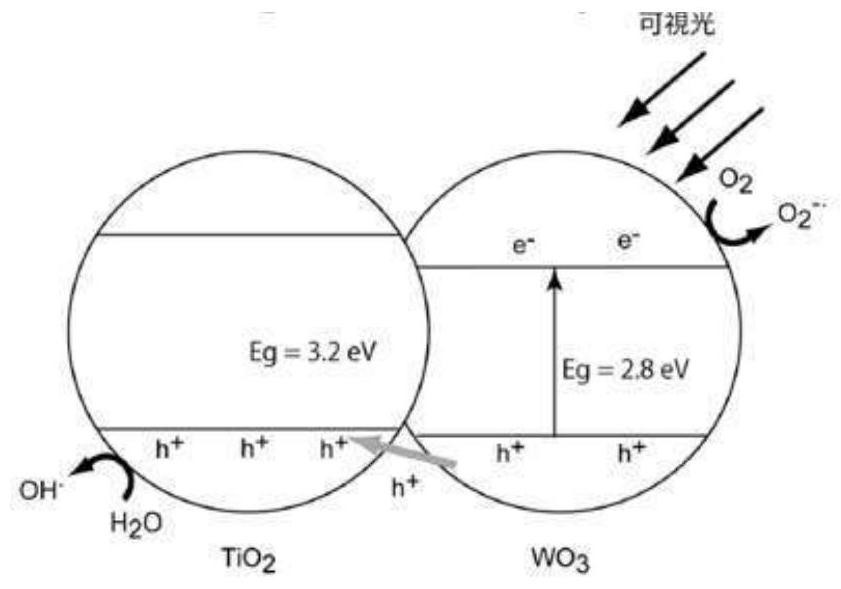
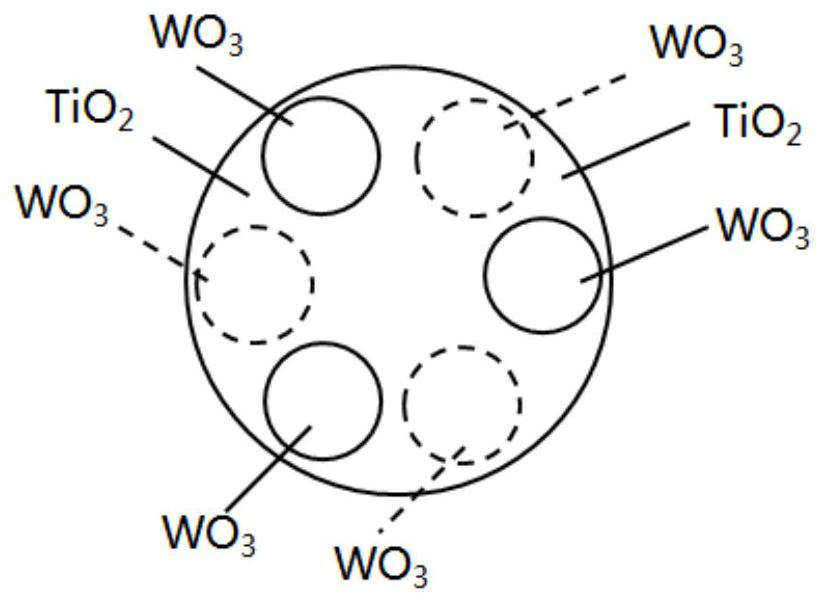
The invention provides a preparation method of visible light response photocatalyst composite nanoparticles. The preparation method is used for obtaining titanium dioxide / tungsten trioxide composite particles with tungsten trioxide attached to the surface of titanium dioxide. Electrons and holes generated by the particles under the condition that illumination acts on the surface of a material diffuse on the surfaces of the respective particles, and active oxygen groups can be generated if the particles encounter oxygen and water. In an air environment, the electrons can reduce oxygen adsorbed on the surfaces of particles into peroxide free radicals, and the holes can oxidize water to generate hydroperoxide free radicals. The peroxide free radicals and the hydroperoxide free radicals have an equilibrium relationship with the hydroperoxide free radicals in water, and both the peroxide free radicals and the hydroperoxide free radicals contain active oxygen with a bactericidal effect. The protective material prepared from the material can be used for resisting bacteria, killing viruses and preventing epidemic securely and easily under the condition that too many living habits of the public are not changed, and the possibility that people are infected by unknown viruses in normal social life and large-area virus transmission is formed can be greatly reduced.

Description

technical field [0001] The invention relates to a preparation method of visible light-responsive photocatalyst composite nanoparticles, and relates to photocatalyst sterilizing materials and the application field thereof. Background technique [0002] Pathogenic microorganisms, molds, mildew, spores, and organic and inorganic pollutants are common in the environment. Microbial control and disinfection in environmental space is of positive significance for improving health and preventing infectious diseases. For example, reactive oxygen species (ROS) generated by photocatalytic oxidation processes kill microorganisms. More specifically, the resulting hydroxyl radicals, hydroperoxide radicals, chlorine and ozone - the end products of photocatalytic reactions, as well as oxidized organic compounds - kill microorganisms and even viruses. However, due to effectiveness limitations and safety issues, the promotion of the above methods has been limited. [0003] Research results ...

Claims

the structure of the environmentally friendly knitted fabric provided by the present invention; figure 2 Flow chart of the yarn wrapping machine for environmentally friendly knitted fabrics and storage devices; image 3 Is the parameter map of the yarn covering machine
Login to View More

Application Information

Patent Timeline
no application Login to View More
IPC IPC(8): B01J23/30B82Y20/00B82Y40/00B01J35/06B01J37/34B01J37/08A61L2/08
CPCB01J23/30B01J23/002B82Y20/00B82Y40/00B01J37/342B01J37/082A61L2/088B01J35/58B01J35/40B01J35/39
Inventor 陈劲风
Owner SUZHOU GINET NEW MATERIAL TECH CO LTD