Preparation method of crystal particle electrode with uniform crystal face orientation characteristic
A technology of crystal plane orientation and particle electrodes, which is applied to equipment for manufacturing conductive/semiconductive layers, cable/conductor manufacturing, circuits, etc., can solve the problem of high cost, and achieve simple preparation devices, flexible operation, and scalability strong effect
- Summary
- Abstract
- Description
- Claims
- Application Information
AI Technical Summary
Problems solved by technology
Method used
Image



Examples
Embodiment 1
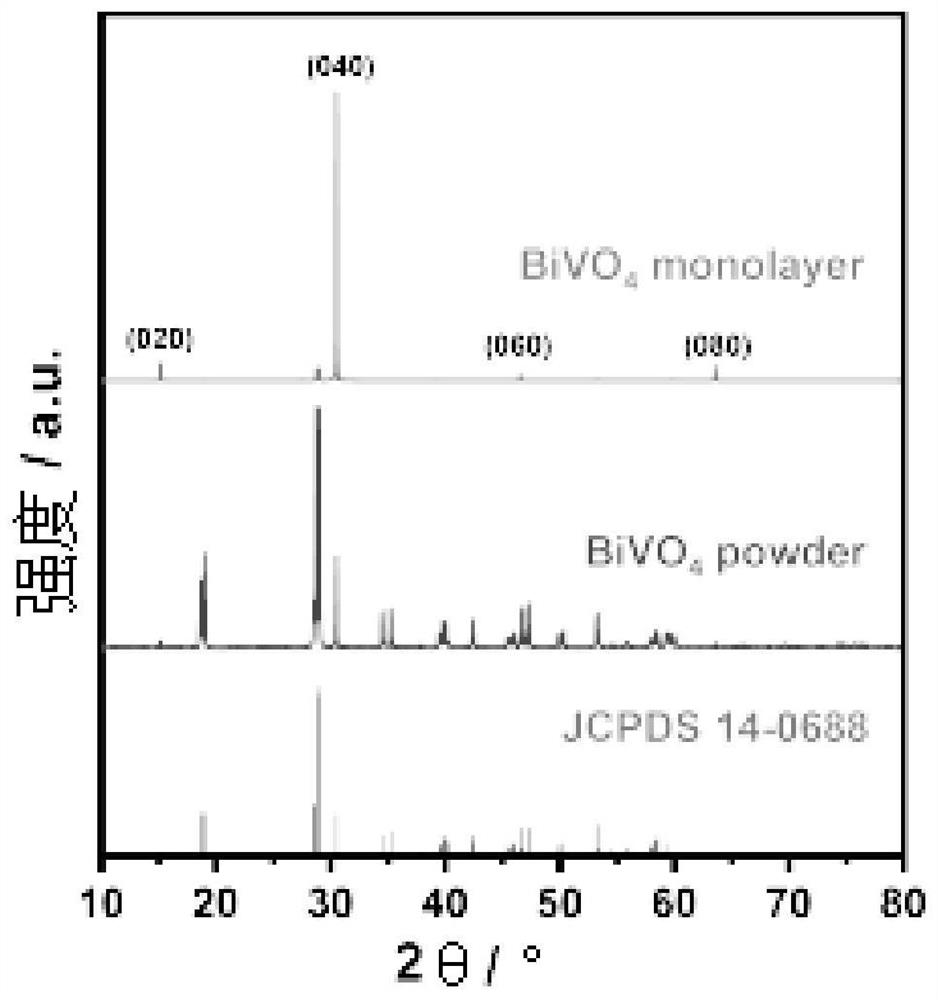
[0037] (040) Oriented BiVO 4 / glass precursor and electrode preparation method:
[0038] BiVO 4 The powder was prepared according to the modified method in the literature [1] . Usually, 6mmol Bi(NO 3 ) 3 ·5H 2 O and 6 mmol NH 4 VO 3 Dissolve in 20 mL of 2M HNO 3 and 2M NaOH, then mix the two solutions, add 4mL of ethylene glycol and stir for 30min, adjust the pH to 2.0 with ammonia water, continue to stir for 30min, transfer the mixture to a 50mL reactor, and conduct a hydrothermal reaction at 200°C for 24 hours, then cool After filtering and washing several times, BiVO was obtained after drying 4 powder.
[0039] Preparation of (040) Oriented BiVO by Rubbing Method 4 / glass precursor: wash the glass slices, according to 5-20μL / cm 2 A 0.2-2wt% polyethyleneimine (PEI) ethanol solution is added dropwise, and spin-coated at 1000-3000 rpm for 30 seconds to obtain a PEI-modified glass sheet. Use latex gloves to dip BiVO 4The powder is gently rubbed on the glass evenly...
Embodiment 2
[0049] (040) Plane-Oriented BiVO Sheets 4 / glass precursor preparation method:
[0050] Flake BiVO 4 The powder was prepared according to the method in the literature [2] . Usually, 6mmol Bi(NO 3 ) 3 ·5H 2 O and 6 mmol NH 4 VO 3 Dissolve in 20 mL of 2M HNO 3 and 2M NaOH, then mix the two solutions, add 4mL ethylene glycol and 60μL TiCl 3 After the solution was stirred for 30 minutes, the pH was adjusted to 2.0 with ammonia water, and the stirring was continued for 30 minutes, then transferred to a reaction kettle, and subjected to hydrothermal reaction at 200°C for 24 hours, cooled, filtered and washed several times, and dried to obtain flaky BiVO 4 powder.
[0051] Fabrication of (040) Oriented BiVO Sheets by Langmuir-Blodgett Self-Assembly Method 4 / glass precursor: 0.3-0.6g flake BiVO 4 Powder, 50-100mL toluene, 5-15mL oleic acid are mixed and ultrasonicated for several hours, then refluxed in Dean-Stark apparatus for 12 hours, washed with ethanol and dispersed ...
Embodiment 3
[0055] (200) Oriented SrTiO 3 / glass precursor preparation method:
[0056] SrTiO 3 The powder is prepared by the molten salt method, and the molar ratio of SrCO 3 :TiO 2 :Na 2 CO 3 =1:1:2 After the three are ground evenly, they are calcined in a muffle furnace at 1000°C for 3 hours, and then lowered to room temperature at 1°C / min. Cleaned with deionized water, centrifuged and dried to obtain SrTiO 3 powder.
[0057] Preparation of (200) Oriented SrTiO by Rubbing Method 3 / glass precursor: wash the glass slices, according to 5-20μL / cm 2 Add 0.2-2wt% PEI ethanol solution dropwise, and spin-coat at 1000-3000 rpm for 30 seconds to obtain a PEI-modified glass sheet. Use latex gloves to dip SrTiO 3 Gently rub the powder evenly on the glass sheet to get (200) crystal plane oriented SrTiO 3 / glass precursor.
[0058] (200) Oriented SrTiO Prepared by Langmuir-Blodgett Self-Assembly Method 3 / glass precursor: add 0.3-0.6g SrTiO 3 Powder, 50-100mL toluene, 5-10mL 1-butanol...
PUM
 Login to View More
 Abstract
Description
Claims
Application Information
 Login to View More