A kind of thioxanthone visible light initiator and its preparation method and application
What is AI technical title?
AI technical title is built by Patsnap AI team. It summarizes the technical point description of the patent document.
A thioxanthone, visible light technology, used in organic chemistry and other directions
Active Publication Date: 2022-06-28
GUIZHOU EDUCATION UNIV
View PDF0 Cites 0 Cited by
Summary
Abstract
Description
Claims
Application Information
AI Technical Summary
This helps you quickly interpret patents by identifying the three key elements:
Problems solved by technology
Method used
Benefits of technology
Problems solved by technology
The existing thioxanthone initiators that can be used in free radical-cationic curing systems cannot take into account the characteristics of visible light initiation, high initiation activity and simple synthesis method (suitable for industrial production) at the same time.
Method used
the structure of the environmentally friendly knitted fabric provided by the present invention; figure 2 Flow chart of the yarn wrapping machine for environmentally friendly knitted fabrics and storage devices; image 3 Is the parameter map of the yarn covering machine
View more
Image
Smart Image Click on the blue labels to locate them in the text.
Viewing Examples
Smart Image
Click on the blue label to locate the original text in one second.
Reading with bidirectional positioning of images and text.
Smart Image
Examples
Experimental program
Comparison scheme
Effect test
Embodiment 1
[0027] Preparation of N,N-bis(benzyl)thioxanthone photoinitiator (TXNB for short) 2 )
[0028] 2-Aminothioxanthone (3.41g, 15.0mmol), benzyl chloride (3.89g, 30.75mmol), anhydrouspotassiumcarbonate ( 4.67 g, 33.825 mmol), 35 mL of N,N-dimethylformamide, heated to 145° C. with stirring, and TLC detected the reaction completion after 0.5 h. Filtration, concentration, washing with water, drying, dissolving in dichloromethane, and reprecipitation in petroleumether to obtain 5.07 g of pure product with a yield of 83%.
[0031] Preparation of N,N-bis(benzyl)thioxanthone photoinitiators
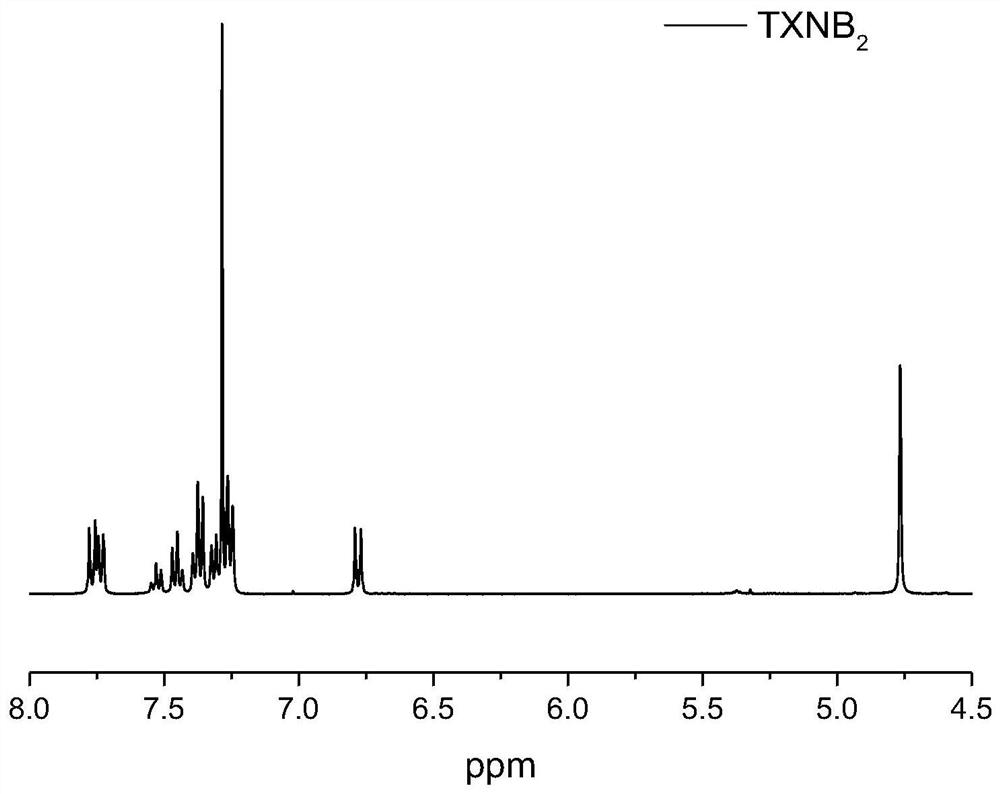
[0032] 2-Aminothioxanthone (3.41g, 15.0mmol), benzyl chloride (4.08g, 32.25mmol), pyridine (3.19g, 40.31 mmol), 68 mL of toluene, heated to 100° C. with stirring, and the completion of the reaction was detected by TLC after 12 h. Filtration, concentration, washing with water, drying, dissolving in dichloromethane, and reprecipitation in petroleumether to obtain 5.61 g of pure product with a yield of 92%. The obtained pure product was confirmed to be N,N-bis(benzyl)thioxanthone from the data of H NMR spectrum.
Embodiment 3
[0034] Preparation of N,N-bis(benzyl)thioxanthone photoinitiators
[0035] 2-Aminothioxanthone (3.41g, 15.0mmol), benzyl chloride (4.18g, 33.0mmol), sodiumcarbonate (4.37g) were added to a 250ml three-necked flask equipped with a reflux condenser, a thermometer and a stirring bar. , 41.25 mmol), 40 mL of xylene, heated to 120° C. with stirring, and TLC detected the completion of the reaction after 10 h. Filtration, concentration, washing with water, drying, dissolving in dichloromethane, and reprecipitation in petroleum ether to obtain 5.68 g of pure product with a yield of 93%. The obtained pure product was confirmed to be N,N-bis(benzyl)thioxanthone from the data of H NMR spectrum.
the structure of the environmentally friendly knitted fabric provided by the present invention; figure 2 Flow chart of the yarn wrapping machine for environmentally friendly knitted fabrics and storage devices; image 3 Is the parameter map of the yarn covering machine
Login to View More
PUM
Property
Measurement
Unit
strength
aaaaa
aaaaa
Login to View More
Abstract
The invention provides a thioxanthone visible light initiator, a preparation method and an application. The structure of this thioxanthone visible photoinitiator is shown in formula (I), wherein R is benzyl, 4-dimethylaminobenzyl, 4-methylbenzyl, 3-methylbenzyl, 2-methyl Benzyl, 4-benzyloxybenzyl, 4-methoxybenzyl, 3-(trifluoromethyl)benzyl, 4-bromobenzyl, 3-cyanobenzyl, 3-nitrobenzyl, 2-(trifluoromethyl)benzyl, 3,5-bis(trifluoromethyl)benzyl or 4-cyanobenzyl. The thioxanthone visible light initiator provided by the present invention has good compatibility with acrylates, can effectively initiate monomerpolymerization without additives, and can initiate epoxy and ethylenepolymerization when used in combination with iodonium salts. Cationic polymerization or radical-cationic polymerization of base ether monomers has high initiating activity and simple structure, which is beneficial to industrial production.
Description
technical field [0001] The invention relates to the field of photoinitiators, and more particularly, to a visible light initiator of thioxanthone, and a preparation method and application thereof. Background technique [0002] Photopolymerization technology is a technology that uses ultraviolet light or visible light to initiate the transformation of reactive liquid substances into solid substances. At present, there are many kinds of photoinitiators, and the initiation mechanism can be roughly divided into four types: decompositionreaction mechanism, hydrogen extraction reaction mechanism, energy transfer mechanism and ionreaction mechanism. According to the reaction mechanism, photoinitiators are mainly divided into free radical photoinitiators and cationic photoinitiators. Among them, thioxanthone photoinitiator is a common hydrogen-pumping photoinitiator, which is often used with hydrogen-donating amines to initiate free radical polymerization, and can be widely used ...
Claims
the structure of the environmentally friendly knitted fabric provided by the present invention; figure 2 Flow chart of the yarn wrapping machine for environmentally friendly knitted fabrics and storage devices; image 3 Is the parameter map of the yarn covering machine
Login to View More
Application Information
Patent Timeline
Application Date:The date an application was filed.
Publication Date:The date a patent or application was officially published.
First Publication Date:The earliest publication date of a patent with the same application number.
Issue Date:Publication date of the patent grant document.
PCT Entry Date:The Entry date of PCT National Phase.
Estimated Expiry Date:The statutory expiry date of a patent right according to the Patent Law, and it is the longest term of protection that the patent right can achieve without the termination of the patent right due to other reasons(Term extension factor has been taken into account ).
Invalid Date:Actual expiry date is based on effective date or publication date of legal transaction data of invalid patent.


 Login to View More