Pathogen detection background microorganism judgment method and application

A microbiological and background technology, applied in the field of bioinformatics analysis, can solve the problems of batch false positives, fluctuations, high internal references, etc., and achieve the effect of wide range of functions and high application scalability

A microbiological and background technology, applied in the field of bioinformatics analysis, can solve the problems of batch false positives, fluctuations, high internal references, etc., and achieve the effect of wide range of functions and high application scalability

CN113284560BActive Publication Date: 2022-05-17GZ VISION GENE TECH CO LTD +3

Image

Smart Image Click on the blue labels to locate them in the text.
Viewing Examples
Smart Image
  • Pathogen detection background microorganism judgment method and application
  • Pathogen detection background microorganism judgment method and application
  • Pathogen detection background microorganism judgment method and application

Examples

Experimental program
Comparison scheme
Effect test

Embodiment 1

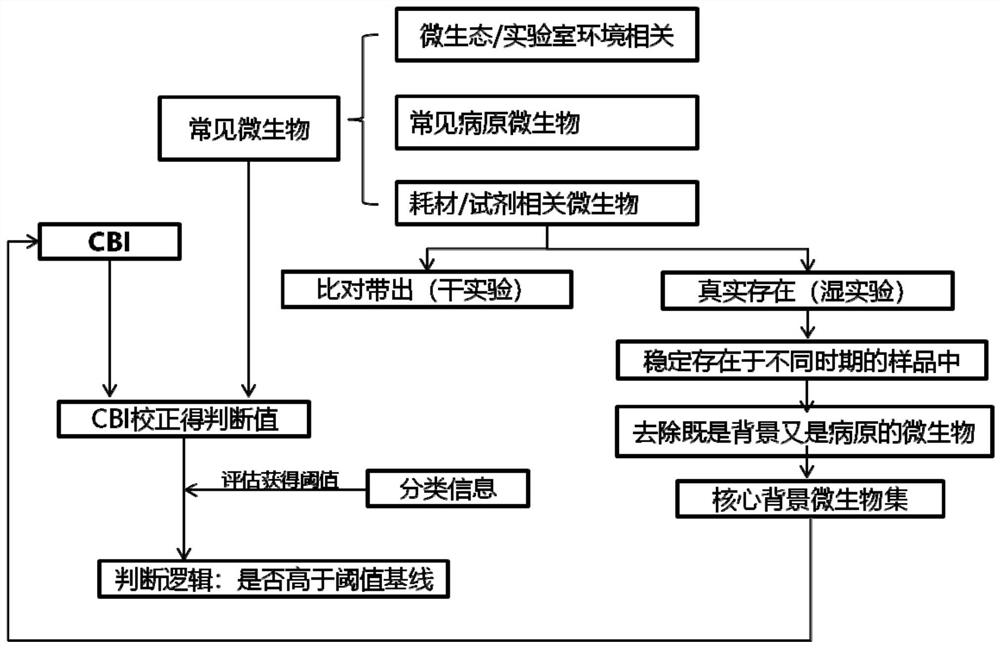
[0107] A method for determining pathogen detection background microorganisms, such as figure 1 shown, including the following steps:

[0108] 1. Determine the list of core background microorganisms.

[0109] 1.1 Sample analysis.

[0110] Take about 20,000 mNGS DNA samples sequenced in our company's Guangzhou laboratory. According to the time sequence of the samples, every 2,000 samples are used as a data set (each data set contains various types of samples at the same time, such as Alveolar lavage fluid, sputum, cerebrospinal fluid, throat swab, blood, tissue, etc.).

[0111] Firstly, obtain the microorganisms whose occurrence frequency is greater than 25% in the data set and appear in all the data sets, that is, the microorganisms that appear frequently and stably in the samples.

[0112] Then calculate the pearson correlation test and spearman correlation test between the nucleic acid extraction concentration or library concentration of these samples and the number of spe...

Embodiment 2

[0138] 639 clinical samples were collected as a verification set, and the method in Example 1 was used to analyze and judge whether the characteristic sequence in the sample was a background sequence.

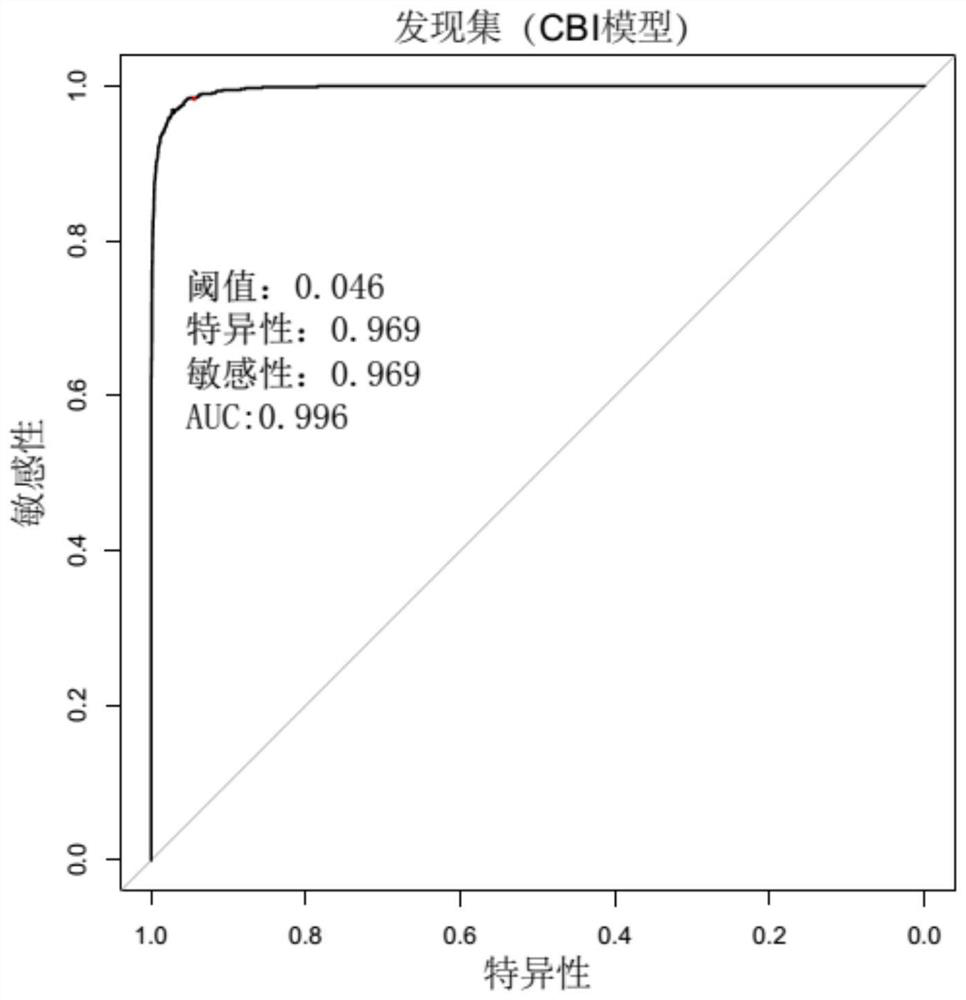
[0139] Sequence according to the method of Example 1, obtain wherein Acinetobacter baumannii gene sequence data, analyze according to the above-mentioned method, build a model, draw the ROC curve, the result is as follows Figure 4 As shown, judging by the threshold value of 0.041, the AUC value was 0.992, the specificity was 0.942, and the sensitivity was 0.983.

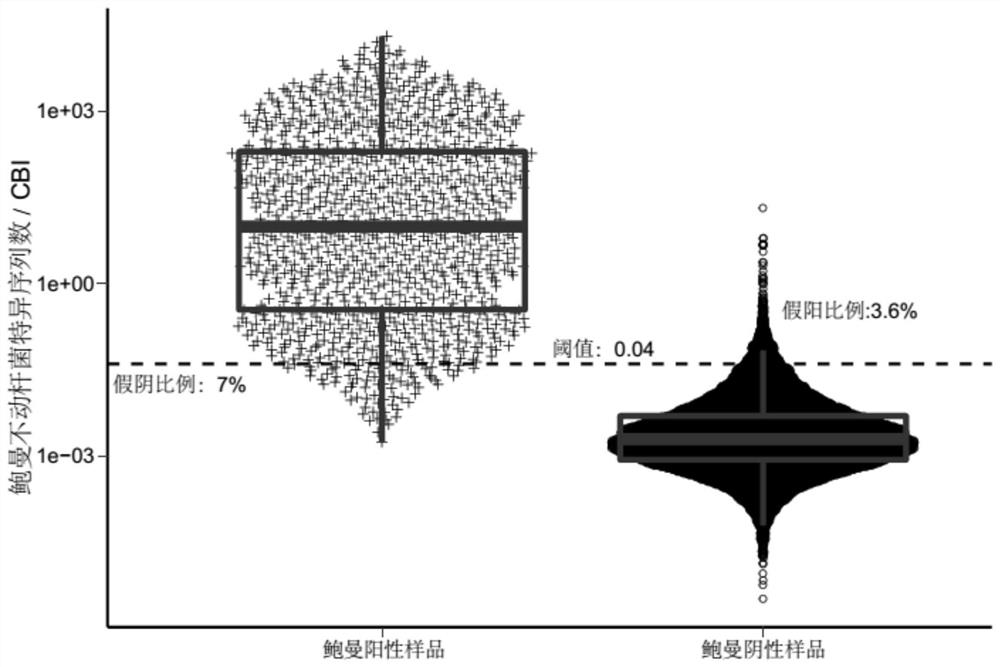
[0140] The above results show that the method for determining background microorganisms in pathogen detection of the present invention can achieve a better discrimination effect on samples from different source batches, and has the advantages of high determination stability and strong practicability.

[0141] It can be understood that the judgment method in the above embodiment is applicable to a wide range of sample...

the structure of the environmentally friendly knitted fabric provided by the present invention; figure 2 Flow chart of the yarn wrapping machine for environmentally friendly knitted fabrics and storage devices; image 3 Is the parameter map of the yarn covering machine
Login to View More

PUM

No PUM Login to View More

Abstract

The invention relates to a pathogen detection background microorganism judgment method and its application, and belongs to the technical field of bioinformatics analysis. The judgment method includes the following steps: determine the list of core background microorganisms: take a number of biological samples, compare the gene sequence data of each microorganism to the characteristic sequence region of the corresponding microorganism, and perform a correlation test with the nucleic acid extraction concentration or library concentration to obtain the correlation The list of microorganisms that are negatively correlated can be used to obtain the list of core background microorganisms; determine the core background microorganism correction index CBI: the sum of the specific comparison sequence numbers of all microorganisms in the above core background microorganism list is the CBI; background sequence judgment: the sample to be tested The judgment value was obtained by dividing the number of specific alignment sequences of microorganisms in the medium and the CBI. Using this method, the background microorganism index can be used to correct the background-related microorganisms, and the presence or absence of the pathogenic microorganisms in the sample can be judged according to the corrected amount, so that the result can be judged more accurately.

Description

technical field [0001] The invention relates to the technical field of bioinformatics analysis, in particular to a method and application for determining background microorganisms in pathogen detection. Background technique [0002] Pathogenic metagenomics (mNGS) is a high-throughput sequencing technology that does not depend on culture, directly extracts nucleic acids from clinical specimens and detects pathogens. Compared with traditional clinical laboratory detection methods, pathogenic mNGS is based on the detection of sequences at the nucleic acid level, which can break through the limitations of different pathogen types, comprehensively cover thousands of pathogens without bias, and simultaneously identify bacteria, fungi, viruses and Various types of pathogenic microorganisms such as parasites, pathogenic mNGS has gradually become an important tool in the field of clinical microbial identification. [0003] However, the accuracy of mNGS is affected by contaminants—DN...

Claims

the structure of the environmentally friendly knitted fabric provided by the present invention; figure 2 Flow chart of the yarn wrapping machine for environmentally friendly knitted fabrics and storage devices; image 3 Is the parameter map of the yarn covering machine
Login to View More

Application Information

Patent Timeline
17 May 2022
Publication
CN113284560B
IPC
G16B40/00; G16B20/30; G16B30/10
CPC
G16B40/00; G16B20/30; G16B30/10; Y02A50/30
Inventors
许腾; 何福生