
Organic waste liquid treatment material
A technology for organic waste liquid and waste liquid, applied in the field of environmental pollution control, can solve the problems of poor activity, cumbersome preparation process, low specific surface area, etc., and achieves the effects of low cost, simple preparation method, and avoiding hole-electron recombination.
Pending Publication Date: 2022-06-24
济南章丘奥丰新材料科技中心
View PDF3 Cites 0 Cited by
- Summary
- Abstract
- Description
- Claims
- Application Information
AI Technical Summary
Problems solved by technology
At present, the common photocatalytic materials have cumbersome preparation process, low specific surface area and poor activity.
Method used
the structure of the environmentally friendly knitted fabric provided by the present invention; figure 2 Flow chart of the yarn wrapping machine for environmentally friendly knitted fabrics and storage devices; image 3 Is the parameter map of the yarn covering machine
View moreImage
Smart Image Click on the blue labels to locate them in the text.
Smart ImageViewing Examples

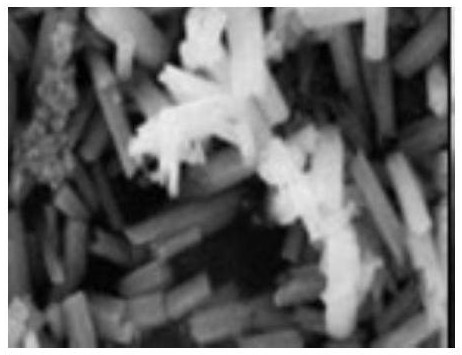
Examples
Experimental program
Comparison scheme
Effect test
Embodiment 1
[0017] (1) 3g of sodium tripolyphosphate is added to 20ml of cyclohexane and 30ml of n-butanol, and ultrasonic mixing forms a blending system;
[0018] (2) the bismuth nitrate of 10mmol, the iron nitrate of 20mmol and the molybdenum nitrate of 1mmol phosphoric acid and 1mmol are added to above-mentioned blending system, followed by water bath reaction at 80-100 degrees Celsius;
[0019] (3) the product obtained is dried, washed with deionized water and ethanol, and dried;
[0020] (4) The product was heat-treated at 350 degrees Celsius for 1 h in an air atmosphere to obtain nanorod-like Mo and P co-doped Bi 2 Fe 4 O 9 .
the structure of the environmentally friendly knitted fabric provided by the present invention; figure 2 Flow chart of the yarn wrapping machine for environmentally friendly knitted fabrics and storage devices; image 3 Is the parameter map of the yarn covering machine
Login to View More PUM
 Login to View More
 Abstract
The invention provides an organic waste liquid treatment material which is characterized by being prepared by the following process: (1) adding sodium tripolyphosphate into a mixed solvent of cyclohexane and n-butyl alcohol, and ultrasonically mixing to form a blending system; (2) adding Bi salt, Fe salt, phosphoric acid and Mo salt in a certain molar ratio into the blending system, and then carrying out water bath reaction at 80-100 DEG C; (3) drying the obtained product, washing with deionized water and ethanol, and drying; and (4) carrying out heat treatment on the product in an air or oxygen atmosphere at the normal butanol degree of 300-500 DEG C, so as to obtain the nanorod-shaped Mo and P co-doped Bi2Fe4O9.
Description
technical field [0001] The invention belongs to the technical field of environmental pollution control, and in particular relates to a preparation method and application of a visible light catalyst. Background technique [0002] In recent years, with the rapid development of society and economy, organic pollution has become a worldwide problem. How to efficiently solve the problem of organic pollution is the hot spot and research focus of many researchers. Some organic substances such as dyes and pesticides exist in water and soil. Degradation seriously affects people's health and life. Photocatalytic technology utilizes semiconductor materials to degrade or mineralize pollutants into environmentally harmless products in a short time under the irradiation of ultraviolet and visible light, and accelerate the decomposition of organic pollutants. It is of great practical significance to develop high-performance photocatalytic materials. CN201710155915.3 discloses a method for...
Claims
the structure of the environmentally friendly knitted fabric provided by the present invention; figure 2 Flow chart of the yarn wrapping machine for environmentally friendly knitted fabrics and storage devices; image 3 Is the parameter map of the yarn covering machine
Login to View More Application Information
Patent Timeline
 Login to View More
 IPC IPC(8): B01J27/192B01J35/10C02F1/30C02F101/30
CPCB01J27/192C02F1/30C02F2101/30C02F2305/10B01J35/61B01J35/39
Inventor李玉柱
Owner济南章丘奥丰新材料科技中心