Check patentability & draft patents in minutes with Patsnap Eureka AI!

Process for preparation of 3,4-methylenedioxy-mandelic acid

A technology of dioxyalmond and methylenedioxybenzene is applied in the field of preparation of 3,4-methylenedioxymandelic acid, and can solve the problems of adding amount recording and the like

Inactive Publication Date: 2005-09-28
UBE IND LTD
View PDF1 Cites 0 Cited by
  • Summary
  • Abstract
  • Description
  • Claims
  • Application Information

AI Technical Summary

Problems solved by technology

Therefore, there is no description of the type of solvent and its effect, and when an organic acid is used, there is no description of its specific addition amount.

Method used

the structure of the environmentally friendly knitted fabric provided by the present invention; figure 2 Flow chart of the yarn wrapping machine for environmentally friendly knitted fabrics and storage devices; image 3 Is the parameter map of the yarn covering machine
View more

Image

Smart Image Click on the blue labels to locate them in the text.
Viewing Examples
Smart Image
  • Process for preparation of 3,4-methylenedioxy-mandelic acid

Examples

Experimental program
Comparison scheme
Effect test

Embodiment 1

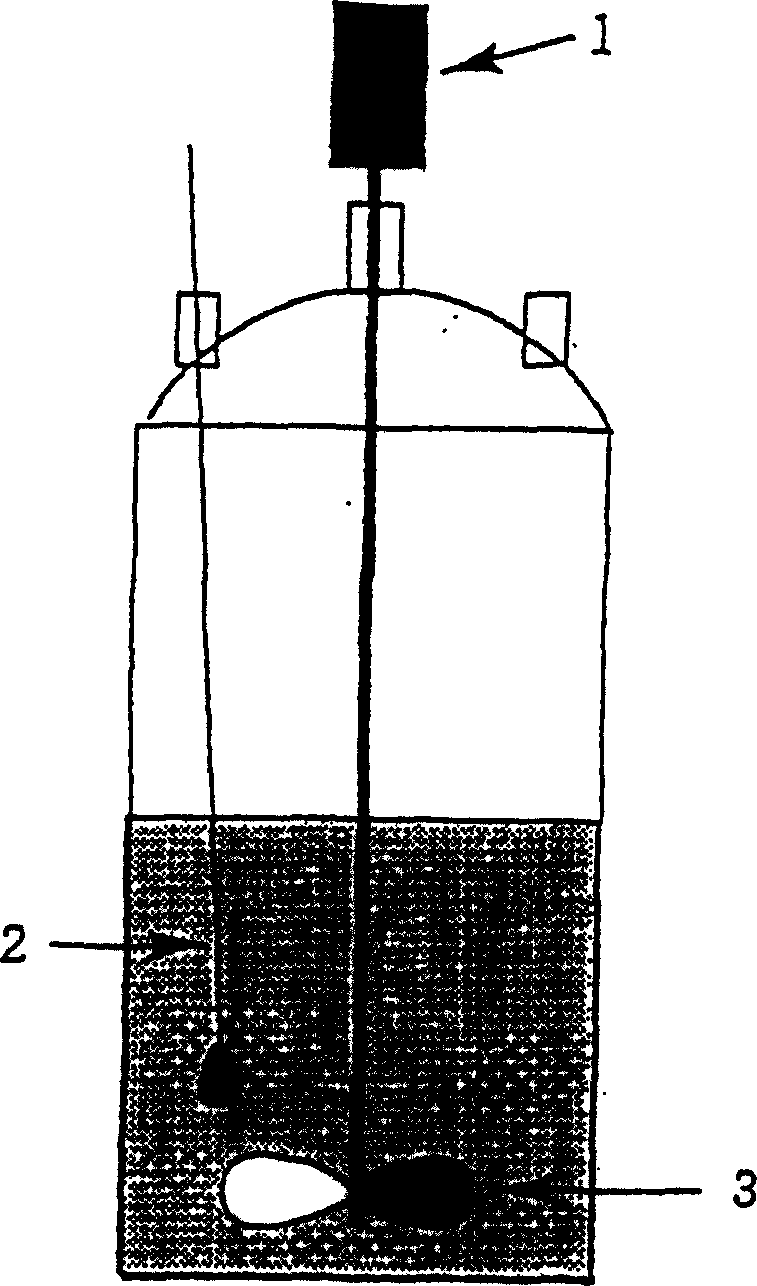
[0018] Under nitrogen atmosphere, to figure 1 Add 1,2-methylenedioxybenzene 50.0g (0.409mol) and 4-methyl-2-pentanone 25ml in the flat-bottomed split-neck flask of shown inner volume 500ml (organic solvent is relative to 1,2-methylene The amount of methylenedioxybenzene used is 500ml / kg), and then cooled to -5°C while stirring. in addition, figure 1 Among them, 1 represents the motor, 2 represents the thermometer, and 3 represents the stirring blade. Next, a mixed solution of 83.4 g (0.450 mol) of 40% by weight glyoxylic acid aqueous solution and 85.8 g (0.839 mol) of 96% by weight sulfuric acid was added dropwise, followed by stirring at -5°C for 21 hours. In addition, stirring during the reaction proceeded smoothly.

[0019] Then, 102.0 g (1.67 mol) of 28% by weight of ammonia water was slowly added for neutralization. Next, 100 ml of 2-butanone was added, heated to 60° C., and the produced 3,4-methylenedioxymandelic acid was extracted into the 2-butanone layer (organic ...

Embodiment 2~4

[0021] In Example 1, it reacted similarly to Example 1 except having changed the organic solvent used, reaction temperature, and reaction time. The results are shown in Table 1.

[0022]

Example

Aprotic organic solvents

temperature reflex

(℃)

Reaction time

(h)

MDB conversion

Rate(%)

MDMA selection

Selectivity (%)

2

3-pentanone

-5

23

94

91

3

Dimethyl carbonate

0

28

93

91

4

Acetonitrile

0

45

87

92

[0023] MDB: 1,2-Methylenedioxybenzene

[0024] MDMA: 3,4-methylenedioxymandelic acid

Embodiment 5

[0028] Under nitrogen atmosphere, to figure 1 Add 1,2-methylenedioxybenzene 500.0g (4.09mol) and 4-methyl-2-pentanone 250ml (organic solvent relative to 1,2-methylene dioxybenzene) The amount of methylenedioxybenzene used is 500ml / kg), and then cooled to -10°C while stirring. Next, a mixed solution of 833.7 g (4.05 mol) of 40% by weight glyoxylic acid aqueous solution and 857.5 g (8.39 mol) of 96% by weight sulfuric acid was slowly added dropwise, followed by stirring at -5°C for 23 hours. In addition, stirring during the reaction proceeded smoothly.

[0029] Then, 1030.0 g (16.93 mol) of 28% by weight of ammonia water was slowly added for neutralization. Next, add 3,000 ml of 4-methyl-2-pentanone, heat to 80°C, and extract the generated 3,4-methylenedioxymandelic acid into the 4-methyl-2-pentanone layer (organic layer) . The organic layer was analyzed by high performance liquid chromatography. As a result, the conversion rate of 1,2-methylenedioxybenzene was 95%, and the ...

the structure of the environmentally friendly knitted fabric provided by the present invention; figure 2 Flow chart of the yarn wrapping machine for environmentally friendly knitted fabrics and storage devices; image 3 Is the parameter map of the yarn covering machine
Login to View More

PUM

No PUM Login to View More

Abstract

A process for preparing 3,4-methylenedioxymandelic acid by reacting 1,2-methylenedioxybenzene with glyoxylic acid in the presence of a strong acid, characterized in that the reaction is conducted in the presence of an aprotic organic solvent and 100 to 1200 ml of at least one member selected from the group consisting of organic acids per kg of 1,2-methylenedioxybenzene.

Description

technical field [0001] The present invention relates to a process for preparing 3,4-methylenedioxymandelic acid from 1,2-methylenedioxybenzene. 3,4-Methylenedioxymandelic acid is a useful compound as a raw material for the synthesis of drugs, agricultural chemicals, etc., and as a raw material for heliotrope in general cosmetic fragrances. Background technique [0002] It is known that in the presence of strong acids such as sulfuric acid or phosphoric acid, the method of making 1,2-methylenedioxybenzene and glyoxylic acid react to prepare 3,4-methylenedioxymandelic acid (for example, JP-A-54 - Publication No. 95573, Perfumer & Flavorist, 14, 13 (1989)). However, in the above-mentioned method, since the generated 3,4-methylenedioxymandelic acid is insoluble in the reaction system, it precipitates as crystals, and while the reaction proceeds, the reaction liquid becomes highly viscous or solidified, and the stirring becomes unstable. very difficult. Moreover, since this re...

Claims

the structure of the environmentally friendly knitted fabric provided by the present invention; figure 2 Flow chart of the yarn wrapping machine for environmentally friendly knitted fabrics and storage devices; image 3 Is the parameter map of the yarn covering machine
Login to View More

Application Information

Patent Timeline
no application Login to View More
IPC IPC(8): C07D317/60
CPCC07D317/60
Inventor 原田胜正白井昌志斯波晃司
Owner UBE IND LTD
Features
  • R&D
  • Intellectual Property
  • Life Sciences
  • Materials
  • Tech Scout
Why Patsnap Eureka
  • Unparalleled Data Quality
  • Higher Quality Content
  • 60% Fewer Hallucinations
Social media
Patsnap Eureka Blog
Learn More