The reverse solidification method (see: Xu Zhongbo, Special Steel, Volume 18 Supplement, p.15) is that the cladding layer metal liquid is attached to the outer surface of the internal
solid metal and solidified. This method is beneficial to solidification feeding and rolling of
casting rolls, but In order to ensure a good composite of the interface between the
coating layer and the master tape, in addition to controlling the key process parameters such as the immersion time of the master tape, the metal overheating degree of the cladding layer, and the original thickness of the master tape, it is also necessary to pretreat the master tape: lye
degreasing→
Clean water rinsing →
pickling to remove
rust →
clean water rinsing → dilute
hydrochloric acid treatment → flux treatment, if the interface pretreatment effect is not good, or if the interface is oxidized or polluted because it cannot be used immediately after pretreatment, the interface will not be well compounded
The cladding layer
continuous casting method (see: Yamamoto Kosei, Japanese Zhao 57-196464 patent) is that the cladding layer metal liquid is attached to the outer surface of the internal
solid metal and solidifies. This method is beneficial to the solidification and feeding of the cladding layer metal liquid. In order to ensure The cladding layer and the core material interface are well compounded. In addition to controlling the key process parameters such as pouring temperature, heater power, preheater power, and casting speed, it is also necessary to apply a layer of glass
powder coating on the core material to prevent the core material from The material is oxidized during the heating process. If the anti-oxidation effect of the interface is not good, or the
coating material cannot completely float when cladding the metal, the interface will not be well compounded.
One-time casting method of multi-layer composite materials (see: Xie Jianxin et al., Multi-layer composite materials one-time casting and forming equipment and technology,
Chinese patent: ZL98101042.3), adopts measures such as oxidation protection sleeves, and there is no oxidation on the surface of the continuous casting core material. , No inclusions, no
oil pollution, direct continuous casting cladding layer in hot state, but this method is difficult to control the
melting point of cladding metal higher than the melting point of core
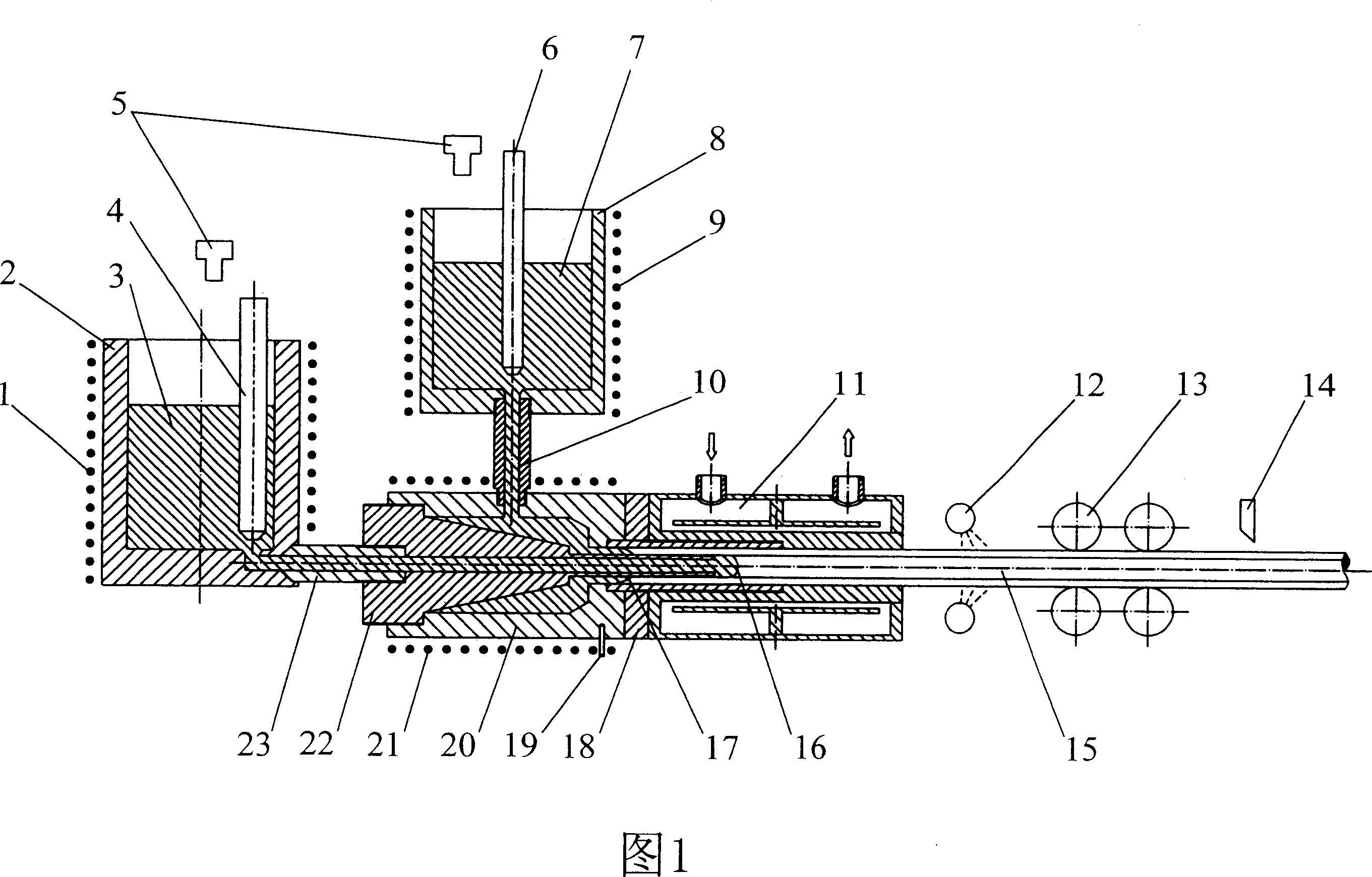
metal metalOne-time casting continuous forming method of cladding material (see: Xie Jianxin, etc., a kind of cladding material one-time casting continuous forming equipment and process,
Chinese patent: ZL01109076.6) proposes a method for producing cladding metals with a melting point higher than that of the core metal. A new method of one-time continuous casting of composite materials. This method has a short process, energy saving and low cost, but this method needs to realize
continuous production, the crimping mechanism is complex, and requires tall workshops and pits. The equipment is not easy to operate and maintain, and automatic production is realized. Relatively difficult; at the same time, in this method, because the connection mode of the equipment is that the core
metal flow guide tube must pass through the cladding layer metal temperature-controlling
crucible, when the core metal liquid flows through the high-temperature cladding layer metal
liquid temperature-controlling
crucible It is difficult to control the temperature when the cladding metal and the core metal are recombined by secondary heating of the cladding layer metal liquid, and it is easy to cause excessive recombination of the cladding layer and the core metal interface (see: Wu Chunjing et al., Special
Casting and Nonferrous Metals
alloy, No.6(2004), p.11-13), resulting in too thick a composite
transition layer or the formation of brittle phases that are not conducive to subsequent
processingThese shortcomings are not conducive to the preparation and large-scale industrial application of high-performance composite materials with the melting point of the cladding metal higher than the melting point of the core metal.


 Login to View More
  Login to View More