Supercharge Your Innovation With Domain-Expert AI Agents!

Starch ester

a starch ester and starch ester technology, applied in the field of starch ester, can solve the problems of hardly achieving the same impact strength level as impact strength polystyrene, difficult to achieve molded articles having an impact resistance of 1, and hardly achieving the stretchability (tensile elongation) of polyethylen

Inactive Publication Date: 2003-06-12
JAPAN CORN STARCH
View PDF0 Cites 0 Cited by
  • Summary
  • Abstract
  • Description
  • Claims
  • Application Information

AI Technical Summary

Benefits of technology

The starch ester exhibits improved impact resistance and tensile elongation, comparable to high-impact polystyrene, and demonstrates high compatibility with biodegradable resins, enabling the production of biodegradable plastics with superior performance without the need for hazardous plasticizers.

Problems solved by technology

Even if produced using the plasticizer, products such as injection-molded articles hardly achieve impact strength at the same levels as with impact strength polystyrene (high impact polystyrene).
It has also been difficult to achieve molded articles having an impact resistance of 1.8 kgf.multidot.cm / cm (17.64 J / m) or more in terms of Izod impact strength (ASTM D256: -23.degree. C.).
Further, products such as inflation films have hardly achieved stretchability (tensile elongation) as good as that of polyethylene.
As a result, such products cannot truly be said to be biodegradable plastics that are based on a starch ester.
Further, the phthalate or fatty ester type plasticizer described above is suspected of being a physiologically disturbing substance, which adversely affects vegetables, foods, and the growth of animals.

Method used

the structure of the environmentally friendly knitted fabric provided by the present invention; figure 2 Flow chart of the yarn wrapping machine for environmentally friendly knitted fabrics and storage devices; image 3 Is the parameter map of the yarn covering machine
View more

Image

Smart Image Click on the blue labels to locate them in the text.
Viewing Examples
Smart Image
  • Starch ester
  • Starch ester
  • Starch ester

Examples

Experimental program
Comparison scheme
Effect test

example 2

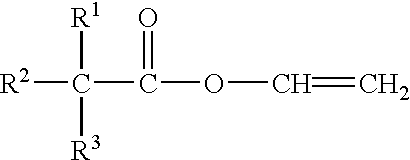
[0077] The starch ester of Example 2 was prepared in the same manner as in Example 1 except that acid-treated regular corn starch was used in place of high amylose corn starch, and 14 g vinyl stearate (C18) was used in place of vinyl laurate.

example 3

[0078] The starch ester of Example 3 was prepared in the same manner as in Example 1 except that 16 g chlorinated stearic acid (C18) was used in place of vinyl laurate.

example 4

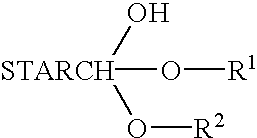
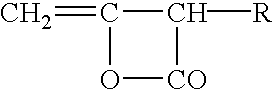
[0079] 100 g commercial corn starch with a water content reduced to 1% or less by preliminary drying, and 800 g DMSO, were introduced into a 2 L separable flask equipped with a stirrer, then heated at 90.degree. C. and gelatinized by keeping it at this temperature for 20 minutes. After a solution of 5 g t-butyl bromide and 532 g hexadecyl ketene dimer (C17) was added dropwise thereto, the mixture was reacted at 90.degree. C. for 5 hours in a system under reduced pressure, during which the DMSO was refluxed. Thereafter, the reaction system was returned to the atmospheric pressure, and a solution of 126 g acetic anhydride and 103.8 g sodium bicarbonate was added dropwise thereto, and the mixture was reacted for 1 hour at the reflux temperature thereof. After the unreacted materials and byproducts were allowed to flow out, the product was recovered under vigorous stirring in water, and then washed repeatedly 5 times with 5 L water to prepare the starch ester of Example 4.

the structure of the environmentally friendly knitted fabric provided by the present invention; figure 2 Flow chart of the yarn wrapping machine for environmentally friendly knitted fabrics and storage devices; image 3 Is the parameter map of the yarn covering machine
Login to View More

PUM

PropertyMeasurementUnit
glass transition pointaaaaaaaaaa
degree of water absorptionaaaaaaaaaa
Login to View More

Abstract

The present invention relates to a starch ester having short- and long-chain acyl groups wherein hydrogens in reactive hydroxyl groups in the same starch molecule have been replaced by C2-4 short-chain acyl groups and C6-18 long-chain acyl groups. The degree of substitution by the short- and long-chain acyl groups are regulated so as to make the starch ester thermo-plasticized and moldable even in the absence of a plasticizer. Accordingly, the starch ester of the present invention can be used as a biodegradable thermoplastic plastic material which can be thermo-plasticized in the absence of a plasticizer.

Description

[0001] The present invention relates to a starch ester wherein reactive hydroxyl groups in the same starch molecule have been replaced by acyl groups and groups derived therefrom (hereinafter referred to collectively as "acyl groups"). Further, the present invention relates to a starch ester preferable as a base polymer in biodegradable starch-based plastic processed articles.[0002] As used herein, the plastic processed articles include molded processed articles and modified processed articles molding-processed or modified as a whole or partially with a plastic composition, and the molding processing includes injection molding, extrusion molding, inflation, T-die extrusion, calendering, compression molding (press molding), transfer molding, casting, laminating, vacuum molding, blow molding, foam molding, coating, flow casting, heat fusion, stretching etc. (see 5th Handbook of Chemistry, Applied Chemistry I, p. 773, Table 10.22, Mar. 15, 1995, compiled by the Japanese Society of Chem...

Claims

the structure of the environmentally friendly knitted fabric provided by the present invention; figure 2 Flow chart of the yarn wrapping machine for environmentally friendly knitted fabrics and storage devices; image 3 Is the parameter map of the yarn covering machine
Login to View More

Application Information

Patent Timeline
no application Login to View More
Patent Type & Authority Applications(United States)
IPC IPC(8): C08B31/04C08L3/06C08L101/16
CPCC08B31/04C08L3/06C08L2666/02Y10T428/31786Y10T428/31971C08L3/02C08J5/00
Inventor TANAKA, HIDEYUKI
Owner JAPAN CORN STARCH
Features
  • R&D
  • Intellectual Property
  • Life Sciences
  • Materials
  • Tech Scout
Why Patsnap Eureka
  • Unparalleled Data Quality
  • Higher Quality Content
  • 60% Fewer Hallucinations
Social media
Patsnap Eureka Blog
Learn More