
Nonlinear optical material with nano-sized dendrimer structure
a technology of dendrimer structure and optical material, which is applied in the field of nano-sized dendrimer structure of optical material, can solve the problems of deterioration of thermal stability, optical loss, and material more restricted in application
- Summary
- Abstract
- Description
- Claims
- Application Information
AI Technical Summary
Benefits of technology
Problems solved by technology
Method used
Image

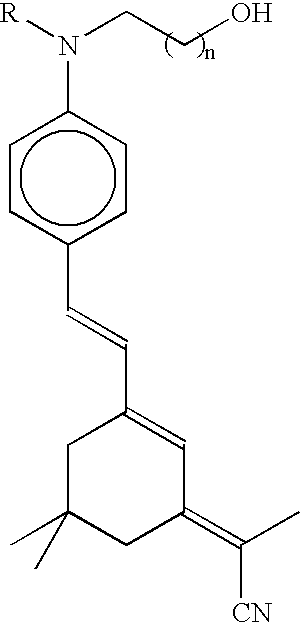
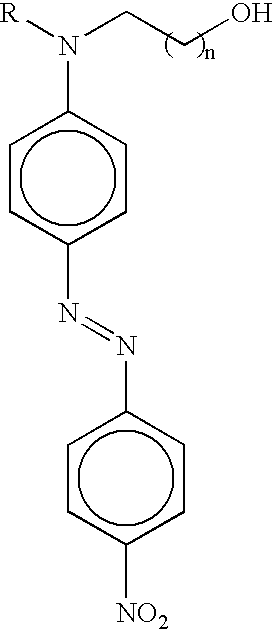
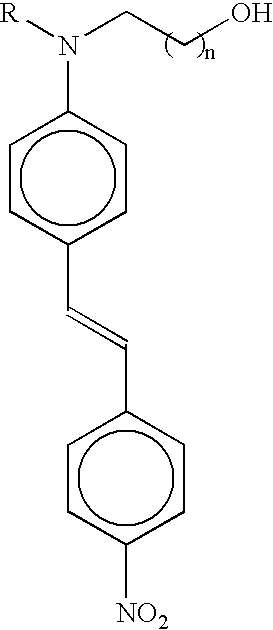
Examples
example 2
[0045] The compounds (2) or (4) obtained in the Example 1 were taken out 3.6 equivalents, individually and dissolved in a refined acetone together with 1,1,1-trihydroxyphenyl ethane. Subsequently, 1.5 equivalents of solid material (4-dimethyl amino pyridinium-p-toluene sulfonate: DPTS), which was obtained from an equivalent reaction between 4-dimethylamino pyridine and toluene sulfonic acid, and 3.6 equivalents of dicyclo hexylcarbodiimide (DCC) were added to acetone solution in an atmosphere of nitrogen, and then the solution was agitated at a room temperature for about two days, thus producing slurry. The slurry was filtrated to remove solid matters. Then, acetone was removed by around two thirds, and the resultant was refined by dropping the resultant in methanol, thus producing a compound (7) of Reaction Formula 2 or a compound (13) of Reaction Formula 4B. The compound (7) or (13) was dissolved in dichloromethane completely and methanol was added thereto in the same amount as th...
example 3
[0050] 0.69 g of the compound (8) of Reaction Formula 2, which was obtained in the Example 2 as a precursor for an optical dendrimer, and 6.3 equivalents (i.e., 4.85 g) of duple connected aminophenyl isophorone dicyanide(DAIDC), which was to be an organic chromophore, were dissolved in 40 ml of tetrahydrofuran anhydride sufficiently. Here, the DAIDC was a DAIDC of Table 2 where B and R are CH.sub.2 and CH.sub.3, respectively, and n is 1.
[0051] Subsequently, 8.3 equivalents (i.e., 2.12 g) of triphenyl phosphine was added to the above solution, and 1.34 ml of DEAD was divided into four portions and each portion of DEAD was added thereto once every 30 minutes for two hours. The mixture was agitated for one day and it was poured in 0.31 of methanol slowly to be precipitated. The obtained precipitate was dried in the air, and then it was dissolved again in tetrahydrofuran at a weight ratio of 12%. The solution was re-precipitated in methanol, again, to remove remaining chromophores and r...
example 4
[0055] 0.505 g of the compound (14), which was obtained as a precursor for an optical dendrimer in the Example 2, and 13.2 equivalents (i.e., 3.5 g) were dissolved in 30 ml of tetrahydrofuran anhydride sufficiently. Then, 14.4 equivalents (i.e., 1.25 g) of triphenyl phosphine was added to the solution in the presence of nitrogen, and 0.77 ml of DEAD was added thereto once every 30 minutes for 8 hours. Each time, a fourth of the DEAD was added. The solution was agitated for one day at a room temperature and precipitated slowly by being dropped in 0.31 of methanol. The obtained precipitate was dried in the atmosphere and then dissolved again in 12 wt % of the tetrahydrofuran. The solution was re-precipitated in methanol to remove remaining chromophores and reaction by-products, thus producing a red powdery compound (37). The red powdery compound (37) was dried in a vacuum condition based on Reaction Formula 14 and used. In a similar method, a compound (35) and a compound (36) can be p...
PUM
| Property | Measurement | Unit |
|---|---|---|
| pressure | aaaaa | aaaaa |
| wt % | aaaaa | aaaaa |
| mass | aaaaa | aaaaa |
Abstract
Description
Claims
Application Information
 Login to View More