This helps you quickly interpret patents by identifying the three key elements:
Problems solved by technology
Method used
Benefits of technology
Benefits of technology
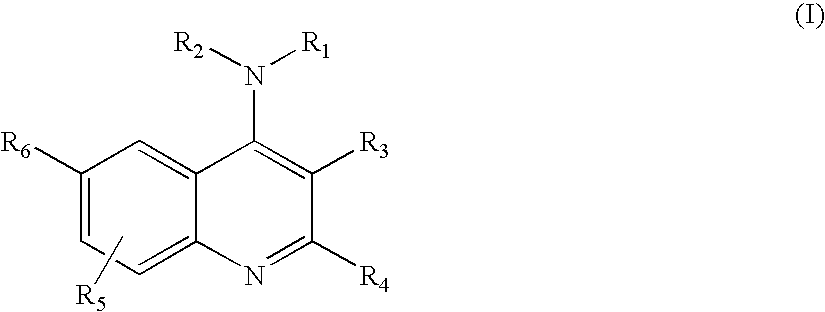
and pharmaceutically acceptable salts thereof, which are useful as melanin concentrating hormone (MCH) receptor antagonists.
As melanin concentrating hormone receptor antagonists, the compounds of the present invention are useful in the treatment, prevention and suppression of diseases mediated by the MCH receptor. In particular, compounds of the present invention are selective antagonists of the MCH-1R subtype receptor. As MCH-1R antagonists, the compounds of the present invention may be useful in treating the following conditions: obesity, diabetes, appetite and eating disorders, cardiovascular disease, hypertension, dyslipidemia, myocardial infarction, gall stones, osteoarthritis, certain cancers, AIDS wasting, cachexia, frailty (particularly in e
Problems solved by technology
Obesity, defined as excess adiposity for a given body size, results from a chronic imbalance between energy intake and energy expenditure.
A BMI above 30 kg / m2 significantly increases the risk of diabetes, hypertension, dyslipidemias and cardiovascular disease, gallstones, osteoarthritis and certain forms of cancer and reduces life expectancy.
The study of energy intake in free living humans has met with only limited success and definitive experimental evidence that hyperphagia causes most forms of human obesity is lacking.
the structure of the environmentally friendly knitted fabric provided by the present invention; figure 2 Flow chart of the yarn wrapping machine for environmentally friendly knitted fabrics and storage devices; image 3 Is the parameter map of the yarn covering machine
View more
Image
Smart Image Click on the blue labels to locate them in the text.
Viewing Examples
Smart Image
Click on the blue label to locate the original text in one second.
Reading with bidirectional positioning of images and text.
Step A: Preparation of ethyl (2E)- and (2Z)-3-{[4-(acetylamino)phenyl]amino}hex-2-enoate
A mixture of N-(4-arninophenyl)acetamnide (9.7 g, 65 mmol), ethyl 3-oxohexanoate (10 g, 65 mmol) and 2 drops conc. HCl in 30 mL ethanol was heated at reflux overnight. After approximately 18 h, the reaction mixture was cooled to r.t. and the solids collected by filtration. The solids were washed with methanol and air dried to afford the crude product as a solid, which was used without further purification in the subsequent reaction.
Step B: Preparation of N-(4-hydroxy-2-propylguinolin-6-yl)acetamide
The crude product (9.0 g) from Step A was mixed with 50 mL of diphenylether. The mixture was heated with a heating mantle at 260° for 2 h then cooled to r.t. The resulting solid was collected by filtration, washed with EtOAc to give a grey solid, which was used directly in the next step.
Step A: Preparation of methyl (2E)-3-{[4-(acetylamino)phenyl]amino}oct-2-enoate
A mixture of N-(4-aminophenyl)acetamide (8.9 g, 59 mmol), methyl oct-2-ynoate (10 g, 64.8 mmol), anhydrouspotassiumfluoride (1 g, 17 mmol) in 100 mL anhydrous N,N-dimethylformamide was purged with nitrogen then heated at 50° overnight. After approximately 18 h, the reaction mixture was cooled to r.t., and filtered. The filtrate was added to 100 mL water, transferred to a separatory funnel and extracted with diethyl ether (5×100 mL). The ether extracts were combined, dried over sodiumsulfate, filtered and the solvent removed under vacuum. The resulting dark oil was purified by column chromatography on silica gel eluting with ethyl acetate / hexane gradient (1:2 to 100:0) to afford the product as a brown solid.
Step B: Preparation of N-(4-hydroxy-2-pentylquinolin-6-yl)acetamide
The product (2.0 g) from Step A was mixed with 20 mL of d...
Step A: Preparatiuon of ethyl (2E)-3-[(4-nitrophenyl)amino]hex-2-enoate
A mixture of 4-nitroaniline (15 g, 109 mmol), ethyl 3-oxohexanoate (10 g, 95 mmol) and p-toluenesulfonic acid (0.5 g, 2.6 mmol) toluene was heated at reflux in a flask equipped with a Dean-Stark apparatus and cooling condenser. After the theoretical amount of water was collected, the solvent was removed under vacuum. The residue was used without further purification in the subsequent reaction.
Step B: Preparation of 6-nitro-2-propylquinolin-4-ol
The crude product from Step A was mixed with diphenylether and the resulting mixture was heated with a heating mantle at 250° for 0.5 h then cooled to r.t. The resulting solid was collected by filtration, washed with EtOAc to give a solid, which was used directly in the next step.
Step C: Preparation of 4-chloro-6-nitro-2-propylquinoline
The crude product (2.3 g) from Step B and...
the structure of the environmentally friendly knitted fabric provided by the present invention; figure 2 Flow chart of the yarn wrapping machine for environmentally friendly knitted fabrics and storage devices; image 3 Is the parameter map of the yarn covering machine
Login to View More
PUM
Property
Measurement
Unit
Fraction
aaaaa
aaaaa
Mass
aaaaa
aaaaa
Dimensionless property
aaaaa
aaaaa
Login to View More
Abstract
The present invention is concerned with compounds of the general Formula I: and pharmaceutically acceptable salts thereof, which are useful as melanin concentrating hormonereceptor antagonists, particularly MCH-1R antagonists. As such, compounds of the present invention are useful for the treatment or prevention of obesity or eating disorders associated with excessive food intake and complications thereof, osteoarthritis, certain cancers, AIDS wasting, cachexia, frailty (particularly in elderly), mental disorders stress, cognitive disorders, sexual function, reproductive function, kidney function, locomotor disorders, attention deficit disorder (ADD), substance abuse disorders and dyskinesias, Huntington's disease, epilepsy, memory function, and spinal muscular atrophy. Compounds of formula I may therefore be used in the treatment of these conditions, and in the manufacture of a medicament useful in treating these conditions. Pharmaceutical formulations comprising one of the compounds of formula (I) as an active ingredient are disclosed, as are processes for preparing these compounds.
Description
CROSS-REFERENCE TO RELATED APPLICATIONS Not applicable. BACKGROUND OF THE INVENTION Obesity, defined as excess adiposity for a given body size, results from a chronic imbalance between energy intake and energy expenditure. Body mass index (BMI, kg / m2) is an accepted clinical estimate of being overweight (BMI 25 to 30) and of obesity (BMI>30). A BMI above 30 kg / m2 significantly increases the risk of diabetes, hypertension, dyslipidemias and cardiovascular disease, gallstones, osteoarthritis and certain forms of cancer and reduces life expectancy. In the vast majority of obese individuals, the cause of the excess adiposity is not immediately apparent. A currently accepted-working hypothesis is that obesity is the result of a maladaptation of the innate metabolic response to environmental challenges such as unlimited availability of low cost / energy dense foods and sedentariness (Hill et al., Science 1998; 280:1371). The study of energy intake in free living humans has met with on...
Claims
the structure of the environmentally friendly knitted fabric provided by the present invention; figure 2 Flow chart of the yarn wrapping machine for environmentally friendly knitted fabrics and storage devices; image 3 Is the parameter map of the yarn covering machine
Login to View More
Application Information
Patent Timeline
Application Date:The date an application was filed.
Publication Date:The date a patent or application was officially published.
First Publication Date:The earliest publication date of a patent with the same application number.
Issue Date:Publication date of the patent grant document.
PCT Entry Date:The Entry date of PCT National Phase.
Estimated Expiry Date:The statutory expiry date of a patent right according to the Patent Law, and it is the longest term of protection that the patent right can achieve without the termination of the patent right due to other reasons(Term extension factor has been taken into account ).
Invalid Date:Actual expiry date is based on effective date or publication date of legal transaction data of invalid patent.


 Login to View More