
Methods for the controlled delivery of pharmacologically active compounds
- Summary
- Abstract
- Description
- Claims
- Application Information
AI Technical Summary
Benefits of technology
Problems solved by technology
Method used
Image

Examples
example 1
[0038] Oxytetracycline
[0039] Oxytetracycline has one tertiary amine group, and the hydrochloride salt of oxytetracycline is readily soluble in water. Adding one mole of fatty acid to one mole of oxytetracycline creates a salt that is more soluble than unmodified oxytetracycline in isopropyl myristate.
[0040] An oxytetracycline composition according to the present invention was prepared by adding 0.464 grams of oxytetracycline and 0.203 grams of lauric acid to 3 ml of isopropyl myristate. The mixture is stirred for 60 minutes, resulting in a clear solution at 25° C.
example 2
[0041] Tilmicosin
[0042] Tilmicosin is an antibiotic in the macrolide class with the following structure:
[0043] It is effective against a broad range of bacteria, and is used for the treatment of respiratory diseases in cattle. The basic form is moderately soluble in aqueous solvents, while the chloride and phosphate salts are highly soluble. At elevated levels, tilmicosin is cardiotoxic, and therefore is not administered intravenously. For safety reasons, its use has been avoided almost entirely in sensitive species such as cats, goats, pigs, and horses.
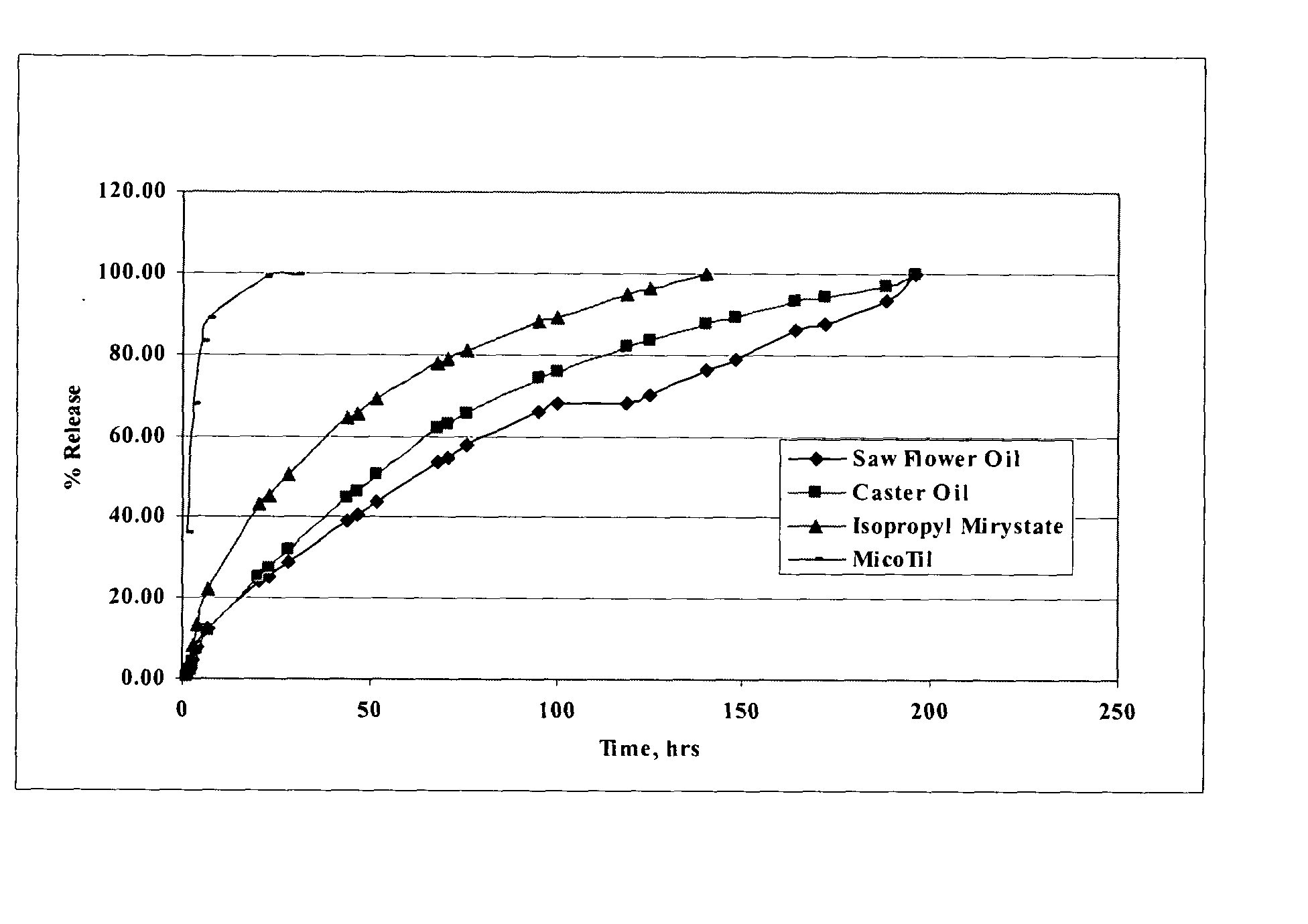
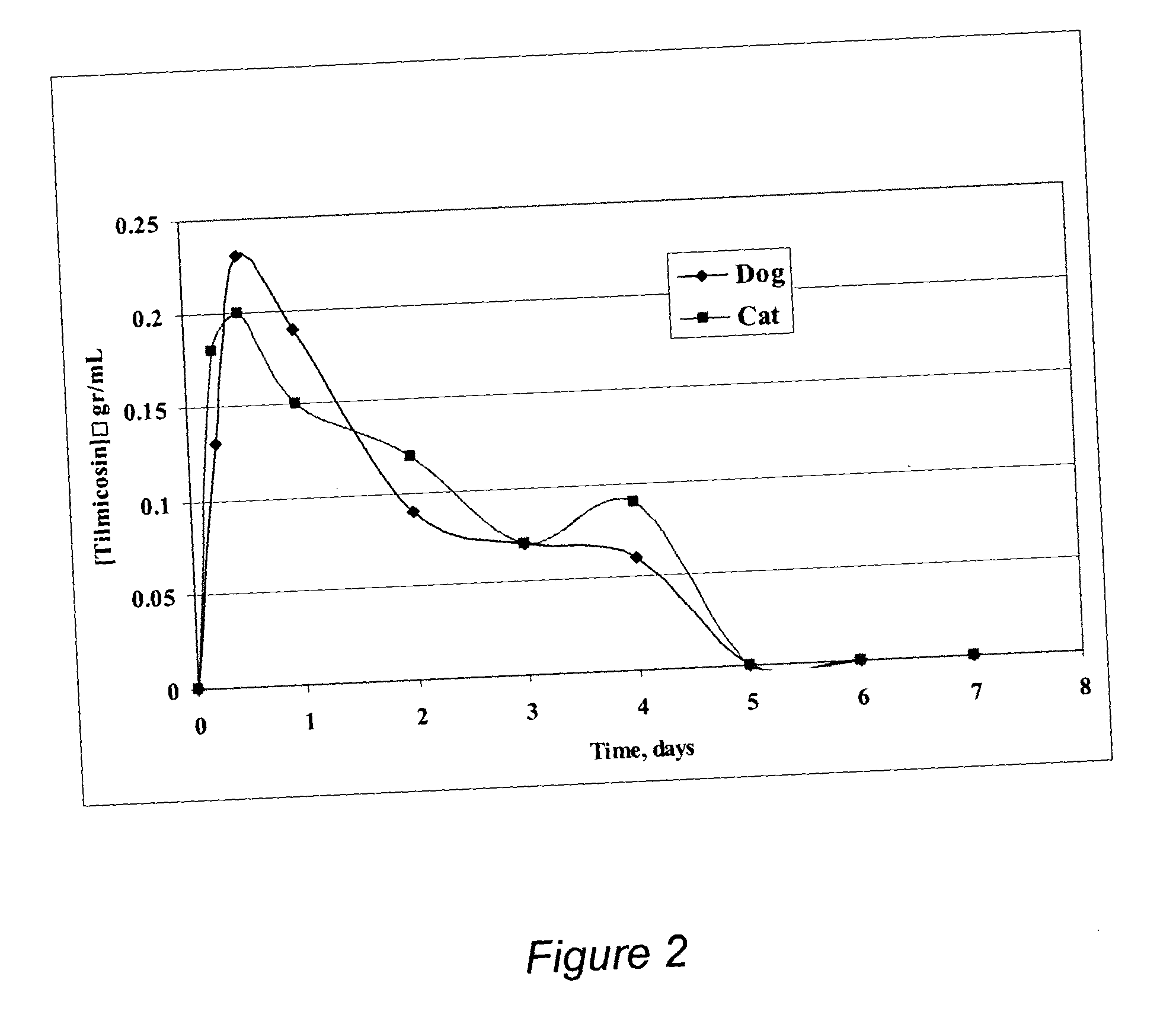
[0044] When the two amine groups of tilmicosin are neutralized with any of several fatty acids (such as, for example, decanoic C10, lauric C12, myristic C14, palmitic C16, stearic C18, oleic C18, elaidic C18, linoleic C18, and erucic C22, sebacic, dodecanedioic), the resulting salt is soluble in pharmaceutically-acceptable water immiscible solvents. When a formulation of the salt (tilmicosin-linoleic acid) is sealed in a dialysis...
example 3
[0045] Roxithromycin:
[0046] Roxithromycin is an antibiotic in the macrolide class with the following structure:
[0047] Roxithromycin is effective against a broad range of bacteria, and is used for the treatment of respiratory diseases in cattle. The amine group of roxithromycin can be neutralized with linoleic acid in isopropyl myristate, and a clear solution is obtained at 200 mg / ml.
PUM
| Property | Measurement | Unit |
|---|---|---|
| Time | aaaaa | aaaaa |
| Time | aaaaa | aaaaa |
| Time | aaaaa | aaaaa |
Abstract
Description
Claims
Application Information
 Login to View More